Six Colors
Six Colors

Apple, technology, and other stuff

Support this Site

Become a Six Colors member to read exclusive posts, get our weekly podcast, join our community, and more!

By Dan Moren

Quick reactions to Apple’s iPhone 13 event

Note: This story has not been updated since 2021.

Sure seems like Apple’s got the whole “slickly produced video” thing down to a science, doesn’t it?

As expected, today’s event saw the wraps taken off the new iPhone 13 series, as well as the Apple Watch Series 7, a revamped iPad mini, and the ninth-generation iPad. With the presentation firmly in the rearview, it’s worth taking a quick look at what Apple showed off.

Lucky 13

Meet the new iPhone…similar to, but basically better than, the old iPhone. Every year, Apple improves the cameras and the processors in the iPhone, and this year’s no exception. But I did find it interesting that Apple chose to remark upon two less sexy features: improved battery life and better durability (or so Apple says). Both of those have real, tangible benefits to users, even if they’re not top-line marquee features. It’s always interesting to see Apple focus on things that make people’s iPhones last longer; it’s one place that seems be at odds with its business, since a functioning iPhone doesn’t necessarily need to be replaced as quickly.1

iPhone 13 Cinematic Video
Knives all around.

Of course, the main attraction are the new cameras. They’re certainly the most visible bump2 from year to year, and the larger sensors and trickle down of the sensor shift optical image stabilization is sure to provide a lot of benefit for low-light photography. Cinematic mode is wild to look at, but seems like a feature very much geared towards those shooting actual movies, not home videos. The engineering is amazingly impressive—it can anticipate when someone is about to enter a scene!?—but honestly, it seems more like a gimmick to me than something most people will use in day to day life.

iPhone 13 Pro Sierra Blue
That blue, though.

One tidbit pointed out later by several sources: the iPhone 13 line is also the first to support dual eSIMs. As someone who’s been using eSIM for a few years now, I love the idea of being able to have two active; here’s hoping that transferring my iPhone 12 with an AT&T eSIM to an iPhone 13 is even easier than it was last year. (But I won’t hold my breath.)

But when all is said and done, I didn’t find the iPhone 13 to be the most compelling model Apple has ever rolled out. Frankly, were I not on the iPhone Upgrade Program, part of me thinks I might give the 13 a miss and wait to see what the 14 has to offer. I already feel like the iPhone 12 Pro is often more camera than I can put to good use; the 13 Pro feels like I ought to let it loose to shoot whatever it wants to—and if it can just go ahead and upload it to Instagram for me, all the better.

I do, however, really like that new Sierra Blue, even if I continue to wish Apple brought the same vibrant colors from the 13 and 13 mini to the Pro lineup.3

Seven game series

Looks like those rumors about a flat-sided redesign could not have been further from the truth. In introducing the Apple Watch Series 7, Jeff Williams emphasized that the corners were even more rounded than its predecessor, as well as incorporating a new “refractive edge”—if anything, Apple seems to be further embracing what’s become the iconic look and feel of the Apple Watch.

The Series 7 does, however, have a larger display, as rumored, which translates to slightly larger case sizes: up a millimeter each to 41mm and 45mm. The Series 7 also has a more crack-resistant crystal and better dust resistance, both of which ought to keep it ticking along pretty well.

Apple Watch Series 7

The biggest question for me here are the colors. I love the look of the green Apple Watch, but I’ve been wearing a space gray model since the Apple Watch series 0, and I find myself trepidatious about switching to a color. What if it doesn’t complement what I’m wearing? I can switch a band; I can’t switch a watch case. Regardless, it would certainly be a bold look.

The addition of the onscreen keyboard is one Series 7 feature already provoking strong reactions. Developer Kosta Eleftheriou, who has been unflinching in his criticism of the App Store’s failures when it comes to scams, has already threatened to sue Apple for what he sees as copying his watch keyboard app, which was recently rejected from the App Store. As Jason wrote recently, you have to assume as a developer that when you add “missing” functionality to one of Apple’s devices that the company’s going to catch up eventually, and though the removal of his app from the store does seem petty, a court case probably won’t go very far.

There had been some back and forth in the weeks leading up to the event about manufacturing delays for the Apple Watch, and there appears to have been at least some truth to that: everything else Apple announced today had a concrete date associated with it; the Apple Watch is “available later this fall.” So, sometime between next week and December, presumably—which is great for me, as I’m still on the fence about replacing my Series 4.

The new iPad normal

The base-level iPad keeps getting more bang for its buck. That $329 price point is hard to beat, and with the addition of a True Tone display, doubled storage tiers, and the huge leap forward in front-facing cameras, this is an incredibly solid device, even if it isn’t breaking much new ground. The front-facing camera is particularly impressive: from a 1.2 megapixel FaceTime “HD” camera to a 12 megapixel Ultra Wide camera with Center Stage! You can bet Apple realizes how important video conferencing is on iPads.

iPad mini
It’s alive! Aliiiiiive!

The surprise for the iPad mini is that it indeed remains a product in Apple’s lineup. The update it got today was sizable—if you will—as it joins the ranks of the iPad Air, iPhone 12 (and later), and iPad Pro in Apple’s modern design language. I’d expect this version of the mini to last for a few years before getting another update, but with the latest and greatest A15 processor, it ought to hold out for a good long while.

The update does mean that the sixth-generation mini is now in the same awkward position that the iPad Air was in last year, when its update meant it temporarily outpaced the iPad Pro. Right now, the mini’s got a better front-facing camera, faster processor, and faster cellular than the iPad Air—plus it can fit in a (very large) pocket. One thing it’s not mini on is price: at $500, it starts at just $100 less than the Air. Remember that “small” doesn’t mean “cheap,” especially where Apple’s concerned.

The rest

Nobody really thought there would be new Macs at this event, and Apple didn’t upend those expectations. A new version of AirPods did seem like a possibility, but they didn’t materialize either. Instead we got a sizzle reel of new Apple TV+ offerings and an update to the year-old Fitness+ service.

Fitness+
Apple Fitness+ got a lot of improvements.

That latter was particularly gratifying to me, since not only does it include new workout types (including Pilates and, uh, some prepping for skiers) and a geographic expansion, but also several improvements that I’d hoped to see, including a social aspect that lets you create group workouts via SharePlay (which will show up later this fall), enhanced filters, and the ability to pause a workout and resume on any device.

Overall, this event didn’t blow me away. As always, Apple gave a polished presentation and its products remain top of their field, but it perhaps lacked a little something in wow factor: that feature that everybody’s going to be talking about over the next several weeks, whispering to each other “Can you believe they did that?” Which is fine! Not every Apple event has to redefine the entire tech industry, and all of these devices are mature products, making it harder to be truly revolutionary year after year.

The good news? There’s always next year.


  1. Of course, it can also always be resold—either by a consumer, or by Apple—for a better profit. 
  2. In every sense of the word. 
  3. Except maybe Starlight. What the heck is that, anyway? 

[Dan Moren is the East Coast Bureau Chief of Six Colors, as well as an author, podcaster, and two-time Jeopardy! champion. You can find him on Mastodon at @dmoren@zeppelin.flights or reach him by email at dan@sixcolors.com. His next novel, the sci-fi adventure Eternity's Tomb, will be released in November 2026.]


Latest Apple updates fight zero-click exploits

Apple released a bunch of software updates Monday to counteract dangerous security vulnerabilities in its operating systems. Ivan Krstic, head of Apple Security Engineering and Architecture wrote:

After identifying the vulnerability used by this exploit for iMessage, Apple rapidly developed and
deployed a fix in iOS 14.8 to protect our users. We’d like to commend Citizen Lab for successfully
completing the very difficult work of obtaining a sample of this exploit so we could develop this fix
quickly. Attacks like the ones described are highly sophisticated, cost millions of dollars to develop,
often have a short shelf life, and are used to target specific individuals. While that means they are not
a threat to the overwhelming majority of our users, we continue to work tirelessly to defend all our
customers, and we are constantly adding new protections for their devices and data.

The smart advice: update immediately.


By Dan Moren for Macworld

Every new product we expect at Apple’s ‘California Streaming’ event

The bigger Apple has gotten, the easier it seems to have become to anticipate the company’s plans. Turning a battleship isn’t easy or subtle—it’s going to make waves.

That’s true in both general terms—expect a new iPhone every fall—as well as, thanks to a leaky supply chain, the specifics. None of which means that the Cupertino-based company can’t keep some surprises up its sleeves, but despite Tim Cook’s repeated insistence that Apple is doubling down on its security and secrecy, information still seems to make its way out.

So, as we look forward to Tuesday’s event, teased with the tagline “California Streaming”, here’s what you might expect to see when Apple executives take the stage.

Continue reading on Macworld ↦


‘What Does It All Mean?’

If you can read only one legal analysis about the ruling in the Epic-Apple lawsuit, let it be John Voorhees’s at MacStories:

While the decision is undeniably a win for Apple in many respects, it’s also a decidedly mixed bag. I’ve taken the time to read Judge Gonzalez Rogers’ 185-page decision and having written an in-depth look at the issues going into the trial, I thought I’d follow up with what the Court’s ruling is likely to mean for Epic and Apple as well as all developers and consumers.

John knows the law and has followed the case closely. There are a lot of interesting details that we will undoubtedly be hearing more about as the case is appealed—by both parties.


It’s another emergency draft! In this bonus episode, Jason and Myke predict what will happen at Tuesday’s Apple media event. What form will the new iPhones take? Will a new Apple Watch make an appearance? And what special bits of stagecraft might propel one of us to a decisive draft victory?


By Jason Snell

Apple bests Epic, but change is coming to the App Store

Note: This story has not been updated since 2021.

On Friday, Judge Yvonne Gonzalez Rogers issued her judgment and counter-judgment on Epic Games’s lawsuit against Apple.

The result largely favors Apple, to the extent that Apple released a statement declaring victory:

Today the Court has affirmed what we’ve known all along: the App Store is not in violation of antitrust law. Apple faces rigorous competition in every segment in which we do business, and we believe customers and developers choose us because our products and services are the best in the world. We remain committed to ensuring the App Store is a safe and trusted marketplace.

Perhaps most notably, Epic has to pay Apple its cut of transactions that bypassed Apple’s in-app purchase system and is still banned from the App Store, and the judge has defined the market in question in the lawsuit as “digital mobile gaming transactions”—rather than what Epic preferred the market definition to be, something more along the lines of “iPhone transactions.” Apple monopolizes iPhone transactions, but the judge decided that the iPhone is not a market unto itself.

But while Apple can claim victory, there’s also the matter of a permanent injunction the judge placed on Apple, effective in 90 days:

Apple Inc. and its officers, agents, servants, employees, and any person in active concert or participation with them (“Apple”), are hereby permanently restrained and enjoined from prohibiting developers from (i) including in their apps and their metadata buttons, external links, or other calls to action that direct customers to purchasing mechanisms, in addition to In-App Purchasing and (ii) communicating with customers through points of contact obtained voluntarily from customers through account registration within the app.

The real question is how to interpret the judge’s order. At the very least, it seems to be harmonious with the recent law passed in South Korea that would force Apple to allow developers to use alternate payment methods. The real question is, will the ruling allow apps to directly embed purchase options, or will it be a more of a redirection to the web for an alternate out-of-app payment program?

There will undoubtedly be appeals and conferences and plenty more to keep the lawyers busy. But it does feel even more inevitable that change is coming to the App Store, one way or another.


September 10, 2021

Breaking Apple legal news, and what we’re excited about for next week’s Apple event.


Updated Marvel Unlimited adds vertical comics and better following features

Marvel has revamped its Unlimited app, and The Verge’s Chaim Gartenberg has the details. One big part of the push are “Infinity Comics”, which are designed vertically, to be scrolled on an iPhone:

Marvel is investing big on Infinity Comics, too. It’ll launch with 27 comics available today, with plans for over 100 by the end of the year. Infinity Comics will be exclusive to Marvel Unlimited subscribers, but they’ll be fully in-universe (meaning that anyone who wants to keep up on the full adventures of Marvel’s superheroes will want to make sure to check them out).

But better than all of that, in my opinion, are improvements to following comics and creators. One of my biggest frustrations when I first used Marvel Unlimited was that there was simply no way to say: follow this series and let me know when a new issue out, a feature that seemed like table stakes. The update adds that, and more: you can also follow both creators (in case, for example, you want to know when Saladin Ahmed releases a new book) and even characters, so you can keep track of them across all titles.

Plus, the app now lets you download an unlimited number of comics for offline reading, instead of the piddling 12 you could previously, and you can save an entire series or run at once, instead of individually. However, the 3-month lag time for new releases remains in place.

These are all great improvements to the app, which costs $9.99 per month or $69 per year; Marvel’s added a new $99 “plus” subscription with additional perks.


What will Apple announce next week? I guess we’ll find out next week, because we don’t know.


Getting ebooks from your library is still fraught

Daniel A. Gross, writing for The New Yorker:

The high prices of e-book rights could become untenable for libraries in the long run, according to several librarians and advocates I spoke to—libraries, venders, and publishers will probably need to negotiate a new way forward. “It’s not a good system,” Inouye said. “There needs to be some kind of change in the law, to reinstate public rights that we have for analog materials.” Maria Bustillos, a founding editor of the publishing coöperative Brick House, argued recently in The Nation that libraries should pay just once for each copy of an e-book. “The point of a library is to preserve, and in order to preserve, a library must own,” Bustillos wrote. When I asked Potash about libraries and their growing digital budgets, he argued that “digital will always be better value,” but he acknowledged that, if current trends continue, “Yes, there is a challenge.”

The experience of checking out ebooks from the library has definitely gotten better, but so much of it remains a frustration, because of the attempts to apply the same models that worked with physical books to ebooks. It’s certainly not an easy needle to thread, but digital books are only going to be more in demand going forward, and I don’t think we’ve reached the final form yet.


How we’d upgrade our tech setups if we had the space, the tech parts of our emergency preparedness plans, our thoughts on cashierless “just walk out” stores, and whether we would add digital IDs to our Apple Wallets.


By Stephen Hackett

Apple’s car project has a long track record

Tim Cook reportedly wants to usher in one more new product category before retiring. Here, he can be seen practicing hailing a driverless cab. (Or just greeting a keynote audience. Your call.)

For years, it has been rumored that Apple has been working on a car or car-related project. Dubbed Project Titan, this project seems to have seen all sorts of stops and starts1 over the years if reports are to be believed. Way back in 2014, the project was supposedly approved by Tim Cook, with Apple veteran Steve Zadesky at the steering things.2 Zadesky left the company in 2016, but in those two short years, it seems that the project really gained traction.3 Employees were poached from several car companies, including Tesla and Mercedes-Benz.

As the team grew, news broke that Steve Jobs had been interested in looking at a car project way back in 2008, the year after the initial iPhone launched. This was confirmed by Mickey Drexler, who was an Apple board member from 1999 to 2015. Not one to miss out on the limelight, Tony Fadell also confirmed the claim to Bloomberg. Here’s Adam Satariano, writing in the fall of 2015:

Jobs and Fadell, who had collaborated on the iPod and iPhone, swapped ideas about car designs on multiple occasions. “We had a couple of walks,” Fadell said in an interview with Bloomberg’s Emily Chang. The pair posed hypothetical questions to each other, such as: “If we were to build a car, what would we build? What would a dashboard be? And what would this be? What would seats be? How would you fuel it or power it?”

That same year, Tim Cook spoke about the car industry as being “at an inflection point for massive change,” but was quick to point out that Apple’s current efforts were centered around CarPlay.

For a while there, it seemed like Apple really was stepping on the accelerator,4 especially when Apple talked Bob Mansfield out of partial retirement to run the program. Mansfield had overseen numerous hardware products in his time at Apple, stretching back to 1999, and there was a certain clout his presence brought to Project Titan.

In 2016, it was reported that Apple had set up a secret vehicle research and development lab in Germany. Added to earlier stories of “motor noises” being heard outside of an Apple campus in Sunnyvale, CA, most Apple followers believed Apple was prototyping full-blown vehicles. However, just a year later, reporting took a turn, saying that Apple was now focused on autonomous systems, something echoed by Tim Cook in June 2017.

Around this time, several vehicle engineers left Apple. In 2019, some 200 Project Titan employees were laid off some six months before Apple purchased a self-driving startup named Drive.ai, which resulted in even more layoffs. To further Apple’s artificial intelligence when it comes to cars, John Giannandrea reportedly took over the project in late 2020, with Bob Mansfield leaving to enjoy retirement. (Kevin Lynch is now in the mix too, apparently.)

In short, reports of what Apple is up to here have been all over the map5 over the years. Perhaps the company is really just interested in making a self-driving system that other companies could integrate into their vehicles. There have been lots of Apple-related self-driving vehicles spotted in California over the years, after all. The more exciting possibility is, of course, Apple making a car of its own, either in partnership with a traditional car manufacturer, or all on its own.

Time will tell if either (or both!) of these possibilities come to pass, but just this month, there’s been a rash of Apple Car news. DigiTimes is reporting that Apple has been in talks with Toyota, LG Electronics and others to line up suppliers for a future project. Apple’s long-time manufacturing partner Foxconn has been in conversations about the car as well, according to Mark Gurman.

In Arizona, it’s been reported that Apple is behind the recent purchase of a vehicle testing site formerly used by Chrysler. This one is hard to write off, as it is believed that Apple has been leasing the site since 2017. Then there’s Apple’s recent hiring of two former Mercedes engineers to work in Apple’s “Special Projects Group.” The newly-minted Apple employees have expertise in the mass production of vehicles, vehicle steering, vehicle dynamics, and software management.

Then, just today, another change took place, with Doug Field leaving Apple for Ford.

If Project Titan ever results in an actual product, we’re probably still years away from seeing it, despite some of the initial conversations at Apple apparently taking place over 13 years ago.

In the meantime, it’s fun to follow the rumors and speculate, even if some Apple followers aren’t thrilled at the prospect of Apple entering the car business. Complaints of Apple taking its eye of the ball when it comes to its core products is nothing new—and they’re frequently at the center the negativity out there about Project Titan.

Of course, Mac users were worried when the iPod came out, and then again six years later when the iPhone was announced. Today, Apple is bigger than ever, and capable of working on many projects at once. I’m pretty confident that those engineers from Mercedes are not working on the Apple silicon Mac Pro. Though stranger things have happened.


  1. So to speak. 
  2. So to speak. 
  3. Ok, I’m done with the car puns. 
  4. Look, I’m sorry. I can’t change who I am. Jason can, though. I wonder if he edited this out. 
  5. [Stephen. No. —Jason

[Stephen Hackett is the author of 512 Pixels and co-founder of Relay FM.]


By Jason Snell

Apple’s “California Streaming” next week

Note: This story has not been updated since 2021.

It’s official: Apple’s next product-launch event will come on Tuesday, September 14 at 10 a.m. Pacific. Apple marketing chief Greg Joswiak announced it on Twitter and the emailed invitations followed.

As always, Six Colors will bring you coverage of the event and its aftermath. So begins the busy season of Apple product announcement news!


By Dan Moren for Macworld

App Store change has been slow, but it may need to get quicker very soon

In the last week, Apple has announced that it’s making a few changes to its App Store rules. These have run the gamut in importance, with some potentially having substantial ramifications to the status quo, while others seem to do little more than pay lip service to the displeasure of developers. But they have one thing in common: they’re the result of outside forces targeting Apple’s marketplace.

But even as these risks have been dealt with, more threats are massing on the horizon. The App Store remains the company’s most significant vulnerability, the one that has put them in the crosshairs of competitors, regulators, and legislators alike. The real issue Apple needs to consider is not whether the App Store will evolve, but how.

Continue reading on Macworld ↦


As Jason and Myke wait for the announcement of an iPhone launch event, they discuss Apple’s curious set of incremental changes to App Store policies, what those changes mean, and how they inform Apple’s possible future strategies.


Apple delays CSAM scanning rollout

As relayed by TechCrunch and many other outlets, Apple has announced it’s delaying the release of its CSAM (Child Sexual Abuse Media) scanning features. Here’s the statement Apple PR furnished to media outlets:

Last month we announced plans for features intended to help protect children from predators who use communication tools to recruit and exploit them, and limit the spread of Child Sexual Abuse Material. Based on feedback from customers, advocacy groups, researchers and others, we have decided to take additional time over the coming months to collect input and make improvements before releasing these critically important child safety features.

The roll-out of these features was utterly botched, from conflating features that should’ve been kept separate to the rolling thunder of damage control as the company carted out technical white papers and FAQ stories and executive interviews to try to explain what they really, actually meant by it. And there appear to be some serious, technical criticisms of the methods Apple is using to detect CSAM media.

It’s all for the best that Apple has decided to delay. Perhaps the company will re-think some aspects of its approach. It’s unlikely that this functionality will simply disappear forever, but after a few months in the penalty box maybe it can emerge alongside a clearer, stronger message. It couldn’t be much worse than this first effort.


September 3, 2021

Apple’s negotiation strategy, and anticipating a September hardware event.


By Jason Snell

Tools we used to make a “call-in” podcast

Note: This story has not been updated since 2021.

This week’s episode of Upgrade was a “call-in show,” in which we answered audio questions sent in by listeners. I’ve heard from a few people who wondered how we put the show together, so I thought I’d provide some of the details. (I use this same set-up for The Incomparable’s annual best-of-the-year clip shows and for various Game Show podcasts that require exciting sound effects.)

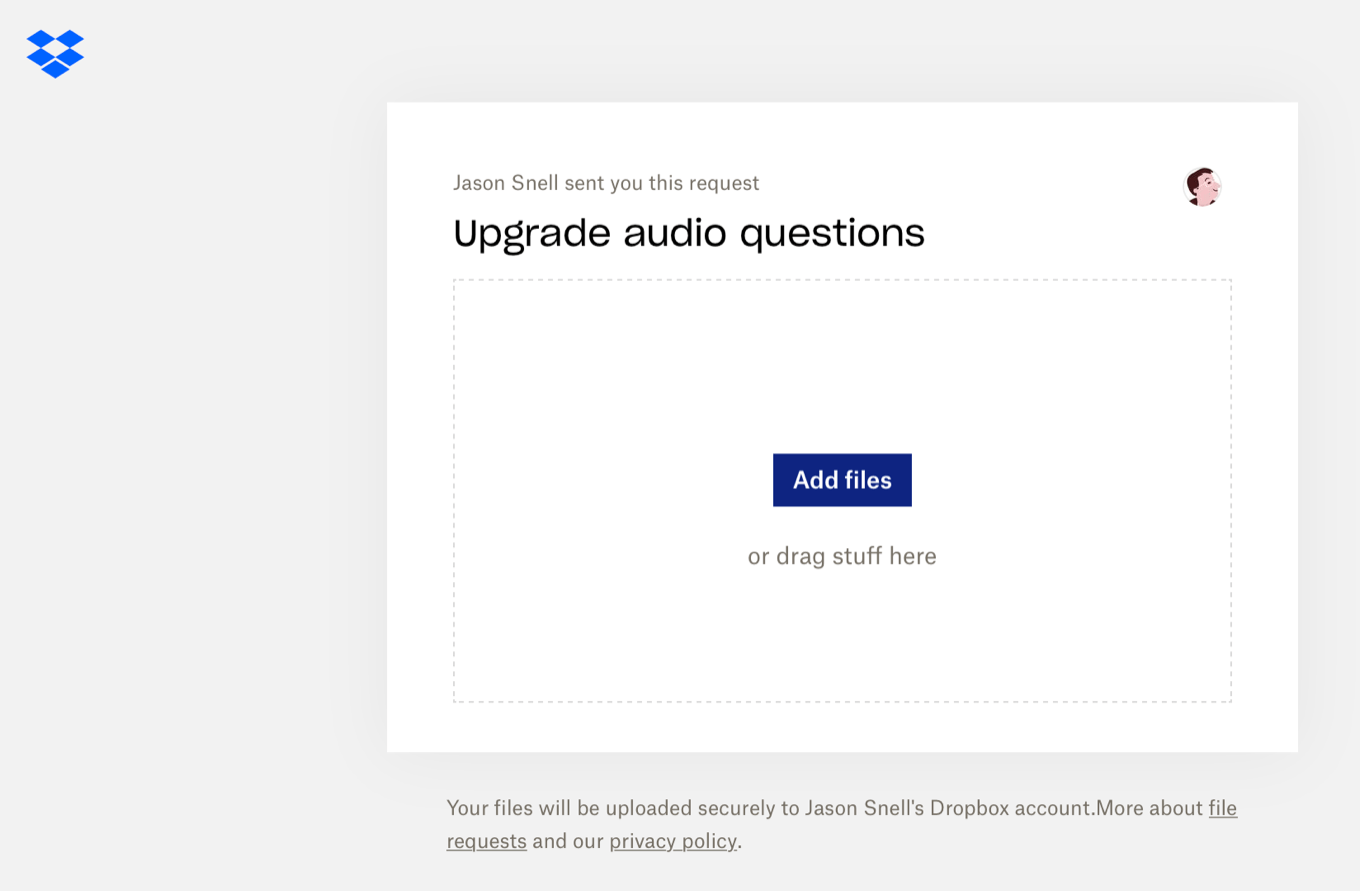
A Dropbox file request

It starts with a Dropbox file request. I rely on this feature of Dropbox for most of my podcasts these days! When you create a File Request within Dropbox, a folder in your Dropbox account is tied to a web page accepting file uploads. The files uploaded to the webpage appear in your Dropbox. That’s it. You take the URL for the webpage, hand it out to anyone who needs to send you files, and you’re on your way.

(I’ve taken this even further by setting up a push notification when a file is uploaded to my File Requests. To do this, I’m forwarding the notification email Dropbox sends when a file is uploaded to Pushover, which does the notification on my iPhone and Apple Watch.)

Once we got the files, Myke Hurley cut them down to size using Rogue Amoeba’s Fission (for easy edits) and Apple’s Logic Pro (for tough ones), and I processed some of them with iZotope RX to remove background noise and, in a couple of cases, echo.

Farrago
Farrago, loaded up.

Next up: Rogue Amoeba’s Farrago, my soundboard app of choice. I usually use Farrago in Grid View, where every sound effect is mapped to a keyboard shortcut—useful for when you’re re-using sounds and choosing them on the fly. For this particular episode, though, I just kept them in List View and double-clicked on an audio file when it was time for it to be played.

Loopback, wired and ready to feed Zoom.

We use Zoom to record Upgrade, and for Myke (and the audience listening live) to hear the calls, that means I needed to find a way to send my microphone audio and the sound coming out of Farrago over Zoom simultaneously. To do this, I used yet another Rogue Amoeba utility, Loopback, which can create virtual audio inputs. In this case, I created a new input that combined my USB audio interface and the audio from Farrago—and selected that in Zoom as my audio-input source.

For recording: Audio Hijack

Finally, I needed to record everything for Myke’s later use when editing the show. For that, I used Rogue Amoeba’s Audio Hijack, which is my favorite audio utility thanks to its remarkable flexibility. I’ve chosen to record my microphone and the output from Farrago on separate tracks so that Myke can have complete control over the final edit.

Myke’s final edit in Logic Pro.

You might wonder why we didn’t use the original audio files (the ones I dropped into Farrago) for the final edit. We absolutely could—but it would require Myke to drop 24 audio files in and position them precisely. The recording of Farrago made by Audio Hijack, on the other hand, is in sync with my audio file. That means Myke can drop that one file into his Logic Pro project, sync it up with his other recordings, and the job is done in one shot.

Usually, recording a podcast is easy. This one was more complicated, but fortunately, we have the tools—yeah, most of them by Rogue Amoeba—to make it work.


By Dan Moren

Apple to let “reader” apps link to their sites

Note: This story has not been updated since 2021.

Late Wednesday, Apple said that, prompted by an investigation from the Japan Fair Trade Commission (JFTC), developers of “reader” apps—a category that Apple has previously defined as programs that primarily let users consume previously purchased content or subscriptions—will be able to include a link to their website in the app. Despite the agreement being made in Japan, the change will apply to the App Store worldwide.

While the exact implementation details have not yet been disclosed, Apple says that the link will be for users to “set up or manage an account.” And yes, the singular is accurate here: it’s one link. The change goes into effect early next year, and Apple will update its guidelines before that point.

As always, the devil is in those details. The company has never shied away from spelling out exactly when, where, and how developers can present certain information inside their apps. It’s not at all out of the question that Apple would say, for example, that such a link could only appear on, say, a first-launch splash screen or buried deep in a settings screen.

But, even if the company does make those restrictions very specific, this is still a crack in Apple’s App Store veneer, and something developers have been clamoring for almost since the beginning. The prohibition for apps like Netflix or Kindle, which are more or less useless without an external account, to show a link to sign up for their service has always been one of the App Store’s most onerous (and most user hostile) restrictions.

The challenges to the App Store have been coming fast and furious recently. Late last week, Apple announced “changes” to the App Store as part of a settlement with developers, but after a flurry of initial reports lauding this as a big deal, the fine details ended up being a whole lot of nothing. (In short: most of the “changes” were things that Apple was already doing, though the company spun it as a huge improvement for those selling apps.)

Then, earlier this week, South Korea passed legislation that would ban platforms from requiring app developers to use the platform’s own in-app purchase systems. Apple has registered its disapproval with this decision, and it remains unclear exactly what the ultimate effect of the law will be.

Along with last week’s developer agreement, this move also demonstrates that Apple believes it can manage its way out of the many regulatory, legislative, and legal threats that are currently circling it. For example, this change clearly won’t apply to Epic’s Fortnite, which doesn’t fall into the “reader” category—a fact that will no doubt infuriate the company, with which Apple is currently embroiled in a high-profile court case.

I’m not sure this particular change will be enough to let Apple avoid antitrust scrutiny, but it’s certainly an arrow in the company’s quiver when it comes to showing politicians that change has been made.

[Dan Moren is the East Coast Bureau Chief of Six Colors, as well as an author, podcaster, and two-time Jeopardy! champion. You can find him on Mastodon at @dmoren@zeppelin.flights or reach him by email at dan@sixcolors.com. His next novel, the sci-fi adventure Eternity's Tomb, will be released in November 2026.]


Search Six Colors