Six Colors
Six Colors

Apple, technology, and other stuff

Support this Site

Become a Six Colors member to read exclusive posts, get our weekly podcast, join our community, and more!

December 31, 2021

Millennials / Terminal / ls -al / What’s your shell?

It’s the last Six Colors podcast of the year. Let the molting begin!


By Jason Snell for Macworld

Why the iPhone won’t take center stage in 2022

2020 brought a redesigned iPhone, but in 2021 the iPhone was fairly static while the iPad Pro took a big step forward.

Given Apple’s longer cycles for iPhone redesigns, I don’t expect a revolutionary new iPhone to spur sales ever higher. But Apple will tinker around the edges, while spending time upgrading the iPad and launching new products the likes of which we’ve not seen before& from Apple, anyway.

These are my predictions for 2022 for the iPhone, iPad, and the rest of Apple’s non-Mac product line. I’m doing this with the risk of being dead wrong in public, but I’ve been there before and what doesn’t kill you makes you stronger.

Continue reading on Macworld ↦


By Six Colors Staff

2021 Favorites: Movies

Note: This story has not been updated since 2021.

It was a weird year for movies. Theaters were closed, open, and sometimes closed again? And not everyone felt comfortable returning to an enclosed space full of other people later in the year. And yet, the move out of theaters also made some films more accessible than they would have been in other years. Most Oscar nominees were available on streaming services before the awards occurred, and one of us (Jason) managed to binge an awful lot of nominees early this year. Some of them made this list! (We’re praising movies we saw in 2021, even if they were made a few years earlier.)

Dune: Part One

I read Frank Herbert’s novel in high school and have been amazed how such a deeply weird book has resonated with so many people for so long. This year, I noticed a bit of an echo to that reaction: I am once again surprised that an enormous audience has watched, and loved, Denis Villaneuve’s new adaptation of the novel. Maybe it’s the delight at seeing such an epic film after a long period of pandemic movie delays and cancellations. Maybe it was the fact that people could watch it on HBO Max over and over and over if they wanted to. I liked it primarily for Villaneuve’s visuals—nobody makes weird stuff hovering in midair look as grand as he does—and the supremely weird soundtrack by Hans Zimmer. The story was familiar, and it’s only the first half, anyway. But I still really liked the film, just for the whole experience of it. It’s a vibe.—Jason Snell

Spider-Man: No Way Home

There have been a perhaps unbelievable nine Spider-Man movies in the last 19 years, but Tom Holland’s incarnation seems to have been among the most well-received, and “No Way Home” continues that trend. It’s the “Avengers: Endgame” of this particular series, wrapping up one chapter of Peter Parker’s story, and packing in so many references, Easter eggs, and callbacks that your head might spin. But it’s still filled with charm and humor amongst the fights and special effects, and it’s hard to not have a good time when the ride is this fun.—Dan Moren

Shang-Chi and the Legend of the Ten Rings

I have to hand it to Marvel Studios—they have managed to take several B- and C-list heroes from Marvel Comics history and turn them into the stars of blockbuster hit films. Shang-Chi is one such character, designed to cash in on the 70s Kung-Fu craze in America with an origin story that’s just as grimace-worthy as you might expect. But processed by the Marvel Machine, it comes out here as a joyous mix of Marvel superhero film and modern martial arts/action film. Simu Liu is game as Shang-Chi, but Awkwafina steals the portions of the movie left over after Tony Leung, Michelle Yeoh, and Ben Kingsley steal the bulk of it. The public-transport-themed action scene that starts the film is one of the best ever in a Marvel movie. I look forward to seeing what director Destin Daniel Cretton does next.—J.S.

No Time to Die

I didn’t go into Daniel Craig’s last outing as James Bond with very high expectations—after 2006’s “Casino Royale”, the franchise has never really passed middling for me—but “No Time to Die” largely surprised me with its swerve away from Bond tropes, especially in regards to its ending and its female characters. (For example, the movie is bookended with scenes from the perspective of Léa Seydoux’s Madeleine Swann, in some ways making it more of her story than Bond’s.) But the real gem here is Ana de Armas, Craig’s “Knives Out” co-star, who appears for about 10 minutes, but absolutely steals every single frame she’s in.—D.M.

In & Of Itself

Derek DelGaudio’s “In & of Itself” is a film, directed by Frank Oz, based on a one-man show by a magician. I think I may have said too much already. This is live theater captured on film for those who couldn’t attend, and it’s… oh, I shouldn’t say “magical,” should I? It is funny, riveting, and ultimately quite emotional. Don’t read anything about it going in. It’s better to be unspoiled. But you’ll be thinking about what you saw, what it means, and how it all happened, long after the movie is over.—J.S.

Tenet

I always find Christopher Nolan’s films worth watching, even if the director does at times get somewhat precious about the nature of cinema. “Tenet” is a brain-bender, and absolutely worth watching at home, where you can pause every couple minutes and assess what the hell is going on. It’s a great looking movie with some fantastic action set-pieces, and, above all, it’s a piece of original science-fiction. Robert Pattinson, John David Washington, and Elizabeth Debicki all lend some solid performances to the mix, as does Kenneth Branagh as a scenery-chewing villain..—D.M.

CODA

My favorite Apple TV+ film so far, “CODA” is a story about a young woman with a deaf family who falls in love with music. From that description, you can pretty much imagine what story the movie will tell, and you’d be exactly right. But it’s more than just that log line. The family business is fishing, and the entire industry is struggling, especially the little guys, so there’s a storyline about how fishermen can collectively organize and how a deaf fisherman can get a seat at the table. Ruby’s parents, played by Marlee Matlin and Troy Kotsur, are unforgettable. The end of the movie is, again, exactly what you’d expect—but with the added seasoning the film has added along the way, it’s completely effective.—J.S.

Widows

I’d heard people talk up “Widows”, and as a fan of heist movies, this is a fun twist on the genre (adapted, to my surprise, from an old British TV series from the 1980s). When a crew of thieves is killed mid-robbery, their widows are on the hook for the score, and have to pay it back. Add some Chicago politics into the mix, and you’ve got a taut, interesting crime story. But the real standout here is the cast: Viola Davis, Michelle Rodriguez, Cynthia Erivo, and Elizabeth Debicki (again!) form the key crew, with Brian Tyree Henry, Daniel Kaluuya, Jacki Weaver, Carrie Coon, Robert Duvall, Liam Neeson, Jon Bernthal, Garret Dillahunt, and Colin Farrell in supporting roles.—D.M.

Promising Young Woman

Emerald Fennell’s story of a woman out for revenge years after the death of a medical school colleague is scathing, angry, darkly funny, and ultimately tragic. (As all stories of revenge should probably be.) Carey Mulligan’s been one of the world’s best actors for a while now, and she’s spectacular as Cassie, who is working at a coffee shop when she meets a former classmate in med school who is indisputably a “nice guy”—whatever that means—and the entire plot begins to kick off.—J.S.

Never Rarely Sometimes Always

This is a movie about a girl in Pennsylvania who gets pregnant and can’t get an abortion. So she steals away with a friend on a bus to New York and try to figure out how to make that work. That’s what the movie is. It’s unflinching. (“Plan B,” a 2021 film with a similar premise and point of view, takes a very different approach—it’s a raunchy road-trip comedy. I liked it, too, just not as much as this one.)—J.S.

Nomadland

It was Best Picture… maybe you’ve heard of it? I loved how quiet and contemplative this film, about an older woman who has been driven by the Great Recession to live in a van and work itinerant jobs among other people who are living the same lives. It’s got beautiful vistas, quiet desperation, camaraderie, and a whole lot of deferred grief. My in-laws, who read the book upon which the film is based, hated it. I haven’t read the book, but as a work of art I find myself more or less in agreement with Oscar on this one, for once.—J.S.

First Cow

Nobody has ever heard of “First Cow,” which was nominated for zero Oscars. But it has stuck with me all year. It’s a quiet, slow story about a period of history that isn’t often seen, namely the west coast of North America in the early 19th century, pre-Gold Rush. Director Kelly Reichardt’s film is set in Oregon Country, and European society is only hesitantly setting up shop. The title cow is the first one to be imported to the region, up from San Francisco, promising milk and butter for those with the money and access. (Or for those who might be able to climb a fence and steal said milk.)—J.S.


By Six Colors Staff

2021 Favorites: TV

Note: This story has not been updated since 2021.


We watch a lot of TV. It’s the platinum era of television—you could watch several hours a day for the entire year and never run out of top-shelf entertainment. But who has the time? So if you’re looking for something to watch, consider these shows, which were our favorites this year.

Ted Lasso (Apple TV+)

Look, a million people have told you to watch Ted Lasso, and there’s a reason for that: it’s great. Season 2 may not be exactly what people wanted after the spectacular first season, but it still delivers on everything I love about the show, and takes it up a notch. In particular, the addition of Doctor Sharon Fieldstone as a foil (and ultimately friend) to Ted, the rich development of supporting characters like Sam, and a heel turn that left many viewers reeling. Plus, let’s not forget a fabulous rom-com pastiche, the utter surreality of the Coach Beard-centric episode, and a redeemed Jamie Tartt. If I’m going to be honest—not now, Jan!—I loved it all.—Dan Moren

Hacks (HBO Max)

Don’t let this one fly under the radar: “Hacks” was the comedy of the year. Starring Jean Smart and Hannah Einbinder as comedy professionals at the beginning and end of their careers, it’s a study in contrasts. She’s in her 60s, she’s in her 20s. Deborah’s trying to figure out how to keep her career going, while Ava is struggling to establish herself. Deborah’s got a mansion in Vegas, Ava’s got a condo in L.A. They’ve both got the same agent and screwed-up families.

“Hacks” has things to say about creative struggles, finding your comfort zone, generational conflict, sexism in comedy (and everywhere else), despair, when to compromise and when to stick to your guns, and a whole lot more. It’s funny, but also serious. After all, comedy can be a serious business.—Jason Snell

Star Trek: Lower Decks (Paramount+)

Yes, it’s a joke machine that’s specially tuned to those who grew up loving 1990s Star Trek. But somehow it’s also a brilliant show in its own right, with characters who you actually end up loving. While this season may never quite reach the heights of the first, there’s still plenty to enjoy, including a new crew member who’s briefly turned into a puppet, some back story on the ship’s apparently mild-mannered engineer, and a stellar (no pun intended) episode that shows us what lower deck life is like on Klingon and Vulcan starships. Plus, Riker…did we mention Riker?.—D.M.

Loki (Disney+)

For me, “Loki” was the highlight of the first year of Marvel’s Disney+ original series. Every time I thought I knew where it was going, it went somewhere different. The set-up was obvious: Loki and Owen Wilson’s Agent Mobius are a mismatched cop/not-a-cop pair who have to travel through time in order to right wrongs and keep things on course for the Time Variance Authority. That set-up doesn’t survive the second episode, and the show kept breaking itself apart and re-forming every week.

I loved the show’s production design. Natalie Holt’s score is the single best piece of soundtrack music I heard in 2021. And while the cast was strong from top to bottom, I have to single out Sophia Di Martino’s great performance as Sylvie. Sure, I liked “WandaVision” and “Hawkeye” too, but “Loki” was the cream of the crop.—J.S.

Mythic Quest (Apple TV+)

The second season of this workplace comedy amps up the conflict between our two main characters, egomaniac Ian and ultra-competitive Poppy, but also manages to maintain its heart. I don’t usually like shows with awful people, but the secret is the characters aren’t really awful—there’s actually something underneath that exterior. Case in point: the season’s standout episode, “Backstory,” which delves into the history of supporting character C.W., who, until that point, has mostly been a caricature. The season’s finale seems to leave most of the characters in a good place, but with some threads untied…which is just as well, seeing as Season 3 and 4 are on their way.—D.M.

What We Do in the Shadows (Hulu)

The third season of this mockumentary series about a group of vampires living on Staten Island wasn’t quite as strong as its first two, but it was still pretty great. “This is Spinal Tap” is one of my favorite movies of all time, and “What We Do In the Shadows” comes closer than anything I’ve ever seen in emulating its hilarious tone.—J.S.

Leverage: Redemption (IMDb TV)

The last couple years have been tough ones, so sometimes you want to sit back and watch something light and fun—and if it involves evil rich people getting their comeuppance, all the better.

I was a fan of the 2008 show Leverage, so the news that it was getting a revival via Amazon’s free IMDb TV was music to my ears. This continuation picks up eight years after the original series’s finale, and though there is at least one significant casting change (the absence of Timothy Hutton’s Nate Ford), the revival manages to deliver on the same campy fun. Simply put: a team of Robin Hood-like outlaws use their skills to con and steal from the rich and powerful people whom the system is rigged to help.

The addition of Aleyse Shannon as Breanna Casey, foster sister of original member Alec Hardison, and ER’s Noah Wyle, as a former dirty-tricks lawyer looking to make good, are both welcome additions. Wyle anchors a lot of the season’s ongoing plot, and he’s a welcome addition as the often-in-over-his-head Harry Wilson. Plus, you’ve got notable guest turns from Reed Diamond, Joey Slotnick, and a corker with LeVar Burton. It’s not the most challenging show you’ll watch, but it’s like wrapping yourself in a cozy warm blanket.—D.M.

For All Mankind (Apple TV+)

Ron Moore’s alt-history story about an extended space race between the U.S. and the Soviet Union moved to the 1980s for its second season. Marriages fall apart, international tensions flare at home and on the moon, and a symbolic gesture becomes something deeply meaningful. (Also, pay attention to the vending machine!)—J.S.

Kung Fu (CW)

A reboot of a kinda problematic show from the 1970s as a CW drama doesn’t seem like the kind of thing that’s likely to blow you away, but I’ve been pleasantly surprised by Kung Fu, which bares basically no resemblance to the old David Carradine vehicle beyond the name. This one focuses on Nicky Shen, a young woman who drops out of school to train in kung fu, and gets embroiled in a search for mythical weapons of untold power.

Fun fight scenes and a talented cast that punches above their weight elevated this series’s first season, and I particularly appreciated the show’s willingness to have more than a few scenes in Mandarin with English subtitles. A special callout to Hollywood legend Tzi Ma who gets a meaty role as the father of the main character.—D.M.

It’s a Sin (HBO Max)

If I describe Russell T. Davies’s “It’s a Sin” as a story about a group of gay men and their friends in London during the height of the AIDS epidemic, you will probably assume that it is a dark, tragic story. And it is, at times. But the magic of “It’s a Sin” is that it’s also joyful. That bittersweet combination—all these young men are finally breaking out of their restrictive families and being who they want to be, forming bonds and building communities and having sex and starting careers… and at the same time, the epidemic that will end so many lives is lurking around every corner.

“It’s a Sin” wouldn’t be nearly as impressive if it were merely joyous or tragic. It’s both at once, in a way that feels true, and only magnifies the tragedy of so many young lives cut so short.—J.S.

Hawkeye (Disney+)

With all respect to my dear friend and colleague, Hawkeye for me is the best the Marvel Cinematic Universe committed to TV this year. As much as I enjoyed the rest of the Disney+ fare, this series’s small stakes, sense of humor, Christmas setting, and tremendously fun fight scenes (that car chase! that office fight!) made it a joy to watch. Anchoring it all is a tremendous performance by Hailee Steinfeld as the enthusiastic and hardly-lacking-in-confidence Kate Bishop, supported by Florence Pugh’s scene-stealing Yelena Belova and, of course, Pizza Dog himself. (I also really enjoyed Christophe Beck & Michael Paraskevas’s score, which feels like the best Mission: Impossible soundtrack never written.)—D.M.

Only Murders in the Building (Hulu)

Steve Martin, Martin Short, and Selena Gomez make an unlikely trio as they try to solve a murder and start a popular murder-themed podcast—not necessarily in that order. It’s a legitimate murder mystery while also featuring a lot of very funny character moments.—J.S.

Ms. Fisher’s Modern Murder Mysteries (Acorn)

The popular Australian series Miss Fisher’s Murder Mysteries may have come to an end, but television execs are never ones to let a good thing go to waste. This year saw the airing of season two of that show’s spin-off, Ms. Fisher’s Modern Murder Mysteries in which Phryne Fisher’s great-niece Peregrine takes up the family mystery-solving mantle but this time in the 1960s instead of the original’s 1920s.

Season 2 expands to eight episode’s from the first season’s four, and there’s a bit more romantic drama as Peregrine and her partner/foil Detective James Steed try to figure out their relationship. The mysteries are entertaining and often ridiculous, including a pretty great episode set at a pigeon-racing club, and there’s a stewing sub-plot that revolves around Peregrine’s friend Birdie who has a shadowy past.

The show’s light-hearted and fun—despite all the murders!—and well worth a watch for mystery enthusiasts or fans of the earlier show, though I’m still holding out for a future flashback episode where Peregrine must continue a case left off by her aunt.—D.M.

Invincible (Prime Video)

From Robert Kirkman, creator of “The Walking Dead,” comes another TV series based on an excellent comic book. “Invincible” the comic is one of my all-time favorites, and it’s been translated to adult animation without skipping a beat. There’s some grotesque violence, but that was always the point of “Invincible”—to use familiar superhero tropes, but undercut them by taking them seriously. Most importantly: there are no walk-backs or fake-outs. Actions have consequences. By the end of season one, our hero’s life is nothing like what it was when the show started—for better and for worse.—J.S.

Schmigadoon (Apple TV+)

Though it mostly flew under the radar, this six-episode Apple TV+ series about a couple, Cecily Strong and Keegan-Michael Key, struggling in their relationship who end up stuck in a musical was delightful. There are more than a few standout musical numbers and the star-studded cast is peppered with Broadway veterans like Kristin Chenoweth, Alan Cumming, Aaron Tveit, and Ariana DeBose. It’s a cute premise, and a half dozen episodes is just long enough for it not to overstay its welcome.—D.M.

Superman & Lois (The CW)

Though the CW’s superhero shows can often seem a dime-a-dozen, Superman & Lois is clearly where the franchise is going. It’s clearly more expensive than its counterparts, feels more cinematic, and manages not to fall into the same weekly tropes. The focus on family dynamics gives it a lot of heart, but it was one particular twist—which will delight longtime comic fans—that really sold me on the show’s first season. (Also, a brief appearance from the classic Superman suit in the opening episode is worth the price of admission.)—D.M.

Taskmaster (Channel 4, purchase on iTunes/Amazon)

My wife and I took a break from the British panel show for a while this year, but we came back with a vengeance to watch the most recent couple seasons (Series 11 and 12) and have no regrets. I can’t imagine there’s anybody left who’s not familiar with it, but the premise is simple: five comedians compete in a variety of ridiculous tasks set by the eponymous Taskmaster, Greg Davies, and his assistant, (Little) Alex Horne. The show is often hilarious, usually delightful, and always a good escape from the everyday.—D.M.


What tech had the biggest impact on us in 2021, our predictions for the most surprising tech story of 2022, whether we seek out short-form videos, and our biggest tech irritations of the last year.


Jason and Julia are off for the holiday, but before they left, they took time to record this special episode featuring answers to listener letters! (Only two-thirds of the letters are from people named David.)


As the year comes to an end, it’s time for the Eighth Annual Upgradies! Myke and Jason discuss their favorites of 2021, take the input of many Upgradians, and hand out awards in numerous categories! Only the finest will walk away with the most coveted of titles: Upgradies Winner.


By Dan Moren for Macworld

Apple’s next things could bring huge changes

This is it: the last installment of Stay Foolish for the year that was 2021. And I think I speak for all of us when I say good riddance, too.

Having already covered the biggest Apple moves of 2021 it’s time now to look forward to the year that awaits us, full of untrammeled possibility and simmering excitement. The last 12 months have been an eventful one for Apple, but we’re already starting to see the shape of the year to come.

With that in mind, here are a few of the biggest things I expect (and hope) to see out of Cupertino in 2022.

Continue reading on Macworld ↦


By Jason Snell for Macworld

Cores, colors, and lucky 13: How 2022 could be the Mac’s best year ever

After such a momentous 2020 for the Mac, it was hard for 2021 to measure up. But with the Apple silicon transition well underway, the question remains: What does the Mac’s 2022 have in store?

Good news, friend. You’re reading a column about where the Mac is going in 2022. Let’s get to predicting the future.

Continue reading on Macworld ↦


It’s time for our annual Christmas gift exchange round-robin, and then the boys get down to business with some competitive picks about what will happen in 2022. All that’s followed by a game of 20 Questions, with the questions supplied by Connected listeners! Happy holidays to everyone.


By Six Colors Staff

2021 Favorites: Games

Note: This story has not been updated since 2021.

We played and enjoyed a lot of games this year. Weird, right? It’s as if we needed to escape. Anyway, here are some of our favorites.

Alto’s Odyssey: The Lost City

As I admitted back in July, the endless-sandboarder game Alto’s Odyssey is my favorite iOS game of all time. This year, Team Alto brought an expansion of the game to Apple Arcade, and wouldn’t you know it? Alto’s Odyssey: The Lost City is my favorite game of 2021.

If you haven’t played Alto’s Odyssey, you can play the new game from the start and the new levels will just get rolled in. I love the whole game for its beautiful graphics, its soothing soundtrack, and its simple mechanic — you tap to jump, tap and hold to flip, and if you’ve got the Wingsuit extra, use your left hand to fly. The expansion added an additional quest above the main game’s level structure, in which you collect items in order to unlock access to the Lost City, where you’re given a new menu of tasks to perform. The catch is that many of those tasks can only be performed in the Lost City, so you’ll need to keep on boarding to get back to the city and continue the tasks.

I played the whole thing, to the end. If I have any complaints about the Lost City, it’s an insufficient acknowledgement that I’ve maximized every part of the game. I crushed it, Team Alto! How about some fireworks?

These are tiny complaints. I couldn’t love this game more.—Jason Snell

Good Sudoku


I never understood the appeal of Sudoku, or to be honest, most newspaper games. My wife is an inveterate puzzle solver; she’s doing crosswords and playing Spelling Bee and has done some Sudoku in her day. But I never really got it.

One of my favorite iOS developers, Zach Gage, released Good Sudoku last year. One of the app’s stated goals is to teach people how to play Sudoku, with a difficulty level that ramps up as it exposes different solving strategies. It’s also designed to (optionally) remove some of the drudgery of paper-based Sudoku, so if you hate penciling in numbers you can skip that step.

Well, well, well. Guess what? I learned how to play Sudoku. I’m actually… pretty good at it? Not great, but pretty good. I get it now. And that’s all thanks to Good Sudoku.—J.S.

Mini Motorways

Dinosaur Polo Club’s Mini Metro is one of the all-time greats, a soothing game of connecting the dots as you build a city’s train system. It pushes all my SimCity buttons, and if you never experienced SimCity back in the day… that’s saying a lot. Only Tetris took more of my computer time in the 1990s than SimCity.

The follow-up to Mini Metro is the Apple Arcade game Mini Motorways, which is also great. You draw roads and highways to connected houses and commercial areas on various city maps. The traffic builds. You toss in a traffic light or a roundabout. It keeps building. It’s the most chill sort of escalating tension you’ll find. It’s strangely soothing.

The initial release of Mini Motorways was frustrating. I wouldn’t call it buggy, but I would say that a lot of the behaviors in the game just didn’t seem to make sense. Over time, Dinosaur Polo Club has ironed out those wrinkles. If you tried it early on and haven’t revisited it, I recommend that you go back. It’s a much better game now. I love it.—J.S.

Oculus Quest 2 games

Eleven Table Tennis.

We got an Oculus Quest 2 for Christmas last year, and I quickly found two favorite games for the VR platform. They’re not at all what I expected.

Beat Saber might be the closest thing to a “killer app” for the Quest. It’s a rhythm game like Rock Band, but you’re using lightsabers to cut flying blocks in time to the music. The game comes with a lot of Polish techno tracks, but you can also buy songs from recognizable artists if you’d rather slash and burn to Imagine Dragons or Panic! At the Disco or Billie Eilish.

Perhaps less cool than Polish techno is Eleven Table Tennis, which is… a virtual-reality table tennis game. I loved playing ping-pong as a kid. Was sort of obsessed with it for a while. Eleven Table Tennis is a spectacularly good simulation. The game’s AI is extremely good, and I was able to quickly find a level where I could win some of the time, but only with enormous effort. I haven’t had as much fun playing a game in a long time. There are also online games (I struggled with lag, alas) if you want to play against a friend or even a random opponent. If you have always loved table tennis and can’t justify buying a table, maybe justify buying a Quest 2 instead?—J.S.

Mario Golf: Super Rush

I’m not quite sure why I got into golf games in the first place, given that my ideal form of golf involves ramps and small windmills. And yet, I’ve enjoyed golf games ever since playing the first Hot Shots Golf on my friend’s original PlayStation.

This year brought Mario Golf: Super Rush for Nintendo Switch, the latest installment in that franchise, which features everyone’s favorite mustachioed plumber relaxing with a little light exercise. There are a few different modes, including an RPG-style campaign that I’ve played through, which sees your avatar travel from course to course, helping the residents and completing mini quests, all culminating in a big boss fight.

Some of the modes are a little too intense for me, in particular the game’s fixation on timed golf rounds. If I wanted tension and adrenaline, I’d play something other than golf, thanks. But it’s a charming game with a surprising degree of complexity and, of course, the usual humor that Mario games involve. (Late appearances by a particular dastardly duo provide a particularly welcome bit of comic relief.)—Dan Moren

Titanfall 2

Sometimes you don’t immediately run out to get a game, but the accumulation of whispers and recommendations over the years eventually leads to a tipping point. So it was with Respawn’s Titanfall 2, an FPS for PCs and consoles that came out back in 2016. Having never played the original Titanfall, which forwent a single-player campaign for an exclusively multiplayer experience, the sequel wasn’t high on my list, but over the last five years I’ve continually heard good things about it.

But a couple months back I was looking for a new game to play and noticed Titanfall 2 had made its way to Xbox Game Pass Ultimate, removing any last excuses, and I’m here to tell you that the acclaim is warranted.

It’s hard to point to exactly what makes this game so good: at first, the storyline is fairly standard (you’re a soldier in a futuristic war who ends up having to pilot a giant robot) and the characters don’t immediately stand out, but the whole concept is just executed to a T. In particular, the shooter mechanics are extremely solid and there are multiple ways to complete your objectives in a given level, with a combination of stealth, combat, and puzzle solving.

But the moment that really blew me away comes later on when the game introduces a particular mechanic for a level that I don’t think I’ve ever seen before. It’s a fun “holy crap” moment that makes you laugh out loud in delight even as you’re trying to stay alive. To say much more would spoil the surprise. If you play shooters at all, give Titanfall 2 a chance—trust me.—D.M.


By Dan Moren

Mystery machine: Automating puzzle hunting

Since 2005, I’ve partaken in a peculiar pastime every January1: the MIT Mystery Hunt. This weekend-long competition sees teams attempt to solve around two hundred puzzles involving everything from obfuscated songs to labyrinthine text adventures. It’s an incredibly fun (and incredibly challenging) event, and one that, in addition to critical and lateral thinking skills, also requires a lot of logistics.

Over the last couple years—especially as both last year’s hunt and this year’s upcoming hunt have been impacted by COVID—I’ve taken on a larger role in helping set up the technology for our Mystery Hunt team of about 25 people.

While I’ve mentioned this obliquely in my previous post on Integromat, I thought it might be interesting to run down the various tools we’re using to automate what’s informally called our “puzzle collateral” system. This largely involves metadata about puzzles that help us track our solving status, as well as the collaborative systems we use in the actual solving. In the past few years, those systems have become inextricably linked, especially as puzzling moves to a remote-only footing. So here’s an overview of what we’re currently using to aid our process.

Discord
Our Discord channels, including our national park-themed “conference rooms.”

Discord

The 2021 Mystery Hunt was the first to go fully remote.2 In the past, some teams have had remote components of various sizes, to help far-flung members who can’t travel still participate, or to take advantage of timezones to provide a 24-hour puzzle-solving crew.

Though our team doesn’t generally have a large remote presence, we’ve still traditionally needed a central communication system to help manage our collaboration and information flow, and also provide access for parts of the hunt where people might be offsite. In past years, we’ve relied on Slack, but with the shift to a fully remote hunt, 2021’s hunt saw us shift to Discord, for two major reasons. First, Discord’s integrated—and, more importantly, free—multi-person video and audio chats make it much easier to have a collaborative environment. Second, integration with automation tools seems to be more accessible and more powerful with Discord.

In addition to a handful of channels for general chatting, non-hunt socializing, burritos3, and administration, our Discord contains a text channel for each puzzle that we unlock, organized into channel categories based on their meta puzzles.4

Rather than create a video/audio channel for each puzzle that we unlock, we opted instead to create a half dozen “conference rooms” where ad hoc groups could gather while working on a specific puzzle. That ended up being easier to manage, especially for the size of our group, and there’s always the ability to create another conference room as needed.

Google Sheets

The backbone of puzzle solving is collaborative data crunching. For that, there’s nothing better than a Google Sheet. For each puzzle, we create a spreadsheet that’s put in a Google Drive folder for the related meta puzzle. Multiple users can join those spreadsheets and view the same data as it’s manipulated (and, if necessary, duplicate and experiment with data on their own). Links to the Google spreadsheet for a particular puzzle are included in the topic of the Discord text channel for that puzzle.

We also use a Google Sheet as our “master puzzle list.”5 This is a Google Sheet that contains the puzzle name, its associated meta, the URL for the puzzle itself, the Discord channel name and ID, the Google Sheets ID and URL, and the solution (if any). But how to populate that?

Puzzlemaker Form
The Google Form to enter new puzzles, with a dynamically updated dropdown of available meta puzzles.

Google Forms

A pair of Google Forms allow us to keep our puzzle list easily updated. At any given time, someone on the team is the “puzzle lead”, in charge of inputting new puzzles into our master list as they’re unlocked. They fill out a Google Form with the puzzle name, the associated meta (or nothing, if it’s a new meta), and the puzzle URL and those results are automatically dumped into the master puzzle list. There’s also a puzzle solver form that allows the puzzle lead to input the answer to a puzzle once it’s been solved.

In both of these cases, I rely on a little Google Apps Script magic to create a drop-down menu in the form where the options are themselves pulled from data in a spreadsheet. That helps eliminate data errors that might come from, for example, a typo in a puzzle name. The one downside is that those scripts can only be triggered at maximum once a minute, which means there can be some lag time between inputting a puzzle and having it show up in the drop down list, although it’s rarely a problem that actually has an effect, given the time between these actions.

Integromat

Now for the duct tape that binds the galaxy together. Integromat is a web-based workflow system that lets you have various services communicate with one another. It’s the main workhorse of our collateral system, because it allows us to take information from the master puzzle list, create the necessary ancillary materials, and then update any records accordingly. We use two Integromat scenarios, of which the more complicated is the Puzzlemaker workflow. Here’s a quick look:

Puzzlemaker

To sum up, the Puzzlemaker workflow is triggered by a webhook that’s manually clicked by the current puzzle lead. (Previously we used a system where it watched for new records every five minutes, but that proved to be not only too slow, requiring manual intervention anyway, but also introduced the potential for collisions depending on the current state of the workflow. This year we’re attempting to batch puzzle creation, which also helps save on the number of times the scenario is triggered, and thus any resultant quotas from Integromat.)

When the webhook is triggered, Puzzlemaker looks for new records within the master puzzle Google spreadsheet. It then creates a new Google Spreadsheet for each new puzzle and shares that sheet with our Google Group so that everybody has access. There’s then a series of branches for various actions, not all of which are executed for every puzzle.

If the puzzle is a new meta, a corresponding Discord channel category is created and a record for the meta puzzle and that channel ID are created in our master puzzle list. A Google Drive folder for that meta is also created and placed in a Metas folder.

If the new puzzle is not a meta, the newly created Google Sheet is placed in a Google Drive folder associated with its parent meta.

In every case, the associated meta puzzle for a new puzzle is located within our master list of metas, so that when the next step creates the Discord text channel for the new puzzle, it can be placed under the category associated with that meta (or, if it’s a meta itself, put under a top level “Metas” category). The master puzzle list is then updated with all the new information about Google Sheets and Discord Channels, and a confirmation message is sent to a read-only “puzzle log” channel in Discord.

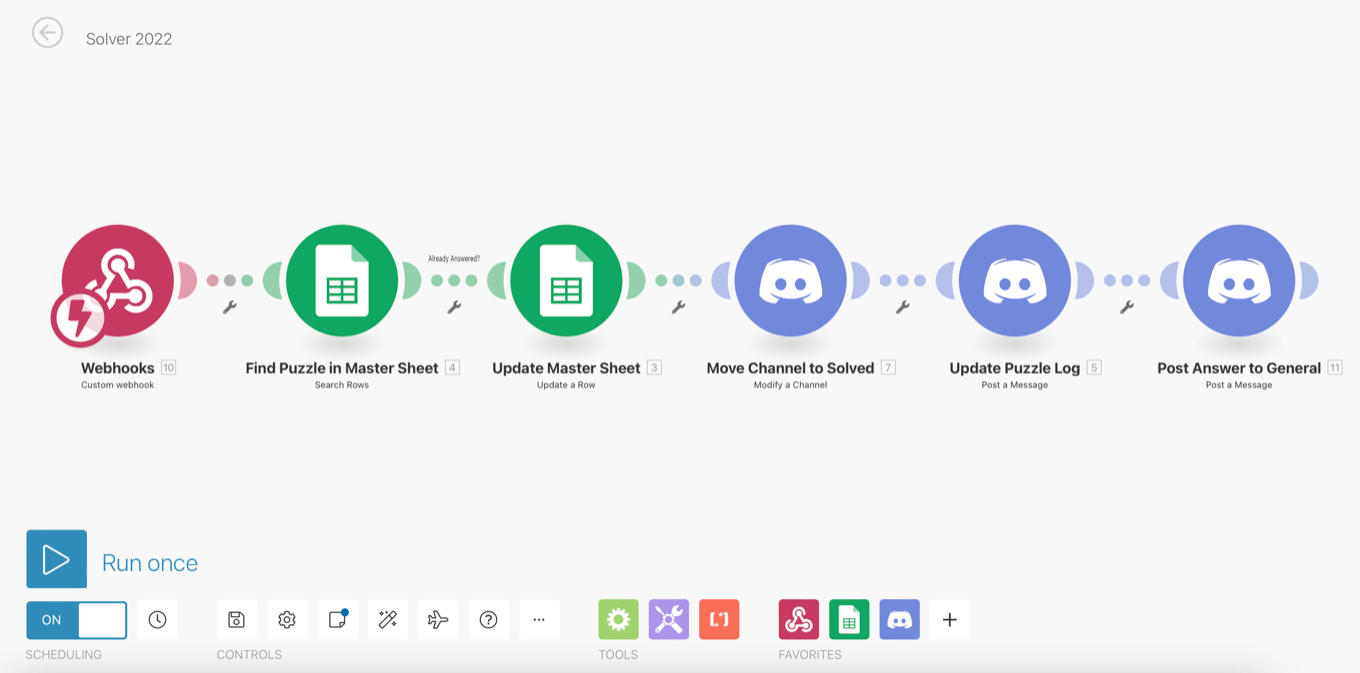
By comparison, the Solver workflow is much more straightforward.

Solver

A webhook is, in this case, automatically triggered by the submission of the relevant Google Form. The puzzle in question is located in the master puzzle list, updated with the answer, and the Discord channel is moved to a category for solved puzzles. Then both our puzzle log channel and out Discord’s general channel are pinged with a celebratory message indicating that a puzzle has been solved, along with the solution.

Grav

The last main tech component for our Mystery Hunt team is a basic website that hosts two main types of information: team-level information that don’t change much during the hunt (such as a team roster, basic tips and reference, and details about the hunt itself), as well as a Puzzle Dashboard.

The latter is an embedded frame that provides a list of our current puzzle status, including whether a puzzle is solved; the puzzle name; links to the puzzle page, Discord channel, and Google Sheet; and the answer, if applicable. This is sort of a central clearing house that can at a glance show what puzzles still need solving, and how we’re progressing on any given meta, as well as provide quick access to puzzle collateral.

Puzzle Dashboard

To host of all this, we use a basic CMS called Grav. Its flat-file approach avoids the need for a database server, and it’s intended to be lightweight, easily editable, and quick-loading. It also has a robust plugin architecture in the case that it needs to be extended. However, as it doesn’t get a lot of use during the hunt—with the exception of the Dashboard itself—it’s not the most critical piece of infrastructure.

Hunt and ye shall find

And there you have it: one team’s approach to keeping track of puzzles. Our tool usage is tuned for our particular team, of course, and it’s anything but a one-size-fits-all approach. What works for us probably won’t work for most other teams, though we are always on the lookout for new tools and improved workflows that can help us simplify things. But, all of that said, we tend not to tinker too much, especially if something is working pretty well so far. And really, it’s quite astounding what you can achieve with a small amount of off-the-shelf software, most of which is free.

I hope you enjoyed this look into our technology infrastructure. If you’re a fellow puzzler, perhaps it’s of interest to you. And if not, perhaps I at least intrigued you enough to check out the Mystery Hunt for yourself. Happy puzzling!


  1. I’ve only missed one year, 2007, thanks to a conflict with Macworld Expo. 
  2. Amazingly, it involved a whole massively multiplayer world that you could wander around. For more on that, check out this post-mortem from the team that ran the event that goes into the behind-the-scenes details. 
  3. To explain: for some reason, our team started keeping track of how many burritos we ate during the hunt. That’s because one of the popular haunts on MIT campus is Anna’s Taqueria. So, of course, this year I added a bot that I programmed in Python to help us log burritos as we eat them. 
  4. Hunt puzzles generally solve to a single word or phrase. Each puzzle is associated with a meta puzzle (or, occasionally, more than one); clues for the meta puzzle’s clues are made up of the solutions to the puzzles within that category. 
  5. Yes, I know this should by all rights be a true database. But Google Sheets is very widely available, easy to manage, and scriptable. I’ve investigated AirTable, and I’d potentially consider switching to it in the future if there were a real reason to, but for now, if it ain’t broke… 

[Dan Moren is the East Coast Bureau Chief of Six Colors, as well as an author, podcaster, and two-time Jeopardy! champion. You can find him on Mastodon at @dmoren@zeppelin.flights or reach him by email at dan@sixcolors.com. His next novel, the sci-fi adventure Eternity's Tomb, will be released in November 2026.]


The last apps we purchased, how we’d handle third-party payment options on our Apple devices, our experience with Exposure Notifications, and how we track our resolutions, themes, and habits for the new year.


You thought you were going to get out of the year without a Epidemiology Corner segment? Fat chance.


WinterFest 2021

WinterFest 2021 is on now. It’s a holiday-themed sale of great independent Mac apps, at discounts of 20 or 25 percent:

The new year brings new plans, fresh projects, and great new ideas. Whether you’re mapping out your next novel, finishing your dissertation, planning a product, or writing memories for your grandkids, these great tools will help. As is our custom in this season, we’re hosting a gathering of software artisans who are working to transform research and writing for a new era. We’ve all finished our latest updates, we’re working together to save you lots of money. Get the tools you need at a terrific price, for a very limited time.

Included in the list are some of my favorites, including Scrivener, BBEdit, and Marked. It’s also got some very interesting apps that I mean to use more in the future—I’m probably going to buy myself a license for Hook Pro, since David Sparks keeps evangelizing it.

Check the whole list out and see if any of them strike your fancy.


In this Upgrade Holiday Special, Jason and Myke answer the holiday-themed questions of Upgradians everywhere. Smart decorations, holiday wardrobes, the definition of fairy lights, monkey strategies, an eggnog recipe, and Santa’s complex cloud-based organizational system are just some of the topics covered.


Search Six Colors