Six Colors
Six Colors

Apple, technology, and other stuff

This Week's Sponsor

Unite Pro: Turn websites into Mac apps with native enhancements

Clockwise 58: ‘All My Money Is Gone’

All the podcasts need to run and hide before the big, bad Apple event comes and blows them all away into irrelevancy… So we recorded this week’s Clockwise this weekend in Montreal with special Canadian Guests Georgia Dow and Rene Ritchie. It’s a rare occasion when Dan Moren and I were recording together in the same room! Crazy times.

Live from Montreal: Expectations of Yosemite, dreaming of Macs with color selections, the Mac App Store, iOS 8, and keeping up with the Cardassians.

This week’s Clockwise is brought to you by Dash, a super cool website that lets you quickly create real-time custom dashboards.


‘Someone Is Threatening My Whales’

This week on The Incomparable, I talked with Brianna Wu, Moises Chiullan, Scott McNulty, David J. Loehr, and Tony Sindelar about the best and worst in “Star Trek” series and movies.

I think Brianna’s great and I’m just sick about the events of this weekend. She and her husband Frank have all my support and respect, and that’s despite Bri’s shocking claim on this week’s podcast that one of my favorite TV shows of all time is, in fact, “the worst of Star Trek.”

At Cingleton this weekend I got to spend some time with Bri’s Isometric co-host Georgia and for a while it just became a praise session for Brianna’s indomitable spirit in the face of some truly horrible behavior. She’s great. Even if I side with Frank on the question of Captain Kirk.

Also posting over on The Incomparable last week:


By Jason Snell

BBEdit at Max Q

Note: This story has not been updated since 2021.

I’m in Montreal for the Cingleton conference. On Saturday Rich Siegel of Bare Bones Software gave a presentation in which he announced that the next version of BBEdit would not be sold in the Mac App Store. (The existing version will remain, and existing Mac App Store customers can upgrade to the next version directly with Bare Bones.)

Çingleton – Rich Siegel from Çingleton on Vimeo.

Siegel’s talk was notable for its restraint and care. This was not a scorched-earth denouncement of the Mac App Store. In fact, at the end, he admitted that it’s not impossible that BBEdit might return to the store someday, if conditions change.

Siegel crafted his presentation as a list of reasons that weren’t the reason Bare Bones was abandoning the Mac App Store. It wasn’t Apple’s 30 percent cut, he said, because while that’s a lot of money, developers get a lot of service from Apple in return. It wasn’t the complete severing of his relationship with his customers, even though it’s frustrating that only Apple really knows who is buying the software and it doesn’t share that data. Nor were it the marketing challenges, the difficulty conforming to Apple’s submissions guidelines (including sandboxing and forcing some features in to add-on downloads), or the numerous problems involving the development tool chain—including the one time that a BBEdit update silently crashed the App Store’s submission tool.

But, of course, all of these frustrations were cumulative. And, Siegel said, many of those frustrations occur at the very end of the development cycle, when the final code is being shipped and the marketing plan is being executed. He likened it to Max Q, the aeronautical term for the period of maximum atmospheric stress on a flying vehicle.

The end result? A lot of soul searching and a realization that being in the Mac App Store just wasn’t worth it for Siegel or Bare Bones, that the added stress and frustration and everything else just wasn’t counterbalanced by the benefit of being in the premier storefront for Mac apps.

For many Mac apps, the Mac App Store is a good home. And the store itself continues to evolve. But in the past few years developers have gotten a better view into all of its quirks and frustrations, and for some of them it’s just not worth it. I suspect BBEdit will do just fine back on its own, and the Mac App Store will continue to chug along, its library imperceptibly poorer.

[While Cingleton does sometimes make presenter videos available after the fact, there’s no video of this presentation available now, and there probably won’t be soon. So you’ll have to take my word for it.]


Sponsor: Tinderbox

This week, Six Colors has been sponsored by Tinderbox from Eastgate Systems. It’s kind of hard to even explain what Tinderbox is, because it’s so versatile and I know people who use it for a variety of different tasks.

The people who make Tinderbox call it “the tool for notes,” and that’s a clear way to describe it, but beneath that simple description is incredible depth. Tinderbox is a professional tool for capturing, visualizing, and analyzing your facts, tasks, and ideas

Tinderbox lets you create smart documents that help organize, reorganize, and evolve your thoughts over the course of months and even years. It’s a great tool for writers planning their next book, teachers planning their courses, product developers and designers who need to create their next big thing, and anyone who wants to organize their thoughts.

Tinderbox is a pro-level tool, and normally costs $249, but this week Six Colors readers can save $100 and pick up a copy for $149. A household license has been discounted to $199. And The Tinderbox Way, an ebook about the ideas behind Tinderbox, is also discounted $5 for Six Colors readers. Click here for more information about the offers.


It’s all about Dan not liking iOS 8 (and John and Lex’s counterarguments) until the gang is interrupted by BREAKING NEWS.


By Jason Snell

A leather-clad robotic core

Note: This story has not been updated for several years.

I was listening to this week’s Accidental Tech Podcast when I discovered that Marco Arment’s take on the iPhone 6 in one key area is identical to mine. And though I know that the plural of anecdote is not _data_1, I think it’s interesting:

Neither Marco nor I have ever used iPhone cases, and yet both of us are interested in using a case on the iPhone 6:

I still don’t have a case on my phone yet, but I picked up Tiff’s a couple of times and… it feels glorious. Like, “Oh my god, I need this,” with the Apple leather case on it. That is how I want this phone to feel—it improves so many things.

Blue iPhone 6 Case
Into the midnight blue…

I’m with Marco. I have always appreciated using my iPhones as they were born, a naked robotic core with no adornment. And I’ve never dropped one. But I’ve been using an Apple iPhone 6 leather case for the last couple of weeks, and really liking it.

Yes, it’s true—the curved glass on the iPhone 6 screen is glorious, and the case completely blunts that feature. However, the leather also makes the entire device more grippable.

I was no fan of Apple’s iPhone 5 cases (the leather models were untextured and boring and hard to put on and take off), but the iPhone 6 leather case feels good and looks good. And it’s potentially a style upgrade: If you don’t like the antenna cut-outs on the back side of the phone, no problem—they’re covered up by a leather back embossed with the Apple logo. And the case lets your phone sit perfectly flat, if you’re bugged by the fact that the iPhone’s camera sticks out.

And as a fan of the deep, dark black color scheme of the original iPhone 5, I can get a darker phone by wrapping my Space Gray iPhone 6 in black (or in my case, midnight blue) leather. It’s a good look. I can’t guarantee that I won’t ditch the case and go back to the robotic core eventually, but I believe this is the longest I’ve ever kept a case on my iPhone.


  1. Or is it? Hat tip: Amadeus Demarzi.

Unannounced product delayed by success, doom sure to follow

The Wall Street Journal reports:

Apple Inc. suppliers have pushed back plans to mass produce a larger-screen tablet to early next year, people familiar with the matter said, as they struggle to make enough new iPhones to meet strong demand.

I’m sure this will be used as proof in some quarters that Apple is doomed, despite the fact that the driving factor seems to be dramatic demand for new iPhones.

Unannounced Apple products are often reported to be “delayed,” but what does that word really mean? Apple didn’t promise that the product would be available at all, let alone at a given time. Product schedules change all the time, and for plenty of different reasons. (That doesn’t stop the report from throwing some shade on the viability of the iPad market in general, because why not?)

The Journal suggests that Apple’s original plan was to “produce the larger iPad in mass volume beginning in December,” which doesn’t necessarily mean the product was meant to ship in December. Production might have begun in December for a planned January release—we just don’t know. And Apple’s suppliers, which are the source of the story, probably don’t know either.

[via Jon Seff]


Clockwise 57: Piegate

The latest episode of the podcast that doesn’t waste your time is out, featuring our dreams of new iPads, Google’s responsibility to patrol the Internet, a hail of technology scandals, and iOS 8’s slow adoption rate. And be sure to leave room for pie!

As always, I co-host Clockwise with Dan Moren. This week’s very special guests are Georgia Dow of iMore and many podcasts (Isometric and Zen and Tech among them) and John Moltz of Very Nice Web Site and The Rebound Podcast Starring John Moltz and others.


By Jason Snell

Apple event set for Oct. 16

Note: This story has not been updated for several years.

“It’s been way too long,” says Apple’s invitation for a special event on Apple’s campus on Oct. 16. (Along with an image that features a certain familiar collection of colors!)


Let the Kremlinology begin! Is it a winking admission that the press was just in Cupertino for an Apple event last month? Is it a promise of updates to the Mac mini, which hasn’t been touched since 2012? Is it a high-school reunion? Is someone trimming his very long beard? (“Nope.”)

All I know is that we’re supposed to meet at the main entrance at 1 Infinite Loop (which is not the usual Apple Town Hall routine) before “an executive presentation” at 10 a.m.

And yes, I will be there! Along with Apple’s very own six-color rainbow, it seems.


Strong encryption is not a luxury

Kevin Poulsen at Wired:

The law enforcement officials criticizing Apple should put aside the sense of entitlement they’ve developed in those seven years and spend some time thanking Apple and Google for making things so easy for them for so long.

Law enforcement officials usually play on our fears whenever their powers are limited, but those limitations are what keep our society from being a police state. The Supreme Court’s ruling in Miranda v. Arizona in 1966 led to catastrophic predictions that many criminals would go free and society would be harmed if all arrested people were informed of their rights. Didn’t happen.

That’s what’s happening here. Law enforcement types are suggesting that Apple and Google are making their products safe for child molesters. It’s the same old tired “good people have nothing to hide” argument against privacy rights that’s been carted out for years.

(Bonus reading: Bruce Schneier, of course.)


Upgrade 4: ‘I Regret My Endorsement of You’

The latest episode of that podcast that says “Hey Siri” at inopportune times is live:

This week Jason and Myke start off the show with a discussion about terrible social networks, before attacking follow-up on Dropbox replacements, data security and streaming services. Other topics this week include Apple Pay and the Pebble.

Sponsoring this episode is Hover, simplified domain management. Use code HEYSIRI for 10 percent off your first purchase.


‘Ancillary Sword’

One of the best reviewed, most decorated science fiction novels in recent memory is “Ancillary Justice” by first-time novelist Ann Leckie. We covered it on three different episodes of The Incomparable.

It’s a big space opera about warring empires that doesn’t bypass any of the crimes an empire commits in order to remain an empire. But at its core, “Ancillary Justice” is a book about identity, about how people define themselves, how our history and actions define us, and even how our language can put us all in boxes we can’t even see.

You should read “Ancillary Justice” if you haven’t. It is fulfilling entirely on its own, and isn’t one of those books that stops in the middle and makes you wait for the next book in the series. However, as of today there is a sequel, “Ancillary Sword,” and the reviews seem good so far.

If you like science fiction stuff, even a little bit, check them both out.


By Jason Snell

How do you compete with the Apple Watch? Don’t.

Note: This story has not been updated for several years.

Last week smartwatch pioneer Pebble announced a software update and a price cut, so the original Pebble is now available for just $99.

Pebble Watch

Let’s face it: The new generation of smartwatches (and the Apple Watch yet to come) has made Pebble look like outmoded technology. But Pebble still has advantages—and yes, I’m still wearing mine a year and a half later.

The big advantage is battery life. Pebble’s screen is a low-power, low-resolution black-and-white LCD. But that screen helps my Pebble last almost a week on a single charge. The other smartwatches out there need recharging more or less every night. You can even wear Pebble in the pool, which you can’t do with an Apple Watch.

The new generation of smartwatches are like little smartphones, packed with features on bright color screens. Pebble, in contrast, is a simple device with a long-lasting battery that’s good at pushing your phone notifications to your wrist. I find value in that, and I suspect that I’m not alone.

Combine all that with a low price, and you’ve got a sales pitch for a product that otherwise would be put out to pasture. Unfortunately, Pebble’s software direction seems to be focused a bit too much on enabling background tasks for third-party apps, which threatens to make Pebble more complicated and harm its battery life.

Simplicity is good. As Ben Thompson wrote in his excellent Stratechery newsletter (membership required) last week:

Pebble is doomed to lose the features game; I’d much rather see them pare inevitably inferior functionality and focus on increasing battery life, thus making their primary differentiation – and marketing – that much more defined.

I couldn’t agree more. Pebble might have something if it focuses on being cheap, with a long-lasting battery and a very simple (but solid) feature set. If Pebble tries to be everything to everybody and compete with Samsung, Motorola, Apple and others on features, it’ll be roadkill. If it makes the right choices and focuses on a solid, simple set of features, it might find a comfortable niche.


‘Twin Peaks’ will return

Young whippersnappers out there may not remember “Twin Peaks,” but there was a time when a major broadcast network (back when that meant something) handed the keys to an hour of its time to David Lynch and let him create a completely insane show that mixed soap opera, police procedural, small-town comedy, science fiction, and horror in a way never before seen on television.

These days, lots of crazy experimentation happens on TV, on premium cable and basic cable and even sometimes on the broadcast networks. But “Twin Peaks” was way ahead of its time, and in college we watched it obsessively. We had viewing parties. I once went to a diner in San Diego and ate cherry pie while watching an episode. And then its second season ended on a cliffhanger, the show was cancelled, the feature film follow-up was a prequel, and we were all left to wonder about how the story might have continued.

Well, “Twin Peaks” is coming back. I can’t believe I just typed that sentence. Deadline reports:

One of the top cult series of all time is coming back with a new limited series on Showtime from its original creators, David Lynch and Mark Frost. The nine-episode series will go into production in 2015 for a premiere in 2016 to mark the 25th anniversary of when the series finished its run on ABC. In a fact that will delight Twin Peaks devotees, Lynch and Frost will write and produce all nine episodes, with Lynch set to direct every episode.

For a lot more detail, check out Deadline’s interview with showrunner Mark Frost. Or buy the Blu-Ray. Or listen to the Fire Talk With Me podcast.

The owls are still not what they seem.


By Jason Snell

How many outs? Design and the Fox Box

Note: This story has not been updated for several years.

Design is everywhere. Even in sports. Last night on Twitter, as I watched the Giants-Nationals playoff game, Todd Vaziri pointed out an interesting design decision:

Put simply, there are three outs per team per inning, but Fox Sports 1’s score box displays only two circles, filling them in as the inning progresses. It led to an interesting conversation on Twitter, which I’ve Storified.

Reasonable people can differ about whether Fox Sports 1’s design decision is a good one. It’s true that there are never three outs during a team’s half inning; once you get a third out, that half of the inning is over. However, I’d argue (and did last night) that not showing the third out as a circle to be filled in suggests that there are only two outs, and not three, in a batting team’s half of the inning. (If there weren’t empty circles to be filled in, implying a maximum number, it would offend me less.)

This is hardly a design catastrophe. In fact, I suspect that the designer only displayed two circles because there just wasn’t room for a third. (J.D. Davis on Twitter did point out that Fenway Park’s scoreboard only has two light bulbs to track outs. I suspect that decision was more about saving money on light bulbs and wiring, rather than being a philosophical statement about when an inning truly ends.) For the record, Major League Baseball’s own app, MLB At Bat, displays three circles.

Does anyone who’s watching a baseball game not know that there are three outs per side in an inning? Probably not. That’s why this is not a major design foul. But still, it grates. Outs is a concept that adds up to three, but the outs graphic adds up to two. As John Gruber wrote, the better decision would be to show all three outs, fill in the third out at the end of the inning, and then fade out the entire graphic as you go to a commercial break.

The entire genre of the on-screen score box, which was introduced to America twenty years ago as Fox Sports’s Fox Box, is a fascinating design playground. Before 1994, American sports broadcasts didn’t feature a persistent indicator of the current score and game status. (The box apparently was invented in 1992 for English soccer.) These days, it’s hard to imagine a televised sport without it. The boxes vary by sport, obviously, but also by individual broadcaster—each one has its own idiosyncratic take on how best to present dynamic information in a small space.

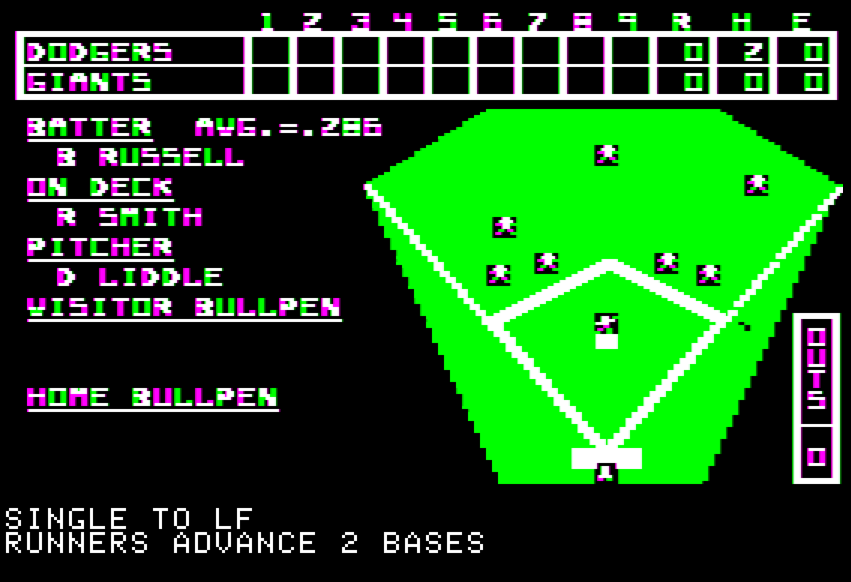
Some boxes are animated—ESPN actually shows numbers flipping over when a score occurs, as if the score counter has to rotate through consecutive numbers like an old clock radio. Fox used to attach an annoying sound effect to every single animation. This baseball postseason, TBS and MLB Network have both tried to show baseball defensive positioning, with varying success. (TBS’s looks like they’re trying to explain where the shortshop plays to people who have never before seen baseball; MLB Network’s is compact, but sort of resembles my old SSI Computer Baseball game on the Apple II.)

If you’re not a sports fan you might not notice these on-screen displays or the interesting challenges they offer for presenting complex information in a compact space, but I find them endlessly fascinating. Televised sports are richer for having them, even if fans sometimes quibble with some of the design decisions.


October 5, 2011

Three years ago:

It might not have looked like it in 2001, but in 2011 it’s clear. This is not the story of a talented but under-appreciated man whose products were influential while his company flailed and failed while others made billions on his good ideas.

This is a story of victory. In the end, the world embraced Apple. It embraced Steve Jobs. And the world’s a better place because he was in it.


‘Fun is Underrated’

This week on The Incomparable, I talked with Dan Moren, Scott McNulty, and David J. Loehr about an incredibly fun sci-fi book series, “The Expanse.” It’s going to be a SyFy TV series soon, but I highly recommend the books, starting with the Hugo-nominated “Leviathan Wakes.”

Also posting over on The Incomparable this week:


Sponsor: Zoompf

Thanks to week’s Six Colors feed sponsor, Zoompf. Zoompf builds software to help websites go faster.

They just launched a new, free product in public beta: Zoompf Alerts. Zoompf Alerts continuously analyzes your website for the common causes of slow performance, notifying you when changes introduce new performance defects. While other products just monitor how fast your page loads, Zoompf Alerts analyzes your website’s content and configuration to pinpoint the root causes of slow performance. If you care about UX, you should check out Zoompf.

Just this morning I found a mistake on The Incomparable’s site that was causing too-large images to load and not be cached, which I was able to fix with a few tweaks, thanks to a Zoompf Alert.

All Six Colors readers can join the Zoompf Alerts beta now.


Search Six Colors