Where the hell did Windows 9 go? Does Apple have a QA problem? Are Lex’s and John’s spouses right not to upgrade to iOS 8? We answer none of these questions.
This week on Clockwise, Dan Moren and I are joined by Myke Hurley and Casey Liss to discuss the prospects for Apple Pay, Apple and software quality, adapting apps to the iPhone 6 Plus, and our nostalgia for unloved old tech. Plus, Myke tells us what they call candy in England.
Having used a retina MacBook Pro now for two years, I can tell you I love it. After all of this time I still sometimes look at text on this screen and just drool. I’m so spoiled. If Apple releases a retina iMac I’m sure it is going to be gorgeous. I do, however, have a few tips if you are thinking about this currently-mythical device.
O’Reilly’s a smart guy. And I don’t think he’s wrong in suggesting that sometimes we demand improvements in horse technology and miss the fact that the invention of the automobile is just around the corner.
And yet he seems to be throwing Apple Pay under the bus in order to promote other payment methods (including one O’Reilly invests in) that represent a fantasy world of a connected future that probably won’t ever come to be. It’s a little like saying the Apple Watch isn’t really relevant because the sun’s going to run out of fuel and burn the Earth.
O’Reilly doesn’t like Apple Pay because it’s a “digital facsimile of a process that is already on its way to becoming obsolete.” His point is that when he summons an Uber, he doesn’t need to identify himself or calculate a tip or pay the bill manually—it’s all done for him. This, says O’Reilly, is a “truly disruptive service” that has “already done away with the old payment model.”
To summon an Uber, O’Reilly needs to take his phone out of his pocket, launch the Uber app, and tap a few times. If those steps sound familiar, it’s because they’re not that different from how one would buy some groceries at Whole Foods using Apple Pay. The phone comes out at the start of the process, rather than the end, but it still comes out.
O’Reilly is proud that he “never searches for his wallet” when he takes an Uber, but he had to pull his wallet out in order to sign up for Uber, and every time his credit-card number changes he’ll need to update that information.
Once an iPhone is set up with Apple Pay, it’s a one-touch system for payment and optional identification. The number that gets transmitted is not your credit card number, so it’s more secure. If you’re shopping at a store that has a loyalty card system, and you wish to add that information to your iPhone, you can pass that along too.
I’ve ridden in Uber cars a few times, and it’s a very cool experience. But transactions require validation. Uber validates by connecting your phone to Uber’s servers and drivers using the Uber app. Apple Pay validates by transmitting a secure string of digits that your bank will translate and accept. These examples don’t seem to be opposite at all. They both use your phone to validate your identity and confirm your purchase.
And of course, it goes without saying that an Uber transaction is about as simple as it gets. When I walk up to the Whole Foods checkout line with my fresh ground peanut butter, a Stone Smoked Porter, and some aged Manchego, how do I get an Uber class experience? Even if RFID technology improved to the point that I could just walk out of the store and be automagically charged, I’d still need to validate my purchase in some way, a la Apple Pay.
Sure, maybe O’Reilly’s post bugged me because he’s playing the familiar game of using recent Apple product news as a strawman to compare to an utterly different kind of technology, while throwing in coded phrases like “Apple hype machine.” (Replying to a comment on his own article, O’Reilly declares, “What I wrote wasn’t really about Apple Pay.” Of course it wasn’t.)
But I think what really rankles is that Tim O’Reilly is applying his vision to a Silicon Valley utopia where people take Ubers to their Cover-booked restaurants, always operating on their own recognizance and never, ever waiting for the check. There’ll be spandex jackets, one for everyone.
Apparently these people never go to the supermarket.
I normally wait for my print copy of Vogue to arrive before reading the articles, but in the case of Robert Sullivan’s profile of Jony Ive, I’ll make an exception:
You might spot the occasional photo of him out in the world—at the White House for a design award; in London being knighted, as he was two years ago, by Princess Anne; at a pizza dinner in San Francisco, sitting with Yahoo’s Marissa Mayer and various Silicon Valley execs. But one of the very natural settings for the real Jony Ive is a workshop at Apple HQ.
We all seem to want to make Ive into this larger-than-life figure (he’s friends with Bono, hello!), but it seems to me that Ive is happiest when he’s hard at work inside his design studio.
However, the experience came with a hefty price tag. With round-trip tickets costing up to $18,400, it was completely unattainable for most people. Formerly, the only way for an average person to fly in the Suites was to take out a bank loan. And then I remembered that most of my personal net worth exists in frequent flier miles rather than cash.
As we debate the price of the Apple Watch Edition, it’s interesting to get a peek into some of the products that are tailored to the high-end market. Like, say, a $18,400 plane ticket.
Noelle Stevenson’s excellent webcomic “Nimona” has wrapped up its story after 251 pages. You can read the entire story from the beginning online, and it will be coming out next May in print from HarperCollins.
“Nimona” is the story of Lord Ballister Blackheart, a villain in a kingdom that’s a strange combination of fantasy and sci-fi. His nemesis is the goody-goody Ambrosius Goldenloin, and boy, do they have a history. Changing the traditional villain/hero balance of power is the entrance of Nimona, a shapeshifting youngster who pushes Blackheart to improve his evil plans and think even bigger.
Project Photoshop Streaming enables selected participants to access Photoshop on Chromebooks. Applications delivered via streaming are easy to access and easy to manage. Even better, streaming apps work directly with files in Google Drive, so no need to download and re-upload files – just edit directly in the cloud.
I’ve got a Chromebook Pixel and it’s a great piece of hardware, but I almost never use it. Too many parts of my workflow rely on apps that just don’t have good in-browser equivalents, and if it doesn’t run in the browser, it doesn’t run on Chrome. Bringing major desktop apps like Creative Cloud to Chromebooks would be a big step forward.
Part of the appeal of Chrome as a platform is that it’s simple and everything happens in the browser—but if you’re someone who can’t do your job in a browser, it’s a platform that doesn’t make sense. Between this announcement and the fact that Android apps are coming to Chrome, Chrome seems to be transforming into a platform that’s much more than an operating system for running web apps.
Episode 3 of your favorite new tech podcast featuring an American and an Englishman is here. This week Myke and I discuss the perils of online streaming services and the uniquely modern problem of having 1TB of Dropbox storage, among other issues.
Omni is one of the great Cocoa development companies, and they’ve grown slowly and steadily over many years. They write lovable productivity apps — not just great iOS apps but also great Mac apps. They’re generous to and respectful of their users, employees, and of the local development community. Their values and ambitions align perfectly with mine.
The Omni Group makes great products and Brent’s a great developer. Congratulations to both of them. (And yes, Brent says he will continue to develop Vesper.)
A new line of iMacs with ultra high-resolution Retina Displays is in late testing stages within Apple, according to our sources who have used the future desktop computer… The fact that the iMac is in late testing indicates that Apple could be preparing to launch it alongside OS X Yosemite this fall…
A source familiar with Apple’s plans tells me that Apple is indeed planning to launch a Retina iMac at their next press event, however the 27”³ Model will be the only model that gets this feature. The source says the new 27”³ iMac will use a 5120 x 2880 panel as leaked in the OSX Yosemite code a few months ago. This resolution is double the current resolution of the 27”³ iMac which is 2560×1440.
I have been hoping that this year would be the year of Retina on the desktop, and it looks like it might squeak in right under the wire. A Retina iMac would be great, though it sounds like external Retina displays and devices that can drive them might not be in the mainstream for a while yet.
I wasn’t ever planning to buy an iMac again, but if a fancy Retina iMac drops from the sky later this year, it’s going to be an awfully tough decision.
Note: This story has not been updated for several years.
[This is probably the first in a series of posts about nerdy podcast things. Apologies to everyone who’s not a podcaster. Are there people left who aren’t yet hosting their own podcasts? Your time will come…]
The ATP hosts and, on the table, their live-streaming setup. The iPad at the end of the table is streaming the show live.
At WWDC this year, I hosted a bunch of podcasters in IDG’s podcast studio. (You can drive up to Mill Valley and use my garage next year, folks.) During the recording of Accidental Tech Podcast, I noticed something interesting: Marco Arment was streaming his show live from his iPad.
As someone who streams his own podcasts live, I was intrigued by Marco’s setup. And while Marco uses this particular setup when he’s on the road (he has a mixing board when he’s at home), for the past few months I’ve been using the same setup to stream The Incomparable. From an iPad mini. (I usually use Nicecast from Rogue Amoeba, but various aspects of my Mac’s audio system began behaving strangely when I started using the Yosemite betas.)
In fact, one of the great advantages to this approach is that you don’t have to deal with the Mac’s finicky sound system, which should be much better than it is. (I’d like to be able to, for example, route a couple of USB microphones and the audio from a couple of Mac apps into a virtual input that gets sent out over Skype. There was some great software that used to do this, but most of it died when Lion was released, believe it or not.) Some new software is slowly starting to appear that fills in the gaps, but the beauty of using an iOS device to stream audio is that your Mac doesn’t have to worry about any of that—all it has to do is play sound, which it’s doing already.
The centerpiece of what I’ve taken to calling the Marco Method is the Behringer UCA202, a $30 USB audio interface. Combine that with Apple’s Lightning to USB Camera Adapter, plug into your iOS device, and you’ve got the start of something. (Yes, iOS devices supply enough power to the UCA202 to keep it running, which is not the case with many USB-based audio interfaces.)
Next up is an RCA-to-minijack cable. The RCA inputs plug into the UCA202, and the minjack goes where I would normally plug my headphones—when I’m podcasting, that’s my Blue Yeti USB microphone. The UCA202 has its own headphone jack and volume plug, so I plug my headphones in there and can ride the volume wheel to get the right volume for my ears, separate from the right volume for the live stream.
Streaming live on an iPad via iCast Pro.
That’s the hardware side. On the software side, Marco discovered a $5 app by Anthony Myatt called iCast Pro. It’s not much to look at, and it’s an iPhone app so it runs in blown-up mode on an iPad, but it connects directly to an Icecast server, which is what both of us use to stream live. The Icecast server then relays the audio stream to anyone who wants to tune in.
This approach doesn’t provide any way to charge the battery of the iOS device you’re using to stream, but my fully charged iPad mini could probably stream for five hours before running out of juice. I haven’t yet had the chance to test out this setup in the field, but it really allows you to stream live from just about anywhere. Thanks for the tip, Marco.
Chris Phin, one of my longtime tech-journalism counterparts (he was editor in chief at Future in the UK), is leaving his job in a month after 12 years. His descriptions of where he’s been and where he’s going hit really close to home for me:
The more senior I’ve gotten, the more I end up merely administering rather than creating stuff. And I miss that. I miss writing, I miss researching, I miss communicating with an audience. I’m excited about being excited again.
We will greet you with open arms here on the other side, Chris.
This week on The Incomparable I talked with Philip Michaels, Lex Friedman, Lisa Schmeiser, Monty Ashley, and David J. Loehr about the best people to ever appear on “Saturday Night Live”. But because I just can’t help myself, we structured the whole thing like a fantasy sports draft.
Why build fantasy sports teams when you can build a fantasy sketch-comedy team? On the occasion of the debut of season 40 of “Saturday Night Live,” we assemble six different SNL fantasy casts from the very first cast to the most recent vintage. Almost everyone gets a Phil Hartman! But only after a whole bunch of rules debates.
Scott McNulty and Monty Ashley broke down “I, Mudd”, one of the most humorously ridiculous episodes of the original “Star Trek,” which contains a couple of my favorite scenes of anything ever.
Note: This story has not been updated for several years.
[Steven Aquino is a freelance writer specializing in iOS accessibility. He writes at stevensblog.org and is co-host of the Accessible podcast.]
In my 33 years on this planet, I’ve never done much traveling. Until recently, the only time I’d left my home state of California was in 2002, when a good friend of mine and I went to Las Vegas to celebrate my 21st birthday. (That trip also marked my first time on an airplane.)
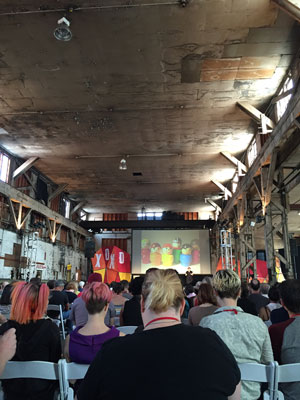
It took me 12 years to again leave the friendly confines of California, as earlier this month my girlfriend and I drove up I-5 to Portland, Oregon for the XOXO conference.
When you apply for XOXO, which is a conference for “independently produced technology and art,” you’re asked to describe what sort of things you make. What I put down is that I write about Accessibility on iOS. In all honesty, I didn’t think I would get in; for some reason, I thought what I make wasn’t big enough or important enough for such an esteemed festival. In short, I never expected to go.
Turns out, I was selling myself very short. My application was accepted.
I paid the $500 fee for the all-access pass, and I had an absolute blast. Given the fatigue I suffer from (caused by my cerebral palsy), I didn’t go to every talk or every social event, but the things I did go to were extremely fun and rewarding. On a personal level, I got to meet so many folks and talk about what I do and why. Most notably, I had opportunities to meet both John Gruber and Jason Snell, both of whom gave me big kudos for my work and my reputation. All in all, the majority of my time spent at the conference was networking to the fullest degree. At the very least, all the conversing was a boon to my Twitter account, netting me a lot more followers at the end than I had coming into Portland.
Yet for as valuable as the networking was and for as cool as it was to meet two of my Internet heroes, the macro-level take I have of XOXO 2014 is most important to me. I was there representing the accessibility community. I was there showing anyone paying close attention that advocating for people with disabilities matters. That people with disabilities can overcome adversity and be successful. I wasn’t a guest speaker, but it was critical for me to act as a voice for my work and for the accessibility community. If anything, the fact that I traveled over 500 miles to go to this thing was a big indicator of personal and professional growth. In short, it was a huge weekend in more ways than one.
It means so much to me that The Andys let me be a part of the fun this year. The swag bag was cool, but the experiences were even better, and I most definitely am looking forward to the 2015 edition of XOXO.
Now it seems that I’ll be leaving California at least once a year.
When I was at the XOXO festival the weekend before this site launched, I saw John Gruber tell the story about how he decided to launch sponsorships on Daring Fireball and how Paul Kafasis of Rogue Amoeba stepped up to support him and become the first sponsor. Paul likes being the launch sponsor for things. In fact, while I was at XOXO I was also emailing with Paul about being the launch sponsor for Six Colors. I’m pretty sure he didn’t even know the name, and he said yes. I’m grateful for his support.
Rogue Amoeba, the company that Paul leads as CEO/Lackey, makes numerous fine audio products for the Mac, including Airfoil, Audio Hijack Pro, and Fission.
Through the end of September, Six Colors readers get $5 off anything at Rogue Amoeba by using the coupon code SIXCOLORS.
Note: This story has not been updated for several years.
I have come to accept that, for a great many people, renting is better than owning. Yet the idea of paying a monthly fee for access to a library of stuff has always made me uncomfortable.
I bought a year-long subscription to Beats Music a while back, and while I do listen to it from time to time, when I find an album I like, I buy it. I buy it even though I could download it within the Beats Music app and listen to it there, even offline.
Part of the reason is convenience. I listen to music a lot when I’m using my Mac—Death Cab for Cutie’s “Tiny Vessels” is playing right now—and Beats Music doesn’t have a Mac app. (Beats’s new owner should probably address that…) But other services have Mac apps, so if it really meant that much to me, I could switch to, say, Spotify.
The truth is, I have a large collection of music, and it’s all in iTunes and iTunes Match, and it’s awfully convenient. More importantly, it’s mine. There’s zero chance that it will disappear tomorrow. I’ve got it on hard drives, and backed up to various cloud services.
Streaming-music service libraries are, for the time being, stable. Chances are good that I won’t ever turn on Beats and discover that every Death Cab for Cutie album has vanished from the service’s library.
The same, however, is not true with online video-streaming services. I was reminded of this when I discovered today that the reimagined “Battlestar Galactica” series expires from Netflix on Tuesday. Someone, somewhere, will be in the middle of watching or re-watching that series next week, only to see it disappear. And it’s just one of dozens of items that will drop off of Netflix at the end of the month.
It’s not as if “Battlestar Galactica” is going out of print; you’ll be able to buy it at Amazon in digital and physical varieties, and download it from iTunes, too. Its disappearance from Netflix may coincide closely with its appearance on another streaming service. Who knows?
The point is, if you’re a Netflix subscriber—or an Amazon Prime customer, for that matter—you are binge-watching in a Barcalounger in a rumpus room built on shifting sands. If your service and the owner of the content can’t come to an agreement, if some competitor swoops in offering more money for exclusive rights, you’re out of luck. The rug can, and will, be pulled out from under you.
I love video streaming services. I subscribe to more of them than I probably should, considering that I am now technically a gentleman of leisure. But the constant disappearing of content sours the entire experience.
In his other life, Nick Arnott of iMore runs the quality assurance department for a mobile development company. These are the people who use, test, and break software in order to stamp out bugs. As someone who’s been on a few private betas with him, I’ve seen Nick in action and he’s really good at it.
For development and QA teams, I can’t think of anything worse than pouring your heart and soul into a project you’re passionate about, working tirelessly night after night to meet impossible deadlines, feeling relieved and euphoric to have finally shipped, only to have the rug pulled out from under you with a horrible bug that somehow got missed. It’s awful. It’s heartbreaking. And even once you’ve pulled a few more days of insane hours remediating the bug, you’re still left unable to stop beating yourself up. You can’t stop thinking “how could I have missed that?”