Note: This story has not been updated for several years.
Well, if your wildcard bet for today’s Apple announcements was an app for making short videos on your iOS device, I applaud your predilection for preternatural prediction. The company announced Clips, an app that lets you combine video, photos, and music into videos to share through Messages or on social media like Twitter, Instagram, Facebook, or YouTube.
As you might expect from an app that seems pretty clearly aimed at something like Snapchat or Instagram Stories, the app includes a number of filters, like comic book styles, as well as speech bubbles, shapes, and full-screen animated posters. There’s also a new Live Titles feature, which lets users make animated captions and titles from voice alone; it sounds as though it leverages Apple’s Dictation skills to create captions as people speak, but it can also synchronize them with your video. It supports different text styling, editing, and even inline emoji, in 36 different languages.
Clips isn’t available yet, but will be on the App Store in April for free, working with the iPhone 5s and later, the new 9.7-inch iPad, all iPad Airs and Pros, the iPad mini 2 and later, and the sixth-generation iPod touch. You’ll need iOS 10.3 or later. (Which, hey, you’ll notice isn’t out yet, so at least we’ve got an idea when that appears.)
[Dan Moren is the East Coast Bureau Chief of Six Colors, as well as an author, podcaster, and two-time Jeopardy! champion. You can find him on Mastodon at @dmoren@zeppelin.flights or reach him by email at dan@sixcolors.com. His next novel, the sci-fi adventure Eternity's Tomb, will be released in November 2026.]
Apple’s development learning tool, Swift Playgrounds, is expanding its global reach. Unsurprisingly, that starts with making the tool available in Simplified Chinese, so as to appeal in the Greater China market that the company does so much business in. The company’s also adding Japanese, French, German, and Latin American Spanish. Programming lessons are localized across all five additional languages, and the company says they are optimized to look better and run faster too.
Apple also makes particular note that Swift Playgrounds is “a perfect companion” for the new 9.7-inch iPad, which starts at a more affordable price, showing the company’s clear positioning of the new tablet as an educational tool.
Note: This story has not been updated for several years.
In addition to a red iPhone, Apple also introduced a new version of the 9.7-inch iPad–no, not the iPad Pro. Called simply “iPad”, this low-cost model appears to replace the iPad Air 2, and starts at a cheaper $329 price point for 32GB and $429 for 128GB. (As usual, cellular-enabled models are $130 extra.) It comes in silver, gold, and space gray versions and will be available this Friday, March 24.
Though this new model is the same height and width as the iPad Air 2, it’s slightly thicker–0.29 inches compared to 0.24 for the iPad Air 2–and slightly heavier, weighing in at 1.03 lbs, compared to the iPad Air 2’s 0.96. It has a Retina display, which Apple describes as “brighter” (presumably compared to the Air 2) and the same A9 chip found in the iPhone 6s and 6s Plus; that’s an improvement over the A8X in the Air 2, if not quite as powerful as the A9X in the Pro line. It features no Smart Connector, so no compatibility with the Smart Keyboard, and it won’t work with the Apple Pencil either.
There’s an 8-megapixel camera, that is probably the same unit found in the 12.9 inch iPad Pro and the iPad mini 4, with no support for Live Photos and no True Tone flash, and it can record video at 1080p. There’s also a standard 1.2-megapixel FaceTime HD camera, two speakers, Touch ID (no indication if it’s the first or second generation of that sensor), and support for Apple Pay.
The new iPad is clearly intended as a budget model, in the same way that Apple long kept around the iPad 2. While it has most of the “standard” features of the iPad, the line gets drawn between the Pro models, which have the Smart Connector, Apple Pencil support, even better displays, and faster processors.
As with the iPhone SE, Apple also snuck in a capacity bump for the iPad mini 4, which is now available in only a 128GB configuration for $399 (or with cellular for $539). That replaces the previous $399 model, which offered just 32GB of storage.
New Smart Covers round out the announcement, in charcoal gray, white, midnight blue, pink, and Product (RED) colors.
[Dan Moren is the East Coast Bureau Chief of Six Colors, as well as an author, podcaster, and two-time Jeopardy! champion. You can find him on Mastodon at @dmoren@zeppelin.flights or reach him by email at dan@sixcolors.com. His next novel, the sci-fi adventure Eternity's Tomb, will be released in November 2026.]
Note: This story has not been updated for several years.
If you’ve been craving an iPhone in a color beyond silver, two versions of gold, or two versions of black, it is your lucky day. After ten years of teaming up with Product(RED) to raise awareness of HIV/AIDS in Africa and releasing red versions of iPods, Apple’s releasing both the iPhone 7 and 7 Plus in a red aluminum finish. The red version of the iPhone 7 is available in two capacities: 128GB for $749 or $849 for 256GB, while the iPhone 7 Plus starts at $869 for 128GB and $969 for 256GB. (In other words, basically the same as the Jet Black iPhone). They’re also available for purchase via the iPhone Upgrade Program. The new iPhones go on sale this Friday, March 24, at 8:01 a.m. Pacific and will be available worldwide.
Buried deep down in its iPhone press release, Apple also notes that it’s bumping the storage on the iPhone SE, which will now be available in 32GB and 128GB models, but at the same prices of $399 and $499 respectively. (This replaces the previous configurations of 16GB and 64GB.) Those two will be available for order on March 24.
Finally, Apple also briefly mentioned new silicon iPhone 7/7 Plus cases in azure, camellia, and pebble, as well as new leather cases in an audacious taupe, sapphire, and berry.
[Dan Moren is the East Coast Bureau Chief of Six Colors, as well as an author, podcaster, and two-time Jeopardy! champion. You can find him on Mastodon at @dmoren@zeppelin.flights or reach him by email at dan@sixcolors.com. His next novel, the sci-fi adventure Eternity's Tomb, will be released in November 2026.]
It would be interesting for Apple to release updated iPads without an event, but if this is a specs update and there’s no entirely new product like that rumored 10.5-inch iPad, update via press release seems perfectly reasonable.
Will there be an iMac update, too? It’s past due, so it’s possible—especially if it’s also just a minor spec increase with nothing new beyond faster processors. Apple’s media events are a good way for the company to tell its story when it’s got something big to unveil, but people will pay attention to any new product Apple introduces, whether or not there’s an auditorium and a live video stream involved.
Then again, maybe someone just needs to change the oil in the WebObjects server that runs the Apple Online Store, and that’s why it’s going to be offline tomorrow for a few hours. We’ll find out soon.
Tim Cook has talked up a lot of technologies since becoming Apple Inc.’s chief executive in 2011. Driverless cars. Artificial intelligence. Streaming television. But no technology has fired up Cook quite like augmented reality, which overlays images, video and games on the real world. Cook has likened AR’s game-changing potential to that of the smartphone. At some point, he said last year, we will all “have AR experiences every day, almost like eating three meals a day. It will become that much a part of you.”
According to Gurman, Apple is exploring the addition of AR features to the iPhone—this seems like a natural to me, and something that could be done very soon—as well as building a full-on set of AR glasses. (It seems like that product is probably a few years away.)
Apple doesn’t have to be early to the AR hardware game to have a winning strategy. It just needs to be the first company to really do it right and make a product people want to buy and wear on their faces every day.
I read this story by Sam Knight with fascination. Queen Elizabeth is 90, and her death will be an event the likes of which most Britons have never seen. It will mark the end of an era (and of an empire), cause the accession of a new monarch, and kick off weeks of ceremony and media coverage that’s already been planned out in detail.
Unlike the US presidency, say, monarchies allow huge passages of time – a century, in some cases – to become entwined with an individual. The second Elizabethan age is likely to be remembered as a reign of uninterrupted national decline, and even, if she lives long enough and Scotland departs the union, as one of disintegration. Life and politics at the end of her rule will be unrecognisable from their grandeur and innocence at its beginning. “We don’t blame her for it,” Philip Ziegler, the historian and royal biographer, told me. “We have declined with her, so to speak.”
An average British woman of the Queen’s age has an average life expectancy of a little more than four years. But the Queen is above average—and I’ll remind you that her mother lived to be 101. When the time comes, though, the British government and press will follow a script that’s been created and rehearsed for several decades.
A Hasbro contest has concluded with three classic Monopoly tokens being replaced by new tokens:
The boot has been booted, the wheelbarrow has been wheeled out, and the thimble got the thumbs down in the latest version of the board game Monopoly. In their place will be a Tyrannosaurus rex, a penguin and a rubber ducky.
Surviving tokens include the dog, battleship, car, top hat, and cat. (Yes, there’s a cat token. They added that one a few yearsa go, when they axed the iron.) I always prefer to play with the car, myself, though I admit that the T-Rex seems like a real crowd pleaser.
So far, the button has only been spotted on the web. Rolling it out more broadly would require app updates on the many platforms where Netflix is available. “We perform hundreds of tests every year to help make the Netflix member experience better,” a spokeswoman told The Verge.
I like opening credit montages, but I don’t need to watch them every single time through a show.
I think we can all agree that it’s about time for an iPad update. The most recently updated model, the 9.7-inch iPad Pro, is approaching the year-old mark. And far be it for me to argue that every Apple product needs to be updated every year, but the iPad, well, the iPad has struggled a bit over the last few years, and it could use a jumpstart.
So, assuming that new iPads are coming down the pipeline–and the consensus seems to be that they’ll arrive sooner rather than later–what can we expect?
Lex recommends Alarm Relay instead of other home security companies: https://www.alarmrelay.com
They use an app from Alarm.com: https://www.alarm.com
Dan is a negative Nelly on the idea of new Mac Pros: http://www.macworld.com/article/3179356/macs/why-the-new-mac-pro-might-never-come.html
Jonathan Zdziarski is joining Apple: https://www.zdziarski.com/blog/?p=7016
An ode to the clamshell iBook: https://www.macstories.net/mac/the-clamshell-ibook-g3/
Our thanks to 23andMe for sponsoring this week’s episode. 23andMe, a genetic testing service that can tell you how your genes might influence your health, ancestry and physical traits. Go to (https://23andMe.com/Rebound) and order your kit today.
Our thanks also to Mack Weldon (https://www.mackweldon.com/rebound). Mack Weldon makes glorious underwear to hold your bits in the way they deserve, anti-microbially. It is truly awesome stuff. So go to MackWeldon.com/REBOUND and use the promo code “REBOUND” to get 20 percent off your order.
Our thanks to Zip Recruiter. Are you hiring? With ZipRecruiter.com, you can get your posting on all the major sites and social media. Go to ZipRecruiter.com/FreeTrial (http://ziprecruiter.com/freetrial) to try it out for free!
Making complex things simple: Perhaps more than any other trait, this is Apple’s superpower. When it’s at the height of its powers, Apple takes complex technologies and boils them down to simple products that delight their buyers.
Complexity is always in our faces, shouting, demanding more. Cutting-edge technology is fundamentally complex. Integrating a suite of technologies together into a single product adds further complexity.
We’re at fault, too, as users, and people like me who write about technology for a living are even worse. We frequently mark down products that are too simple and pine for added settings, more options, and extra complexity, without recognizing how much complexity can weigh down a product, robbing it of its essence.
Apple can get this wrong. Worse, it can making this infuriatingly complex while in pursuit of simplicity, which in some ways explains the debacle that is iOS device syncing in iTunes. But when it gets it right, that’s when its products shine.
Note: This story has not been updated for several years.
Last month at the Code Media conference, Apple’s Eddy Cue was interviewed by Recode’s Peter Kafka about a variety of subjects. The trailer for “Planet of the Apps” seemed to get the lion’s share of the attention immediately afterward, but I was intrigued by what he said about podcasting:
I think there’s a huge resurgence in podcasting. And it’s exactly what customers want because it’s the ability of listening to something on demand when you want. And that’s exactly what it’s about. Can we do more and will we do more? Absolutely…. We’re working on new features for podcasts. Stay tuned.
I’ll grant you, Cue didn’t say much about podcasting. He was cryptic as any other Apple executive on stage at a non-Apple event might be. But I care a lot about podcasting—it makes up a surprisingly large share of my income these days—and Apple’s place in the podcasting world has always been a strange one. It has been a prominent player for well over a decade, but a strangely passive one. So much so that last year a bunch of prominent podcasters complained to the New York Times that Apple wasn’t doing enough to help them.
Cue’s remarks at Code Media could easily be interpreted as mumbly marketing-speak by an executive who doesn’t have anything to say. But I take Cue at his word that Apple is “working on new features for podcasts,” and that the company has noted the huge resurgence of podcasting. I suspect that, after more than a decade of slumber, Apple’s about to become much more active on the podcasting front.
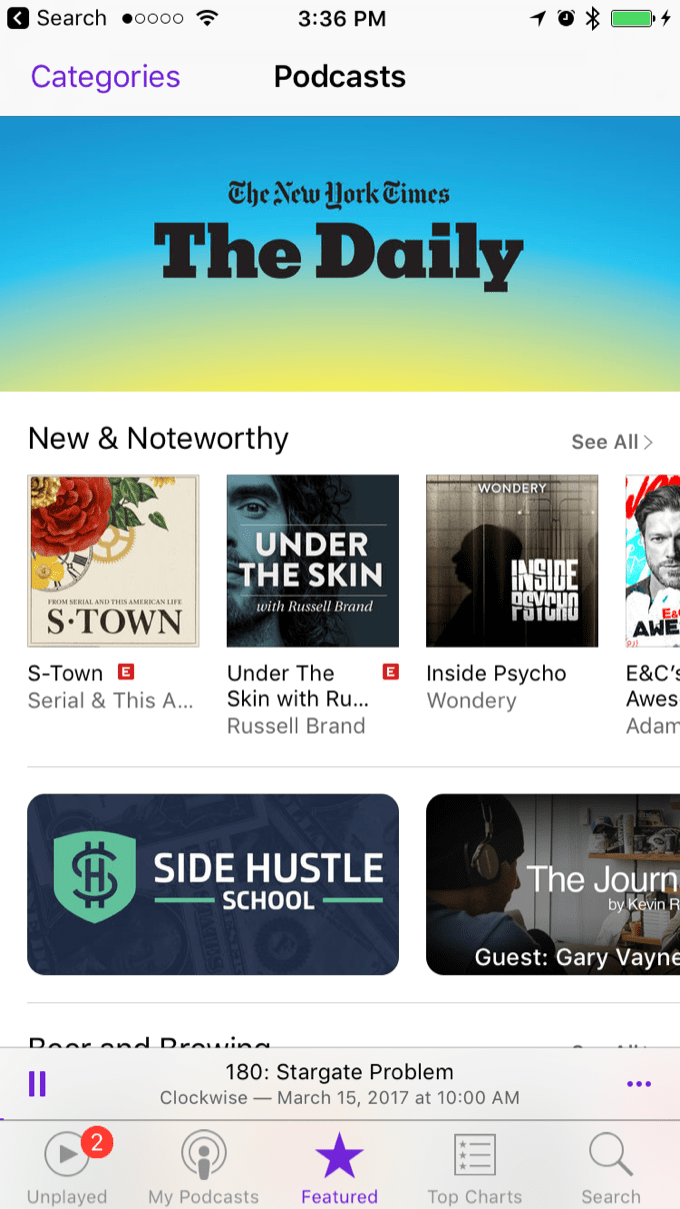
Apple’s podcast directory in the Podcasts app.
A decade of podcast curation
Apple holds such a prominent place in podcasting because, very early on, it embraced the medium as a way to improve what was available for the iPod. In June 2005—at the very predecessor to the Code Media conference, All Things D—Steve Jobs demonstrated podcast integration with iTunes, as a part of iTunes 4.9. Now you could subscribe to a podcast in iTunes and sync episodes directly to your iPod—a process that seems barbaric today, but was a delightful innovation 12 years ago.
Key to Apple’s strategy was its creation of a large and relatively open directory of podcasts. Three years before the App Store, Apple repurposed the iTunes store infrastructure to build a global podcast directory. Anyone could submit their podcasts to Apple’s directory and, once approved, those podcasts would remain in the directory more or less forever. And it’s been pretty much this way ever since. At some point Apple provided podcasters with some back-end tools to make publishing and promoting their podcasts in the directory a bit more hands-on; it was a scattershot process, but in recent years it’s rolled those tools out to a much broader audience of publishers.
Other than adding some podcasting-related features to GarageBand (which it stripped out of a later version), Apple hasn’t been particularly active in the realm of podcasting. There’s a small iTunes team that promotes podcasts in the iTunes interface, and those promotions can be very helpful in acquiring new listeners. Apple’s release of an iOS app for listening to podcasts, and its bundling of that app with releases of iOS, was a huge step forward in both the visibility of the format and the curation being done in iTunes.
After 12 years, Apple’s directory is the definitive directory of podcasts. You don’t have to be in iTunes to be a podcast, but most podcasts are in iTunes. Other directories exist, but iTunes is the big fish. Google’s trying to build one, sort of, with Google Play Music—but Apple has a decade head start. Even third-party podcasting apps tend to use Apple’s directory data, either as their entire directory or as a verification tool for their own homebuilt podcast databases.
Apple looms large in the world of podcasting, but in all this time, it hasn’t really changed its basic approach from what it was in 2005: A simple, open directory of podcast submissions with a set of curated pages to help people find new podcasts to listen to.
When Eddy Cue says Apple is “working on new features for podcasts,” he might not be indicating a change from Apple at all. He could simply mean that there are some new features coming to the Podcasts app that will make it better. But I suspect that Apple’s planning on some larger moves, given the increased popularity of podcasting and the leverage Apple has built up over a decade.
So, shifting into pure speculation mode, here are some things that Cue could be talking about when he promises new features for podcasts:
What Apple won’t do: Provide a lot of user data
This is, I suspect, what every podcasting startup wants. Unlike the web, where user behavior can be closely measured and quantified, podcasting is a bit of a mystery. In general, we know that you downloaded a file—and that’s it. To know more, you need to be inside of the apps that people use to listen to podcasts.
Apple’s Podcasts app might be the most popular single piece of podcast-listening software out there today; if Apple were to measure how its users listen to podcasts and then shared that data with the publishers of podcasts, it could be revolutionary to our understanding of how podcasts work. Podcasters (and podcast advertisers) could know how many downloads lead to plays, how deep most listeners get into any given episode, and whether people listen to or skip the ads. It would be a flood of data, and most modern digital publishers say they love data.
Consider me skeptical. While I’m frustrated by the lack of detail and consistency about podcast listenership—I’ve got a podcast that regularly hits 30,000 downloads by one measurement and 20,000 by a different one—I’ve see what the flood of user data has done to the world of web publishing. Most web data is used to justify reducing ad rates and increasing the invasiveness of advertising.
Besides, if an advertiser is happy with the result it receives on a podcast that claims 20,000 listeners, doesn’t that mean the advertiser is paying the right price? If it turned out that same podcast only had 10,000 listeners for a regular episode, it wouldn’t change the result. In fact, you could argue it shows that podcasts are that much more effective at connecting with an audience. But someone else might use that data to argue for a 50 percent rate cut for the podcast instead. More data doesn’t generally improve the quality or price of advertising.
I’m also dubious about what anyone would do with that level of data. For more than a decade I’ve been flooded with page-view data, and I have ignored most of it and focused on using my judgment to make good stuff. In aggregate, it could be useful to find out when people tune out podcasts, whether certain podcast topics or lengths are more or less successful, and what makes podcast advertising successful versus unsuccessful. But the day to day drone of stats? On the web, you just let it fade into the background, because there’s too much data and a lot of it is conflicting.
I doubt Apple will do anything that increases individual surveillance on the habits of its users, and then shares that with third parties, because that’s not what Apple does. While this is the progress that many commercial podcasters say they want, I don’t think it’s likely to happen.
What Apple might do: Support paid podcast subscriptions
There is a technical barrier to making money from podcasts: They have to be free. The podcast and RSS format make it essentially impossible to charge for podcasts and protect them with passwords, as you can to subscription websites. You can make your podcast feeds secure-ish via obscurity, but a dedicated person can find their way to the crown jewels. Right now if a podcaster wants to wall off content—whether it’s new podcasts, back episodes, or everything—the only real choice is to use a separate app. I listen to “Presidents are People Too” in the Audible app, and “Offices and Bosses” in the Stitcher Premium app for these reasons.
But I know a company with a whole lot of credit-card numbers and a great facility at taking payments on the internet, including subscription payments. Apple could potentially build a paid podcast subscription system, using Apple’s payment infrastructure and its podcast-playing apps, and open it to all podcast publishers. Listeners would still need to download a specific app—Apple’s app—but they could mix the free podcasts in Apple’s catalog with the ones they’re paying for.
This one feels a whole lot more likely to me. Yes, it means that Apple’s podcast directory would shift from its current emphasis on the open standards of RSS to a hybrid model that also features limited-access content. But if Apple wanted to encourage the commercial growth of the podcast world, it would be entirely within its powers to make it happen.
Of course, for an approach like this to work, Apple might need to expand its podcast-playing empire a little bit, which takes us to…
What Apple might do: Expand across platforms
For Apple to get podcast publishers on board with paid podcast subscriptions, it’s going to need to answer the questions about users on non-Apple platforms, most notably Android. The answer here is for Apple to create a version of the Podcasts app for Android, and it wouldn’t surprise me if it did. There’s already Apple Music on Android—why not Podcasts, too? Google Play Music’s support for podcasts is weird, and while there are a few good Android-based podcast players out there—Pocket Casts comes to mind—combining standard podcast functionality with the ability to get access to new, subscriber-only podcasts could be a winner.
iTunes for Windows already exists, but it would be great if Apple created a standalone Podcast app for Mac and Windows alike. Failing that, how about a Podcasts web app that syncs subscription status with mobile players? It works pretty well in Overcast today, and Apple’s upped its iCloud game lately. It could happen.
What Apple will probably do: Keep iterating on app and curation
Beyond offering subscriptions, the Podcast app could get better, with better speed adjustment settings and automatic silence removal. It’s a pretty solid basic player today, but there’s always room for improvement. Maybe it’s time to add chapter support?
There’s never going to be an ultimate solution to the problem of giving people good suggestions about what kinds of podcasts they might like, but I expect that Apple will always keep pushing in this direction, both with curated features like the ones currently in the Podcasts section in iTunes, and algorithmic lists tailored to individual listeners. Maybe there’s some intelligence to be gleaned from Apple Music’s equivalents to these features.
If I had to place a bet on a major change in Apple’s approach to podcasting, I’d place it on adding money to the equation. It’s an area Apple knows well, and it’s already got many of the pieces in place to quickly bring on publishers and create its own library of premium, subscription-only audio programs. All while taking its traditional 30 percent cut, of course, at least for the first year. And if it does that, I’d be surprised it it didn’t offer a version of its Podcasts app on Android, too, just to make publishers confident that they’ve got all their bases covered.
It would be the first major change in how Apple has approached podcasting in the 12 years of the iTunes podcast directory. But after 12 years of inaction, maybe Apple finally feels it’s time for podcasting to become more than just a hobby.
Note: This story has not been updated for several years.
The other day, a friend was asking me about compressing PDFs without losing too much quality–in particular about a custom Quartz filter in Preview, which we’ve used over the years for that purpose. It’s based on this Macworld tip by Kirk McElhearn from 2012, and involves copying and altering the existing “Reduce File Size” Quartz filter to provide a better balance between compression and quality.
While most of that tip still works as described, there’s a bit of a wrinkle when it comes to macOS Sierra. The original tip specifies dropping the new file in /System/Library/Filters, but in Sierra, that folder is off-limits–even to administrators.1 You simply can’t drop a file in there.
That’s okay! Because there are actually three Library folders in a macOS installation2, and often if you can’t use one of them, another will do. In this case, the solution was to create a Filters directory in /Library (that’s the one at the root of your Mac) and put the file in there. Sure enough, the next time I went to export a file from Preview, my “Reduce File Size – Better” option appeared in the Quartz Filter dropdown.
(One puzzle I couldn’t solve, however, was that the PDF he was trying to compress actually ended up larger after running it through the filter. I double-checked myself and got the same result, even though the resolution did not appear to have changed. Bit of a head-scratcher there, though I expect it has something to do with the original already being optimally compressed by the program that created it.)
Even resorting to sudo in command-line didn’t help me out. ↩
As of Sierra, my rubric for these is: ~/Library: Sure, whatever you want to put in here!; /Library/Filters: Okay, but this applies to every user on this machine.; /System/Library: As if it were a swarm of bees, you should stay away from this folder. ↩
[Dan Moren is the East Coast Bureau Chief of Six Colors, as well as an author, podcaster, and two-time Jeopardy! champion. You can find him on Mastodon at @dmoren@zeppelin.flights or reach him by email at dan@sixcolors.com. His next novel, the sci-fi adventure Eternity's Tomb, will be released in November 2026.]
At SXSW, Sam Machkovech at Ars Technica got to play some of the board games CIA uses for training:
Another Clopper game game, Collection Deck, focuses less on collaborative work and more on the sheer act of collecting intel. It also differentiates between “things that are secret and not secret.” This collectible card game plays like Magic: The Gathering, Clopper says. Multiple players work to resolve intelligence problems (represented by cards laid on the table) while dealing with out-of-nowhere issues (represented by “reality check” cards that players can use against each other).
“You try to use a card representing an overhead satellite–you want to use that to take a picture,” Clopper says. “Another player throws down a ‘ground station failure’ card. Now you can’t use that one.”
Board games as team-building and educational tools are nothing new–and video games have been used as training tools for the military for years–but it’s fascinating to see that CIA has created its own games to specifically deal with the kind of challenges it faces. I doubt we’ll be putting these on our list of favorite board games any time soon.
Note: This story has not been updated for several years.
A few months back, I picked up the Philips Hue motion sensor, thinking it would be a nice addition to my smart home setup. But despite my favorable impressions of the hardware, I was ultimately disappointed that the software didn’t let me accomplish what I wanted: namely, using it as a light-based switch for my office.
Fortunately, that wasn’t the end of the story. A few weeks back I came across Philips’s Hue Labs site, which offers additional functionality for Hue devices–think of it as a “not quite ready for primetime” showcase. Among the options was a “Sunlight as a switch” formula that does exactly what I was shooting for: use the motion sensor’s ability to measure ambient light as a switch for turning lights on and off.
Setting it up was pretty easy: to use any of the Hue labs formulas with your setup, you need to connect it to your Philips Hue Hub by clicking the Connect button in the top right of the webpage and then pressing the link button on the top of the Hub. Then you can install the formulas by going in, tweaking their settings, and clicking Install.
The sunlight switch formula offers a few configuration options, including which sensor to use (if you have more than one), which lights to activate and with what scene, and a slider that lets you choose how much daylight should trigger the action. There’s also a way to set hours during which the formula should be active (so you don’t have your lights on all night, for example).
While the formula was mostly easy to configure, finding the right setting the daylight sensitivity slider took some work (even now I’m not sure I have it set up optimally). The Hue labs provides descriptions of the light level you choose (“‘Cosy’ living room”, for example, or “Dimmed light”), and there’s a line that says “This formula should be active”, though I could never quite determine whether that was based simply on the active hours setting or the actual current amount of light detected in the room.1
Overall, once I got the configuration ironed out, it’s worked pretty well, though there are always going to be some rough edges. Today, for example, as snow is falling here in New England, the ambient light appears to be right on the cusp of the sensitivity level I set, which means my light has gone on and off a few times.
I’d love to see a more sophisticated option that would let it maintain a constant level of light, dimming as ambient light gets brighter rather than just shutting off, but perhaps that’s too complicated. Overall, though, this has encouraged me to check out some of Hue Labs’s other offerings, including a fade-in wake up, a sunset timer, and the ability to make it look like you’re home even when you’re not. There’s a bunch more there, too, so if you’re looking for ways to take more advantage of your Hue light set up, definitely check it out.
If it isn’t the latter, that would definitely be a useful addition for testing. ↩
[Dan Moren is the East Coast Bureau Chief of Six Colors, as well as an author, podcaster, and two-time Jeopardy! champion. You can find him on Mastodon at @dmoren@zeppelin.flights or reach him by email at dan@sixcolors.com. His next novel, the sci-fi adventure Eternity's Tomb, will be released in November 2026.]
This decision marks the conclusion of what I feel has been a matter of conscience for me over time. Privacy is sacred; our digital lives can reveal so much about us – our interests, our deepest thoughts, and even who we love. I am thrilled to be working with such an exceptional group of people who share a passion to protect that.
So even if you don’t know who Zdziarski is, know this: Apple hiring him makes all of Apple’s stuff that much more secure. And that’s good for all of us.
Tom spotted Crazy Apple Rumors and asked if it was the work of me and Philip Michaels because he thought it sounded like us. A flattering thought, but it wasn’t us. It turns out there was this guy Moltz who wrote a lot of funny stuff, and so we started paying for him to write funny stuff and analytical stuff and other stuff for us at Macworld. And that eventually allowed John to quit his job “toiling away in the SQL mines.”