Six Colors
Six Colors

Apple, technology, and other stuff

This Week's Sponsor

ZenStand: Walnut MagSafe Charger with Award-Winning Design

By John Moltz

This Week in Apple: Delayed gratification

The Air might be getting bigger up here, this Mastodon deal keeps getting better and better, and the Apple headset get kicked down the road (disclaimer: kicking an Apple headset down the road will void your warranty).

Serious Air time

How big can a MacBook Air get before it’s no longer able to achieve lift? Asking for a rumored 15-inch Air, possibly coming as soon as April.

15-Inch MacBook Air Rumored to Launch in April as Display Production Begins

15-Inch MacBook Air Will Reportedly Have M2 Chip

Speaking personally, I’m happy with my 13-inch Air and, if anything, a return of an 11-inch Air would be more likely to tempt me. Still, this is a smart move by Apple. Plenty of non-pro users want more screen real estate.

It you’re a fan of smaller laptops, however, you can hang your hat on still other rumors that have the company returning to the 12-inch form factor.

“Apple May Still Be Planning to Reintroduce 12-Inch MacBook”

I wouldn’t use a hat you particularly like all that much, though.

In 2022, Apple analyst Ming-Chi Kuo said that he hadn’t heard of any plans for a new 12-inch MacBook model. Display analyst Ross Young similarly expressed “skepticism” about Apple launching new MacBooks with display sizes below 13-inches.

Presumably such a device would be another one-port wonder like the previous 12-inch MacBook (although probably with a MagSafe port) but such a device has more the… air… of Jony Ive than today’s Apple.

From Musk to dawn

Let us rejoice, for Tapbots has released a beta for Ivory for the Mac, rounding out the Mastodon user experience on Apple platforms for those lucky enough to click the TestFlight link fast enough.

Further, when the beta for iOS 16.4 was released, Mastodon aficionados were treated to another pleasant surprise: Apple has added rich content previews for Mastodon posts to the upcoming operating system release. So, pretty soon Mastodon will be a full-fledged replacement for whatever the name of that social media site we used to use was.

Look at our little pachyderm! All grown up!

OH, MY GOD, RUN! IT’S STAMPEDING!

Meanwhile, on that other site, sentient mid-life crisis Elon Musk has had quite the week. First he fired an engineer for the high crime and misdemeanor of informing him that his reach on the site he spent $44 billion to buy is dropping. Not to worry, Muskstanistas, your very stable genius reacted quickly by ordering changes to the algorithm so his tweets will now get shoved into peoples’ timelines like ground organ meats into a sausage casing.

Problem fixed.

Things are going equally well for the dullest edgelord in the drawer at his other company as Tesla has fired dozens of workers in retaliation for trying to unionize. Free speech is super cool when it’s about harassing people and stuff but not when it’s about collective bargaining. Important distinction. Also great news for Musk is that the company has had to issue a recall for hundreds of thousands of vehicles because… let me just pretend to put on my reading glasses here… they might kill a whole bunch of people.

“Tesla recalls 362,758 vehicles, says Full Self-Driving Beta software may cause crashes”

“May cause crashes” is not a great side-effect to have to list at the end of a car commercial. Ideally you wouldn’t be listing any side effects because it’s a car commercial.

It might be slightly less bad if Musk hadn’t claimed for years that fully autonomous driving that would be safer than humans was just around the corner. A corner his company’s cars apparently couldn’t navigate, causing them to crash through a guardrail and explode dramatically over Reality Gulch. Earlier this year, the SEC decided to investigate these claims, so this hasn’t been a great start to 2023 for Musk.

Headset headwinds

As a long time follower of Apple rumors, this is one of my favorite tropes: that thing that Apple hasn’t even announced yet is “delayed”.

“Apple Delays Debut of AR/VR Headset Until June”

Based on a report by Mark Gurman, the device has experienced another “setback”, which is probably just as well because I only got about $1.24 out of the couch cushions and $100 for my paper route, leaving me a little shy of the $3,000 it’s supposed to cost.

It’s still mind-bending to try to imagine the kind of causality loop that results from delaying something that doesn’t have a release date yet. Likewise I must sadly announce the delay of me winning the Lotto. I had expected it to be this week but there was an unfortunate setback.

I didn’t win.

That was the setback.

Are there internal dates that Apple has to get these things out? Sure. But the reason it doesn’t announce them to the world and say “The Apple Car will be available on March 1st, 2025! Put it on your calendar!” is because stuff happens. Anyone’s who’s worked in project management knows there’s a reason OmniPlan and MS Project exist, and that’s to help you manage changes in deadlines.

But take it from applecarfan69 on Reddit, the Apple Car is totally coming on March 1st, 2025.

Unless it gets delayed.

[John Moltz is a Six Colors contributor. You can find him on Mastodon at Mastodon.social/@moltz and he sells items with references you might get on Cotton Bureau.]


Packing for vacation, Mac Pro, beta updates

Jason’s counting out socks and packing his bags. Dan’s planning on keeping the lights on. Also we discuss the Mac Pro and HomePod a bit more, and Apple released some beta updates with interesting small new features.


Windows on ARM comes to the Mac… officially

Microsoft Edge for Windows running in Coherence mode on my Mac Studio.

Parallels announced on Thursday that Microsoft has officially authorized running Windows 11 Pro for ARM processors on M1 and M2 Macs via the Parallels Desktop app for Mac.

Previously, users of Parallels Desktop and VMWare Fusion have found success virtualizing Windows for ARM by downloading and installing prerelease versions, but it was never approved by Microsoft and only unofficially supported by the makes of those VM apps.

But as of now, it’s all on the up-and-up. Earlier today I downloaded the Parallels Desktop installer, used the app to install Windows 11 Pro directly from Microsoft, bought and entered a Windows product key, and I was off and running.

While Windows itself runs at near-native speeds on M1 and M2, if you want to run Intel binaries on Windows, they’ll run using Microsoft’s code-translation layer—the Windows equivalent of Rosetta—and things will slow down.

Whether Apple and Microsoft will ever make the effort to bring Boot Camp to Apple silicon remains to be seen, but at least running Windows on M1 and M2 Macs is now not just a sneaky workaround but an entirely legal and supported option for Mac users who need to run Windows 11 Pro on Apple silicon.


New Apple betas bring new emojis

new Apple emojis
Five of the new Apple emojis.

Keith Broni at the Emojipedia blog:

New emoji designs have arrived on iOS as part of the first iOS 16.4 beta, including the shaking face, two pushing hands, and the much-requested plain pink heart emoji.

The two pushing hands enable digital high-fiving, and there’s also a Wi-Fi symbol at last. New animals include donkey, moose, goose, and jellyfish. And for those of us who love ginger, there’s good news—the ginger emoji has also finally made it!

The final Apple OS releases are probably a month or two away, but when they arrive, the new emoji will come along for the ride.


How we’d add AI technology to our tasks, our non-starter factors for buying an electric car, the device screen sizes we think Apple should consider, and how we’re using climate data to automate our smart homes.


By Jason Snell for Macworld

Is Apple making a Mac Pro nobody wants?

It’s been a rough decade for the Mac Pro. In 2013, Apple released a weird cylindrical model that didn’t meet the needs of most of Apple’s pro customers and wasn’t really upgradeable. In 2017, Apple called a bunch of tech journalists into a room and reaffirmed their commitment to the Mac, promising a new Mac Pro. That Mac Pro shipped in 2019… right before Apple made the announcement that it was shifting the Mac off of Intel and onto its own processors.

Just short of the tenth anniversary of that first Mac Pro misstep, Apple is now late in concluding its processor transition by shipping the first Apple silicon-based Mac Pro. What’s worse, reports from Bloomberg suggest that the company has ditched the next Mac Pro’s highest-end processor, calling the computer’s entire purpose into question.

Is Apple rethinking its commitment to the Mac Pro? And, given the many powerful characteristics of Apple Silicon Macs, should it?

Continue reading on Macworld ↦


Jason has released the 2022 Apple Report Card, and now it’s time for him and Myke to once again share their grades for Apple for the year gone by. Also, Tim and Eddy go to the Super Bowl, and Apple gets a new Chief People Officer.


By Jason Snell

HomePod (second generation) review: More of the same

Note: This story has not been updated since 2023.

HomePod 2

The new, second-generation HomePod is a funny product. So many of us assumed that the original model was discontinued because it was a sales flop, but here it is: reincarnated, and not as some sort of Hollywood-style reboot, but more like a faithful remake of the original, right down to the $299 price tag1.

I guess it wasn’t such a flop after all, since Apple brought it back. The new HomePod is not quite the same as the original model, but it’s similar in bad as well as good ways. It’s better in a few small areas, but is this progress? More than anything, it seems to call Apple’s lack of progress in the smart home category over the intervening five years into sharp relief.

Let’s start with what forward progress there is: The new HomePod’s basically picked up a bunch of technology from the HomePod mini. Like the mini, its brain is an Apple Watch chip, though a slightly newer model. It’s been outfitted with a Thread radio and can act as a home hub, which will be great when the Matter smart home standard finally materializes. And it’s got temperature and humidity sensors, which show up in the Home app and could theoretically be used by intelligent automations in your house. Theoretically.

Now for what hasn’t changed much. The new HomePod has two fewer tweeters than its predecessor, but the truth is that the two speakers sound remarkably similar. No, they’re not the same—the new HomePod offers more clarity in the mid-range (most notably, it feels like vocals were generally clearer on the new HomePod) but doesn’t quite offer the same oomph when it comes to big bass. (Given that the original HomePods were so bass-heavy that Apple had to add a “reduce bass” preference, it’s not that big a deal, but it is noticeable at loud volumes.)

But if I had to boil it down, I’d say that both the new and old HomePods sound really good. If a (bizarrely generous) burglar broke into the house of someone who had old HomePods and swapped them out for new models, they probably wouldn’t notice. (There are slight physical differences—a slightly recessed top panel and detachable power cable, most notably—but only someone with Sherlockian powers of observation would notice at a glance.)

I also compared the HomePods (old and new) to the $99 HomePod mini and the $199 Sonos One. Sorry to be boring, but at least among these products, you get what you pay for. The HomePod mini is half the price of the Sonos One but doesn’t sound as good. The Sonos One is much larger than the mini—it’s roughly the size of the HomePod—and while it definitely outpaces the mini, it is definitely inferior to both old and new HomePods.

Now double the prices in order to get a stereo pair of these speakers. Your choices are now $200 for HomePod minis, $400 for Sonos Ones, or $600 for HomePods. The HomePods sound remarkably good for the compact space, and they look good on a shelf or countertop, but they sure aren’t cheap. (I’ve used a pair of Sonos Ones in my office for the last few years and feel like I found a decent balance between quality and price.)

My biggest disappointment with the new HomePod is that it’s too much like its predecessor. The touch-sensitive top panel is easy to brush accidentally and can’t be seen easily if the speaker is placed up high—which I suppose is okay since the little light show it plays when it’s listening to a Siri command or playing music is completely pointless. Worse, the volume up/down controls (which were already hard to see on the original model since they didn’t light up until you touched the surface) now don’t light up at all, making changing the volume via touch a frustrating guessing game at times. Apple would’ve been better off dumping the “screen” and just putting a few physical buttons up top.

And then there’s Siri and AirPlay, which should be the highlights of all of these products—and instead are their greatest liability. When the wind is blowing right, and the moon is in the right part of the sky, Siri can be solid, responding to your questions quickly and playing music with ease. When it falls over, it’s incredibly frustrating, and it still falls over far more often than it should.

As for AirPlay, like Siri, it’s great when it works, but it doesn’t work reliably enough. In testing for this article, I AirPlayed from a Mac, an iPhone, and an iPad to all four speaker pairs at various times. AirPlay failed far too often, especially if I tried to play from more than one speaker at a time. Several times I ended up in a situation where only one speaker in the pair would play or only one speaker would respond to commands.

To be fair, this isn’t just about AirPlay—it’s also about the fundamental instability of the HomePod stereo pair. I also encountered multiple situations where one HomePod would simply stop playing audio, even though it was listening for audio commands, and I could pause or change the volume on its opposite pair from its controls. So strange. But then, the first-generation HomePods in my living room also sometimes go off on their own. It’s a thing HomePod stereo pairs do.

My point is that the new HomePod doesn’t appear to address any of the underlying stability issues with the original model, and both Siri and AirPlay are frustratingly inconsistent. At $299, this is a premium audio product that can live up to that price when it’s working flawlessly—but the bugs and errors and quirks are so great that I can’t in good conscience recommend them to anyone who isn’t well-versed in troubleshooting misbehaving Apple technology.


  1. The original HomePod premiered at $349, but by the end of its life, it was re-priced at $299. 

By John Moltz

This Week in Apple: Pie in the Skynet

Apple looks to the future as two of its rivals make AI announcements, rumors swirl of an even more expensive iPhone, and the company would like some games for the Mac, please.

Bing, where can I dispose of a dead loveseat?

This was a big week for announcing your new AI strategy so if you didn’t have one ready to go, that’s on you.

Google announced that its AI service, Bard, is now in a private beta test and will be opened to the public “in the coming weeks”. No word on whether or not the number of those weeks is closer to 2 or 52, but if history is any guide, Google will lose interest in the project by about 260 weeks. In fact, it’s already having a bit of a rough start.

Meanwhile, Microsoft announced an AI-aided version of Bing, which the company says will let you ask real questions from how to attend your first EDM festival to whether or not a loveseat will fit in your 2019 Honda Odyssey. This is helpful because there is a direct path between EDM fandom and owning a minivan and I don’t think we talk about that enough.

These announcements leave many people wondering where Apple is in this space. Apple’s not really in the search business so it doesn’t seem like it really has to ship an AI chatbot, but if this technology can be used to make Siri better, that’d probably be a good thing. Anything that would make Siri better would be a good thing. The company is holding an AI summit for employees next week, so look for some leaks that will drive Tim Cook to fits of apoplexy.

While not a big fan of the technology in general, I have to admit that this use case, having a chatbot respond to spam texts for you, has me thinking maybe there is a good reason to have a system-wide chat AI on iOS.

The iPhone Thicc

Who’s looking forward to paying even more for an iPhone?! Many of you, apparently, because the iPhone 14 Pro line has largely sold better than the iPhone 14. Don’t think that Apple hasn’t noticed. If you keep buying the more expensive iPhones, you shouldn’t wonder why the price of iPhones keeps going up.

“They want expensive phones, eh? Then, by God, we will give them expensive phones! Ready for maximum chamfer!”

Now the company is reportedly considering:

…releasing a new top-of-the-line iPhone alongside future Pro and Pro Max models, tentatively referred to as “iPhone Ultra,”…

Mark Gurman indicates this high-end iPhone would be part of the iPhone 16 lineup in 2024, if it becomes a reality. Naturally, the device would come at a… well, what do call a price point that’s above the iPhone Pro Max’s already premium pricing? Premiumier? Premultimate?

A German designer has posted speculative renders of what the device might look like if it were based on the Apple Watch Ultra styling, resulting in an iPhone that looks thick enough to have great battery life—which is how we know for certain this is not a design that Apple will use.

Apple follows a strictly Buddhist approach to iPhone design, teaching the impermanence of battery life, suffering through repeated charging cycles, and non-self, when your iPhone goes dead and you may as well not exist anymore. Through this you will attain enlightenment.

Game on?

In an interview with TechCrunch’s Matthew Panzarino this week, Apple’s vice president of Platform Architecture and Hardware Technologies Tim Millet and VP of Worldwide Product Marketing Bob Borchers made the pitch for the Mac’s potential as a gaming machine.

Of course, you have to say “potential” because the Mac hasn’t been a serious contender in gaming since… let me just pretend to check the calendar here… forever.

Man, this calendar goes back really far. The Big Bang picture is cool.

Still, the company has high hopes for the future.

Millet has been building chips for 30 years and has been at Apple for nearly 17. He says that with M1, Apple saw an opportunity to “really hit it.”

Is Millet a Star Trek: Strange New Worlds fan? Does Craig Federighi’s hair make him wistfully think of Captain Pike? Sadly, Panzarino fails to ask these probing questions.

“Gamers are a serious bunch. And I don’t think we’re going to fool anybody by saying that overnight we’re going to make Mac a great gaming platform. We’re going to take a long view on this.”

That’s probably wise because, as Dan pointed out this week, Apple has a real chicken-and-egg problem—developers don’t make games for the Mac because there’s no audience, gamers don’t buy Macs because there are no games—that prevents this from getting solved in a fortnight. (Yes, the temptation to spell that differently was high, but I pushed through it.)

A lot of us would probably love it if the Mac had more games, but when the big Apple gaming news of the week is an iOS port of a 30-year-old game, you know the company’s got a long row to hoe.

Given the options of Apple building an AI system, shipping a more expensive iPhone, or making the Mac into a great gaming platform, I know which one I’d bet on. Start saving up for an iPhone Ultra.

[John Moltz is a Six Colors contributor. You can find him on Mastodon at Mastodon.social/@moltz and he sells items with references you might get on Cotton Bureau.]


Report Card, iPad frustration, and HomePod

Report card results make Jason sad about the iPad Pro. Dan’s home network is messed up. Jason tests HomePods and sees various colors of disaster.


Disney’s first financial results of the Iger II era make us consider the future of Hulu and ESPN. Discovery+ pulls a fast one, Showtime can’t dodge its fate, Peacock looks surprisingly robust, and Netflix’s password crackdown is stuff you already knew!


By Jason Snell

Fun With Charts: A 2022 Report Card breakdown

Note: This story has not been updated since 2023.

As I did last year, I turned to Six Colors member, Duke University professor, and data visualization expert Kieran Healy to take the initial Report Card scores and slice them in a few interesting ways.

First up is a chart that drills down into the vote distributions across all the categories, so you can see which categories gathered a variety of votes and which ones were a bit more consistent across all 55 voters.

Answer Distribution for Each Question

Continue reading “Fun With Charts: A 2022 Report Card breakdown”…


By Jason Snell

Automating podcast transcripts on my Mac with OpenAI Whisper

Note: This story has not been updated since 2023.

a demo podcast transcript
A little section of Upgrade 444 in David Smith’s original Podsearch engine.

A while ago, David Smith created a site called Podsearch, a search engine for a few of his favorite podcasts, including a couple of mine. That project went by the wayside after a while, and I found myself getting frustrated during episodes of Upgrade that I couldn’t refer people back to specific episodes where we had already discussed a topic.

About the same time, I began reading about OpenAI Whisper, an automatic speech recognition system that “approaches human level robustness and accuracy” for converting the spoken word into written text. Up until then, I’d been doing speech-to-text—most notably, for my transcripts of Apple results calls using various services (Trint, Rev) that charge by the minute.

Whisper’s free, and you can run it on your own computer. I thought that I might give Whisper a go in transcribing Upgrade—or at least recent episodes of Upgrade, maybe since episode 400—for my own reference.

I rapidly discovered that while the python implementation of Whisper would run on my Mac, it ran at about 0.5x speed—so a two-hour podcast would take four hours to transcribe. Not great. Still, the results were promising. Here’s the state of the art of podcast transcription circa 2017:

Alright we’re going to wrap it up that this ends this edition of our red chickens with Batman that are affiliated with like extension cords for Batman University I’d like to think my gas for being here and watching some Batman movies with me… and told her I think you were the king of the Wicker people. Goodnight everybody for listening to be uncomfortable I’ve been your Hostess and smell but really I Batman.

And here’s how Whisper fared:

All right, we’re gonna wrap it up. This ends this edition of our check-ins with Batman that are affiliated. It’s like extension course for Batman University. I’d like to thank my guests for being here and watching some Batman movies with me…. And Tony Sindelar, I think you were the king of the Wicker people. Goodbye nerds. And thanks everybody for listening to The Incomparable. I’ve been your host Jason Snell. But really, I’m Batman. Hmm.

While not perfect, Whisper was staggeringly better than the 2017 transcript and really, much better than any other AI-driven transcription I’d tried recently. It got the punctuation. It got proper names. And it didn’t turn “Thanks for listening to The Incomparable, I’ve been your host Jason Snell” into “Goodnight everybody for listening to be uncomfortable, I’ve been your Hostess and smell.”

Fortunately, a fellow named Georgi Gerganov made a C++-native port of Whisper that is easy to install and run on macOS and is optimized for Apple silicon. I downloaded and installed Gerganov’s version, downloaded the medium English model, and discovered that it could transcribe a podcast at rates up to 2x!

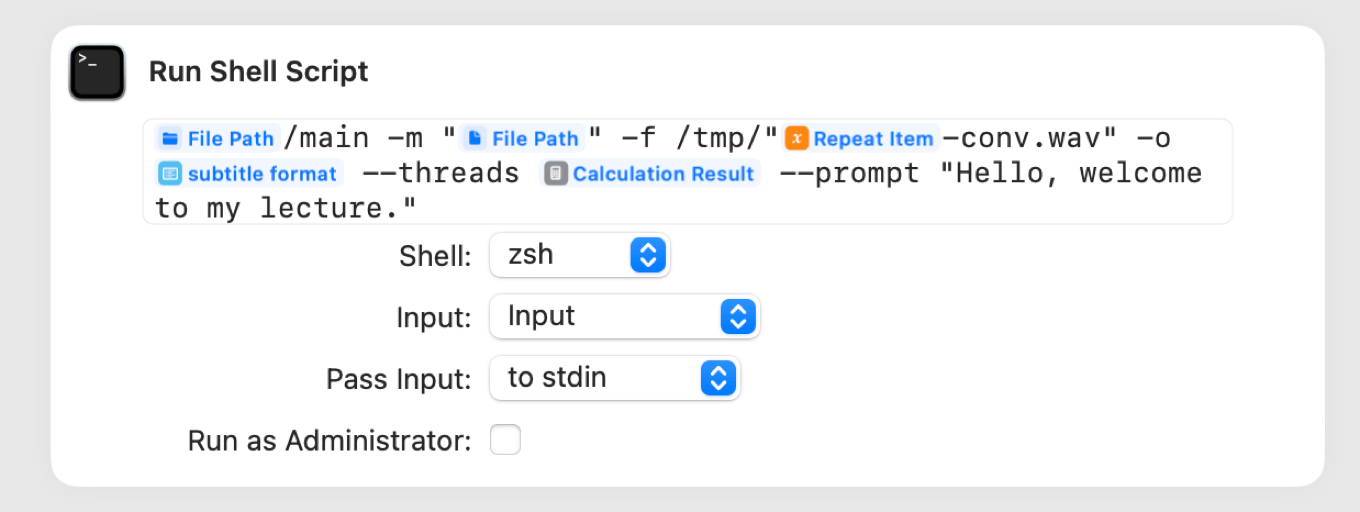
This was great, but the last thing I needed was to have to remember all the arcane command-line commands required to get the files in the right place. So instead, I wrote The Transcriptor, a Shortcut that lets me control-click on audio files and turn them into transcripts in a format of my choice. (I also pointed Whisper at an episode of Total Party Kill and it made a remarkably good subtitle track ready for uploading to YouTube.)

shortcut action block
Who needs to remember all this stuff?

Along the way I mentioned what I was doing to David Smith, who sent me his code for PodSearch so I could use it to generate my Upgrade archive. This apparently turned David on to Whisper and he’s since revived the site with Whisper-derived transcripts of seven podcasts, including Upgrade.

Then last week, Apple’s financial results came out. Rather than using Rev, which I had been using to generate and correct transcripts the past few years, I decide to use Whisper and The Transcriptor to do the job.

Other than a few hiccups involving using separate tools to record, transcribe, edit, and play back audio—I need to figure out a more complete workflow there—it worked spectacularly well. Over the years I’ve internalized all the Apple financial analyst call-specific phrases that the AI engine used by Rev would get wrong, which I’d need to correct. Almost all of them were rendered correctly by Whisper! I had to do less to get the transcript in good shape than I ever have before.

This is not to say that web apps like Rev aren’t always seeking better speech-to-text systems, and might even adopt Whisper themselves. And those services add other nice features—like the integration of audio playback and text editing—that definitely make editing a transcript easier than what I did. (I was editing in BBEdit and clicking into Overcast—playing back uploaded MP3 files at 1.5x speeds—when I needed to pause or back up.)

Still… this is amazing. If I have learned anything from this journey, it’s that the ability to generate high-quality, readable transcripts from podcast audio is going to be here soon. It’s not quite here yet—Whisper has quirks that make it better for searchable transcripts than actual reading, and it doesn’t identify speakers—but it’s perilously close now.

While reading a podcast transcript will never be the same as listening to the podcast, providing usable transcripts will make podcast content more accessible, searchable, and able to be referenced. It’s all just around the corner now.


Our experiences with modern day Internet search, what we’re doing with AI tools, actors and AI voice generation, and our favorite Black technologists.


By Shelly Brisbin

Checking in on the accessibility of the Dynamic Island

The dynamic island selected by VoiceOver
With the Dynamic Island expanded as a song plays, you can select the scrubber with VoiceOver, and flick up or down to move through the track.

Every hardware innovation from Apple brings some version of this question to my mind: “Yeah, but how does it work with VoiceOver?” Or any other relevant accessibility tool, for that matter. Before I got my hands on them, I asked this question about Apple Watch, Apple TV, and even the MacBook Pro’s touch bar. And as part of my ongoing adventure in documenting everything the iOS platform offers for accessibility, I needed to pay a visit to the iPhone Pro’s Dynamic Island.

The island is an interface that also hides Face ID and the front-facing camera. You’re meant to interact with the pill-shaped space visually, glancing at it to unlock the phone, or to gather tiny bits of information about what’s going on in a supported app.

phone info in Dynamic Island
During a phone call, the Dynamic Island shows its duration. The heavy border indicates the island is selected by VoiceOver.

Now, being visual doesn’t make an iOS feature inaccessible. Far from it. But it raises questions for the accessibility nerd about how information will be delivered to to a non-visual user, and what gestures are needed to get and control it. Most times, it’s extremely straightforward — notifications can be read by the VoiceOver screen reader, and they can be interpreted by other accessibility tools, too. You can have VoiceOver speak the notifications if you want. (I do not want, by the way.)

But my curiosity about the Dynamic Island centered on the seemingly incidental nature of the data offered – the status of a phone call, duration of a timer, or what song Music is playing. It’s not necessarily a notification, meant to capture your attention. And even if Dynamic Island could give up its secrets to VoiceOver, would the user get anything from it they couldn’t find elsewhere? Can a VoiceOver user save taps and swipes with Dynamic Island the way a non-VoiceOver user can? Is Dynamic Island a selling point for the Pro phones if you’re blind?

Is it, or isn’t it?

First of all, the Dynamic Island is accessible. If an app puts content there, VoiceOver will be able to read/speak it. The screen reader does not announce that there’s currently information on the Dynamic Island, a la notifications. But you can flick through the status bar or explore by touch – essentially, drag your finger in the general vicinity of the island until you hear its contents spoken. When you encounter Dynamic Island with VoiceOver on, it’s selected, just like any other screen element. That means you can double-tap (the VoiceOver equivalent of a single-tap) to open the current host app, or use a double-tap-and-hold or a rotor action to expand the island’s display. Either is the equivalent of a standard long press. The rotor also includes Activate and Dismiss actions, to open the app or empty the island’s contents.

Expanding the Dynamic Island gives VoiceOver access to whatever control the current app provides. Adjust volume in Music, mute your mic during a phone call, switch to the Remote app while AirPlaying to an Apple TV. Just as in any app, the controls are accessible to VoiceOver with a double-tap, and you can collapse the display again by double-tapping outside it.

Flexible little pill

Dynamic Island showing a timer and music.
A timer is active as a song plays. The timer is selected with VoiceOver.

I set a lot of timers: sometimes it’s my sandwich in the toaster oven. Or maybe I’m reading a script aloud and need to know how long it took. An active timer’s countdown appears in the island. Just pass your finger over the pill to have VoiceOver read the display.

If something else, like Music, is already displaying data there, a timer button appears in a space of its own, to the right of the main Dynamic Island. Visually, the timer button updates with a visual representation of how much time remains. To access the countdown with VoiceOver, you’ll need to expand the timer. It would be great to have VoiceOver read time remaining when I flick to the unexpanded timer button.

Audio selected in the Dynamic Island
As an audio file plays, album artwork, if available, and a waveform are visible. This one is selected by VoiceOver, which reads the track’s name and artist aloud.

There’s one way in which the Dynamic Island experience with VoiceOver is superior: If you’re listening to audio, whether from Music, Spotify, Overcasts, Audible, or another supported app, swiping into the island causes VoiceOver to read the track and artist. Visually, there’s only a tiny album art thumbnail at one end, and a pulsing waveform indicator on the right, that tells you something’s playing.

Island on the go

Maps has a few Dynamic Island tricks. Just as the app will display a card if you’re not in the Maps app as you navigate, Dynamic Island delivers tiny status updates instead, including arrows indicating turn direction and distance. VoiceOver speaks these, just as it does when cards appear onscreen. If you expand the island’s contents, you can even end a route immediately. This is a real time-saver over returning to Maps, pulling up the card and choosing the End Route command.

More and more third-party apps offer Dynamic Island support. For a busy traveler using VoiceOver, FlightAware’s updates save both time and lots of flicks and taps. If I were a baseball fan, I’d want my scores flashed atop my phone screen, once again saving me the trouble of digging into the app that provides them.

Though Dynamic Island might not be enough of a justification on its own for some people to splurge on an iPhone Pro, it’s not only well-implemented for VoiceOver, but occasionally provides info more quickly than a host app can.

[Shelly Brisbin is a radio producer and author of the book iOS Access for All. She's the host of Lions, Towers & Shields, a podcast about classic movies, on The Incomparable network.]


By Jason Snell for Macworld

Imagining Apple’s biggest potential threats

It’s the dead of winter, even in endless-summer California. Everything’s dormant. Gray. Cold and hazy. What better time to ponder the scary, the unthinkable—the existential threats to Apple.

Back in 1997, Apple was weeks or months away from bankruptcy, depending on who you ask. Of course, Steve Jobs came back and turned it around and instilled in the company a save-every-penny ethos that persists even as Apple has transformed into one of the most valuable and profitable companies in the world.

Given this mindset, it’s undoubtedly true that inside Apple, there are people thinking deep thoughts about the long-term future of Apple. With well over $100 billion in cash and enormous profits rolling in every quarter, Apple can afford to take the long view when it considers existential threats.

So why not perform that exercise ourselves? Apple’s riding high right now, but 25 years ago, it was at death’s door. Life comes at you fast. What could lay Apple low?

Continue reading on Macworld ↦


How you read Apple’s financial results really depends on what you want to see in them. We break down the numbers, ponder the state of Apple’s deisgn group, and reconsider what Apple may or may not be folding in the near future.


Search Six Colors