Six Colors
Six Colors

Apple, technology, and other stuff

This Week's Sponsor

ZenStand: Walnut MagSafe Charger with Award-Winning Design

By John Moltz

This Week in Apple: Cocaine Bear

This week we wonder what the Apple headset will look like, hope that Apple will improve the Apple Watch’s battery life, and sigh loudly again at Twitter.

Looks aren’t everything, but they’re something

Remember Google Glass? Sure you do. You laughed so hard milk came out your nose. And you weren’t even drinking milk at the time.

Which is how we found out you were a replicant. Different story, though.

The point is, it looked silly and everyone hated it because they didn’t want someone in their face recording literally everything. I don’t want to get into a discussion of the inevitability of the surveillance state in a weekly wrap-up column, so let’s focus on the looking silly part. Because if Xiaomi’s new prototype AR glasses are any indicator, that particular issue has still not been fixed. For some reason I am reminded of the unibrowed baby from The Simpsons.

Based on precedent, it is not unreasonable to expect the industry to quickly jettison their existing designs and immediately follow the cues of whatever Apple ships. There’s certainly a lot of movement in the space based on expectations of an Apple announcement in a few months. Meta is cutting prices on its existing lineup, which is already priced significantly below what Apple is expected to charge.

It’s possible a differentiating factor for Apple will be a newly patented handoff method that allows a user to transfer content and focus with facial expression and gestures. That sounds like it beats my usual shuffling of papers and confusedly using my Mac mini’s mouse for several seconds while wondering why the cursor on my MacBook isn’t moving.

The low power mode lifestyle

I scream, you scream, we all scream for more battery life.

I mean, I wouldn’t say no to ice cream, but… c’mon.

Is Apple finally taking the hint?

In an interview with India Today, Apple Vice President of Worldwide Product Marketing Bob Borchers discusses one of the places battery life is most acutely felt: on the Apple Watch.

Borchers says that the question of battery life on Apple Watch is a tricky one and the company is hoping to answer it in various ways.

Oh, good, now we’re going to get some solutions!

One of them is faster charging…

Customers: “The real problem with the Apple Watch is when I’m out wearing it and it dies.”

Apple: “Ah! Well, what if you could charge it faster?”

Customers: “That’s not… that… What?”

At the same time, the company also continues to explore how it can achieve the best way to balance features … and battery life.

Uh. OK.

“We were going to put lasers into the Apple Watch but they burned through the battery in 15 seconds so we didn’t do that.”

The message here seems to be less “We’re focusing on Apple Watch battery life!” and more “Apple Watch battery life continues to be a product in our lineup.” It’s always interesting that when you ask Apple customers what they want, more battery life is usually fairly high on the list. But the company usually only ships minimal battery upgrades that are measured in the “how long you can watch a movie” metric. Which, incidentally, is why every time there’s an iPhone event Martin Scorsese suddenly feels sad, though he does not know why.

Certainly the company has managed to greatly improve battery life on the Mac by switching to Apple silicon, but the iPhone and Apple Watch particularly continue to be just sort of fine. Looks like we can continue to expect more just fineness in the future.

If anything, it’s unfair to the bear

Twitter-related drama is the new normal, as the steady rain of nuclear fallout from Electric Bugaboo’s purchase of the platform continues to fall.

This week the makers of both Twitterrific and Tweetbot, most likely after hashing out options with Apple, shipped what are likely to be final updates to their apps. As Dan describes, the updates let users choose whether or not to get a prorated refund for the amount time the app(s) were no longer able to connect to Twitter or, in the case of Tweetbot, convert the subscription to a license to Ivory, Tapbots’s Mastodon client. If you do nothing, you’ll receive a refund.

There’s been some question as to why Apple is forcing these refunds when they have no material impact to the company’s bottom line but will have substantial impact to The Iconfactory and Tapbots. No one has really said so publicly, but it’s most likely because there are certain jurisdictions where if a service is no longer being provided, you legally have to give the option of receiving a refund.

Going to the trouble to choose not to get a refund might seem like a ridiculous exercise—an excessercize, if you will1—but I’d urge you to consider doing it.

I don’t know about your finances, but if someone said they were going to have to garnish my wages because a capricious billionaire decided to take away one of my revenue streams so he could trash a platform like a bear that has accidentally taken too much cocaine, that would cause me some financial distress. And anger, honestly.

If you think comparing one of our titans of industry to a hopped-up ursine is unfair, consider that Twitter outages are on the rise, Musk has backed a cartoonist who went on a racist rant, Twitter is being sued over unpaid bills, and misinformation is on the rise on the platform. And these are all just stories from the last week.

There has long been a concern about the race to the bottom created by the App Store in terms of pricing. If we’re legitimately concerned about the negative effect of downward price pressure, it’s pretty easy to argue that we were probably not paying enough for these apps in the first place.

In the end it comes down to who you think needs the money more. It really might be you. But if it’s not, consider taking a few seconds to help out some valuable members of the app community.


  1. I will not. —Ed. 

[John Moltz is a Six Colors contributor. You can find him on Mastodon at Mastodon.social/@moltz and he sells items with references you might get on Cotton Bureau.]


Passcode security, Twitter client refunds, and grain

Dan is joined by special guest Guy English to discuss iPhone passcode security, App Store refunds for third-party Twitter clients, and the rising costs of grain.


How we decide which companies get our data, how we manage our personal music collections, our thoughts on iPhone and Apple ID security, and the last time we felt like a clueless technophobe.


By Dan Moren

Tweetbot and Twitterrific updated with option to opt-out of subscription refund

Note: This story has not been updated since 2023.

When Twitter shut down third-party clients in January, it not only left out in the cold the users of those apps, but the developers too. Many of those apps were significant sources of revenue for the teams behind them, and that income was cut off capriciously, without any warning.

Subscription Refund

One additional complication is that some clients had shifted to a subscription-based system in recent years, with users paying by the month or the year. Since those subscriptions were generally prepaid, users ended up in a situation where they essentially no longer had access to the app they’d paid for.

Now two of the most popular iOS clients, Twitterrific and Tweetbot, have been updated to offer options to their former customers. By default, if you take no action, you’ll get a pro-rated refund for the amount of time left in your subscription at the point when Twitter cut off access.

While that’s well within your rights as a consumer, it’s also kind of awkward, given that the money comes out of the pockets of those independent app developers like Tapbots and The Iconfactory, who got just as much of the short end of the stick as their users—if not more so. So for both apps there’s also an option to opt out of the refund. (Though you remain eligible if you change your mind.)

In the case of Tapbots, which has recently launched the Mastodon client Ivory, there’s also an option to transfer your existing Tweetbot subscription to Ivory on a non-recurring basis.

Unfortunately, chances are the developers will still end up refunding the majority of subscriptions, if for no other reasons than most customers will probably not even know these options exist, given that they have probably not opened their now defunct third-party Twitter client since they stopped working. But if you’re a former customer who feels like they got their money’s worth over the time you used one of these app, you can at least help lighten the load on those developers as they move on to their next projects.

[Dan Moren is the East Coast Bureau Chief of Six Colors, as well as an author, podcaster, and two-time Jeopardy! champion. You can find him on Mastodon at @dmoren@zeppelin.flights or reach him by email at dan@sixcolors.com. His next novel, the sci-fi adventure Eternity's Tomb, will be released in November 2026.]


By Dan Moren

The Back Page: Inside Apple’s most secret secret research & development group

Apple is a notoriously secretive company. A company so secretive that, in the past, when information has leaked out, it has stridently told its employees that it’s doubling down on its already secret secrecy but secretly it’s quadrupled down on its secrecy. (You haven’t heard about that because, well, it’s secret.) Of course, two men can keep a secret if one of them is dead. And the other is Tim Cook, because he is very good at keeping secrets. And doing away with people who leak secrets. Secretly.

So, when a reporter gets ahold of a story about a secret Apple design group working on secret projects—and no, not that secret group or that secret group, yes literally, a more secretive third secret group—you can draw two important conclusions: first, that whoever disclosed said secret has already been entombed within Jony Ive’s featureless white cell to live out their days in perpetual oblivion. And second, that there is clearly an even more secretive group inside Apple working on secrets that you still haven’t heard of.

Which is how I can now exclusively confirm the existence of an ultra-secret Apple R&D group dubbed the Secret Exploratory Design Research Engineering Team, or SEDRET.1

If you thought that Apple’s AR headset, electric car, or blood glucose monitoring technology were the acme of the company’s secret projects, think again. SEDRET is involved in no less than three super secret projects in various stages of development, all of which have the potential to shake up the entire technology market—if not the world—as we know it. Let’s do a quick rundown.

  • Edible screens: Forget foldables. Forget rollables. Meet munchables. Thanks to advances in 3D printing and revolutionary display technology, these new screens put the “organic” in “Organic Light Emitting Diodes.” You can have a display of whatever size and shape you want just by nibbling away at the corners until you’re happy. Plus, with 19 essential vitamins and 8 grams of fiber, it’s part of a balanced breakfast.
  • Self-driving ebike: Electric cars may have the attention of the world at present, but electric bikes are far more practical. Only who wants to pedal? Or steer? Or avoid the odd squirrel darting across the road? The Apple Bike will take care of all most of that for you2, letting you spend that pesky commute time working on today’s Wordle, immersing yourself in the virtual reality of the Apple headset, or I guess talking to your kids or something. These are priced to be a steal at under $100,000.

  • Artificially intelligent virtual reality meetings: We all have way too many meetings, especially remote ones, and with the coming wave of augmented/virtual reality, that’s only about to increase. But Apple’s devised a clever workaround for the digital avatars we’re all sure to soon be sporting: artificial intelligence. Yes, you can get photorealistic digital representations of yourself to converse in the metaverse, but what if we took that a step further so you didn’t have to go to meetings at all? Leveraging Apple’s machine learning technology, AI voice synthesis, and the conversational skills of ChatGPT, you can skip out on those meetings and let virtual you handle them instead, totally seamlessly. Overbooked? No problem: digital avatar lets you attend up to three meetings at the same time.3 Just a caveat: There is a slight possibility that your digital avatar may tell your coworkers you love them and try to convince them to leave their partners for you. But what new technology doesn’t have some kinks to work out?

I’m told that this is just a sampling of the super secret projects that SEDRET is hard at work on, and while none are expected to ship in even the next ten to twenty years, Apple is clearly well poised for the next generation of technological evolution. Now, if you’ll excuse me, that’s the doorbell, and I just need to…Tim Cook?! What are you doing he——


  1. Of course you’d think the acronym would be SECRET, but that’s just what they’re expecting you to think! Okay, look, they’re engineers, not acronymologists. 
  2. Squirrel Avert is a beta feature currently available only in parts of California, Greenland, and the Canary Islands. 
  3. Due to technical limitations, however, in any additional meetings you will be rendered as an Animoji of your choice. 

[Dan Moren is the East Coast Bureau Chief of Six Colors, as well as an author, podcaster, and two-time Jeopardy! champion. You can find him on Mastodon at @dmoren@zeppelin.flights or reach him by email at dan@sixcolors.com. His next novel, the sci-fi adventure Eternity's Tomb, will be released in November 2026.]


Myke is joined by Casey Liss to discuss Mark Gurman’s report on Apple’s ‘Moonshot’ efforts. Also, what is that ‘ComputeModule’, how thick will the Pro Max camera bump be, and how does Casey fare in a brand new segment?


By Dan Moren for Macworld

Apple’s machines are learning more intelligently than Bard and Bing

There’s an age-old take when it comes to Apple and hot new technologies: if the company hasn’t shipped whatever everybody else in the industry is currently focusing on, it must be behind.

This is rarely the truth.

Apple’s business is like the proverbial iceberg: we only see the tip of what the company’s doing, while the vast majority of its research and development efforts are looming beneath the surface. Just look at its finances in its most recent quarter: it spent $7.7 billion on R&D, accounting for more than half of all of its operating expenses.

The latest technology to feature in this storyline is, of course, artificial intelligence. How can the company compete in this burgeoning new market if it doesn’t come out with a chatbot or image generator post haste? (Never mind that it still hasn’t shipped its virtual reality headset that was the last market where the company was clearly falling behind.)

But, as is always the case with this particular canard, the truth is that Apple’s been doing AI in its own particular way, and it’s never about chasing the market.

Continue reading on Macworld ↦


By John Moltz

This Week in Apple: A stopped Watch

Is the Apple Watch about to become as scarce as woke liberal elites at Elon Musk’s birthday party? Meanwhile rumors about the iPhone 15 and the Apple headset are heating up, hopefully not like the devices themselves.

Apple Watch fracas

Like squirrels storing nuts, is it time to buy up and stash away Apple Watches?

Well, that’s one strategy. A strategy employed by rats with good hair style. If you want to go that way. I’m not here to judge your role models.

If things continue apace, the U.S. International Trade Commission could ban imports of most Apple Watch models due to a patent ruling in favor of a company that makes electrocardiogram technology. ECG technology is in every currently shipping Apple Watch model except the SE.

Is this game over for the Apple Watch, one of the most successful Apple flops ever?! Before we even get the recently rumored blood glucose testing?! Say it isn’t so!

OK, I’ll say it. It’s probably not so.

Consider the fact that Apple spent $9.4 million on lobbying the U.S. government in 2022, an amount that John Gruber points out is about what the company makes in profit every hour. There is a way to solve this impasse and that way is sweet, sweet lucre. You know it, you love it, it’s the thing that sadly makes the world go ‘round.

I’m not saying AliveCor, the company holding the patent Apple has been charged wth infringing, is solely in it for the money. But this is capitalism we’re talking about, so they’re probably north of 95 percent in it for the money, just like Apple is. Expect a deal to be struck, the details of which will not be made public.

It’s possible Apple will let it drag out and maybe Apple Watch supplies will get tight for a while, but don’t bother stashing any in a tree. Because I’m not sure if that’s covered by AppleCare.

iPhone 15 rumor time

When the iPhone 15 comes out, you can have any size screen as long as the screen is larger.

According to CAD files obtained by 9to5Mac, the next iPhone Pro will have a 6.2-inch display rather than the 6.1-inch display on the iPhone 14 Pro.

A tenth of an inch isn’t a lot and 9to5Mac doesn’t reveal whether or not the iPhone 15 gains the increase through reducing the bezel size even further or increasing the size of the body.

The iPhone’s body, not yours. You can increase the size of yours the old fashioned way, if you’re so inclined.

Either way, as the #1 iPhone mini superfan, it’s going to be too big for my tastes.

Speaking of the body (again, the iPhone’s), another rumor indicates that the iPhone 15 could come in new colors: a dark red as well as pink and light blue. Given Apple’s predilection for making these colors just barely noticeable, I wouldn’t expect a real blood red. Most of their Pro colors are like someone softly whispered the name of a color at you from across a field.

“Bluuue.”

“WHAT? I CAN’T HEAR YOU. DID YOU SAY ‘SHOE’?”

Ming-Chi Kuo also weighs in to tell us that the 15 Pro models will have an improved LiDAR scanner which is more power-efficient. That sounds great, but I wish someone would tell me what I’m supposed to do with the LiDAR camera I already have in my iPad. I saw a Nova episode where they used them to find evidence of ancient civilizations in the rainforests of South America, but so far I haven’t found any in my backyard. Maybe I’m holding it wrong.

Don’t let it go to your head

For a device that hasn’t been announced yet, there sure are a lot of rumors about the upcoming Apple headset.

Excuse me. Headsets.

Yes, Apple is expected to announce two high-end headset models this year, with guesstimated high-end price points between $3,000 and $5,000. Foxconn is now reportedly already working on two cheaper models with price points, uh, lower than the high-end models. These cheaper models could arrive in 2024 or 2025. Apple will reportedly make the devices more affordable by using cheaper components such as “lower-resolution lenses”.

I will have to remember to stock up on dramamine.

Maybe the company can also cut back on the number of cameras in the device, as the high-end models are expect to have a dozen. And here’s me, already not knowing how to make use of the cameras I have.

[John Moltz is a Six Colors contributor. You can find him on Mastodon at Mastodon.social/@moltz and he sells items with references you might get on Cotton Bureau.]


Blood glucose monitoring and machine learning

With Jason off on assignment, Dan recruits his Clockwise co-host Mikah Sargent to talk about reports of Apple’s latest medical device and how the company uses machine learning.


How we listen to digital music, would we pay for increased account security, keeping our devices clean, and Apple’s pricey upgrade costs.


Report: Apple working on non-invasive glucose testing device

Bloomberg’s Mark Gurman says that Apple is working on a “moonshot” project for continuous non-invasive blood glucose testing, and that it’s looking promising:

Apple is taking a different approach, using a chip technology known as silicon photonics and a measurement process called optical absorption spectroscopy. The system uses lasers to emit specific wavelengths of light into an area below the skin where there is interstitial fluid — substances that leak out of capillaries — that can be absorbed by glucose. The light is then reflected back to the sensor in a way that indicates the concentration of glucose. An algorithm then determines a person’s blood glucose level.

Rumors of Apple working on this have been around for at least as long as the Apple Watch, and it meshes nicely with the company’s focus on health.

But there are a lot of challenges still to overcome. Gurman mentions that the prototype is likely to be the size of an iPhone and will be strapped to the user’s bicep. Obviously, the company will probably want to get it smaller (and less obtrusive) than that over time. In an ideal world, I’m sure they would like it to be simply a feature of the Apple Watch, but I wouldn’t be surprised if the first version is an accessory.

The bigger challenge is probably regulation. Apple can get away with saying that the Apple Watch’s blood oxygen sensor is “not intended for medical use” and “only designed for general fitness and wellness purposes.” That’s not going to cut it with glucose monitoring, where an inaccuracy could have significant damaging consequences to those who rely on it. This tech needs to be absolutely rock solid before the company can deploy it, which suggests that it may still be many years before it’s ready for consumer use.


By Joe Rosensteel

Music to no one’s ears

Look, I’ve been hoping that at some point, the rocky transition from iTunes to the Music app would be over and we’d all look back on it and say, “Wow, I can’t believe that was so brief.” But it isn’t over. Here I am, in the year 2023, and I have the same problems using the app that I’ve had for about half a decade at this point. And yes, many of these problems are tied to changes made for the Apple Music service.

Apple Music's Listen Now screen
Somehow, none of these things are what I want to actually listen to now.

When launching the Music app on macOS, you always start off at the Listen Now section of the app. It doesn’t matter what I was previously listening to in the app—that information has been lost to the sands of time. I can’t resume playback of anything I was listening to on this device, or any other. Anything I was looking at in the interface is wiped away too. I can, instead, see the four things that Apple thinks I want immediate access to. Those are “Joseph Rosensteel’s Station” in Apple Music, a new EP from Mariah Carey (sorry, Mariah, this is not one thing I need), the opportunity to revisit Beyonce’s Super Bowl performance, and the new album from Orbital (I know, we’re all surprised they’re still releasing albums, but I listened to this several weeks ago so it’s not new to me at this point).

What’s so bad about that, Joe? Well, the “station” Apple Music compiles for me—and, anecdotally, every Apple Music user I’ve spoken with—is trash. A churning abyss of things I’ve tangentially listened to that spans every genre, tempo, style, etc. Listening to it is unlike listening to a radio station; it’s more like an angry jukebox out to shuffle in some random thing and kill whatever vibe you had from the previous song. As a rule I don’t bother even listening to it, so for it to always be the number one thing here is ridiculous.

Surely, the section under it, Recently Played, is exactly what I want? No, I want what I was last listening to, where I was last listening to it, tied directly to the play button. Recently Played only provides the entire song, album, or playlist I was listening to from its start.

If I scroll down, I get more recommendations. It’s good that they’re further down, because if I’m not in the mood, I can just stop scrolling, but that first chunk of the interface is irritating because I want to resume what I was listening to. Even if I quit and reopen the app instantly, it all resets.

Let’s say I start listening to Flowering Jungle by Monster Rally on my Mac, but I realize that I need to go downstairs. There’s no way to transfer where I currently am in my Mac’s Music app to my iPhone’s Music app. My iPhone says “Not Playing”, so it has no playback history of its own to even resume from at this moment. Instead, the iPhone’s Music app presents me with the same Listen Now options, where I can go to Recently Played, navigate into the album, and pick the song, and then offset the time to match roughly where I was on my Mac. Convenient!

If only there was some way to do, oh I don’t know, let’s call it a hand-off between the two devices that are both made by the same company, running software by the same company, and using the same music service that knows exactly what I am streaming from it. Something with a little continuity. What a concept.

But I still haven’t found what I’m looking for

The other thing that’s really irked me is searching, which is usually the other thing I want to do when I open the Music app, if I’m not resuming what I was previously listening to.

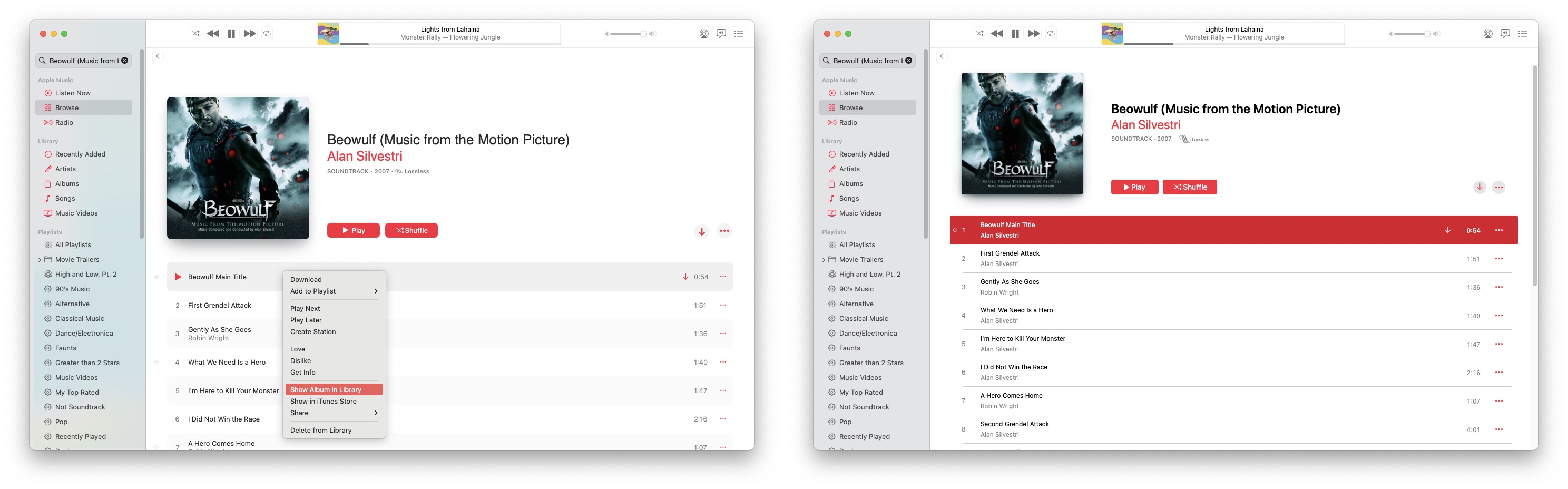
The search field in macOS used to have a little toggle at the top that let you choose whether it was finding results in your library or Apple Music. That’s moved to the browse page and the search results page, which changes the behavior of the search text field, even though those buttons are not even in the same ZIP code. For a while I thought they’d just removed the library search, but it’s still there…if you want to do more work to use it.

You can also search in Apple Music and then go to your library version of an album or song by right-clicking on the tracks and picking “Show Album in Library” which also does a neat thing where you can see that whatever they use to style the album interface is different between the two for no good reason at all.

Two screenshots of the album view in Music on the Mac, from a music library and from Apple Music.
The same album viewed in Apple Music (left) and the Music.app library (right). Enlarge

If you want your own version of the album and isn’t exactly what Apple Music has, then you must use the toggle in the browse interface before searching. I have a version of the Tron: Legacy soundtrack that I bought from Amazon because it had an exclusive track. It’s in my library and I can manually navigate to it, but I can’t use Apple’s search to get to it at all, only the versions of the album in Apple Music. Doesn’t seem like a huge deal, right? Well at some point I “loved” a track in Apple Music from this album, and now I have a version of the Tron: Legacy soundtrack in my library that has one track in it.*

Look at the stars, look how they shine for you

Speaking of “loving” music, some of us prefer a more nuanced system for rating music. Sure, five stars is overkill and most people are either ranking their music either zero stars or five stars, but there are those of us with a rating system that we’d like to keep using because we were using it already. Even though the stars have been eradicated from the interface, you can still right-click on a track to see its star rating metadata or to even to rate it. Like when you go two levels deep in Windows’ Settings and you get that Windows 95-looking dialog about a network adapter—that’s where your stars are buried.

Some of my albums have had their star ratings wiped out, which I can only assume is from some iCloud Library sync issue at some point in the last eight years, so it’s no longer something I can reliably use or invest additional time in. It does, however, drive some of the features I like to use, like Smart Playlists.

What, you’ve never heard of Smart Playlists? Gather ’round, kids and let me regale you with how they work: They’re basically saved searches that filter your music library by the file metadata, and they’re super neat. Unfortunately, having a library is kind of the enemy of using a music streaming service. Apple would much rather you use stations or their human-curated playlists, but I don’t like to rely on those because at any point the human-curated playlist could be changed by a human who isn’t me. It’s not versionable and it’s not mine—it’s the service’s.

C’est la vie! I can make my peace with Apple product managers who the stars made sad, but not so much with the slow erosion via data loss of something that I use to play the music I want.

You’re getting closer to pushing me off of life’s little edge

As a long time user of iTunes, and now the Music app, I’m at a loss for why all of this is so bad, other than that Apple makes too much money to care. Why is this a streaming-first experience that is executed like a standalone music player? Why does my library even exist if I’m not really supposed to use it?

There are a thousand other things I could needle Apple Music product managers about, but let’s just start with playing what I want. A high bar.

[Joe Rosensteel is a VFX artist and writer based in Los Angeles.]


Susan Wojcicki steps down as YouTube CEO, what will her legacy be? Ant-Man performs well at the box office, but do reviews indicate ‘Marvel Fatigue’? And guest-host Myke Hurley quizzes Julia on why he has to wait for shows to premiere in the UK.


By Dan Moren for Macworld

If Apple is making a bigger MacBook Air, why not a smaller one too?

A wise green puppet once contended that “size matters not.” Obviously he never had to contend with navigating Apple’s product lineups.

Recent reports suggest that Cupertino might soon be releasing a MacBook Air with a larger 15-inch screen. Strategically, that makes a lot of sense: the MacBook Air is Apple’s best-selling Mac, and for it to only be available in a single size is a missed opportunity. Yes, there are upsell opportunities for those who want a larger display above all else, but given that currently entails a jump all the way from $1200 to $2000, many customers won’t take the leap—especially if they don’t need the power or performance of a MacBook Pro.

Screen size has proven to be a key differentiator in many of Apple’s other product lines, and even the MacBook Air was itself available in multiple sizes in its past incarnations. But I say why stop there? There are plenty of other Apple products where another screen size might make a big (or small) difference.

Continue reading on Macworld ↦


With Jason on vacation, Myke is joined by David Smith. They discuss a potential delay for Apple’s headset and what that may mean for WWDC. Also, David’s AI-powered podcast transcription website, and the introduction of ‘Ask Underscore’.


By Dan Moren

Setting up iOS’s two-factor authentication for Twitter

Note: This story has not been updated since 2023.

If you’re already using two-factor authentication on your Twitter, account, great! But with the company’s announcement Friday evening1 that it would be discontinuing two-factor authentication via SMS for all but its paying Twitter Blue subscribers, you may suddenly find yourself wondering what a person’s to do if they want to keep their Twitter account secure?

Have no fear: while these changes were perhaps hastily and questionably enacted, there is a silver lining here. Two-factor authentication via an authentication app is more secure than using SMS, and, better yet, if you’re using a recent version of iOS, iPadOS, or macOS, then not only is the ability to set up that feature baked right into the operating system, but the system will even autofill the password for you every time you login.

Here’s how to set it up:

First, fire up Twitter, either on the web or in the app. In the toolbar on the left, tap the More button (the one with the three dots), and then tap Settings and Support; under the menu that appears there, tap Settings and Privacy.

This will take you to the account section of your Twitter Settings; tap the entry for “Security and account access” and then, on the right hand side of the screen, tap Security.

You’ll see an entry for “Two-factor authentication”: tap that and you’ll get options for the various ways to secure your account. Tap the checkbox for “Authentication app” and a dialog will appear prompting you to get started.

Twitter Security Settings

Fun so far, right?

Here’s where it gets a little tricky, depending on what device you’re using. To set up the two-factor codes, you’ll get a QR code. While in some apps and websites, macOS/iOS can actually detect the QR code being show onscreen, allowing you to tap and hold on it to set up the feature, that didn’t happen for me on Twitter on the iPad. That leaves two other options for configuring this feature.

Twitter 2FA Setup
Scan this QR code with another iOS device to setup two-factor authentication.
Scan QR code

If you happen to have an iOS device handy, you can point its camera at the QR code on your screen. In the Camera app, as you hover over the QR code, you should see a yellow bubble pop up that says Add Verification Code to Twitter.com. Tapping that will open the Passwords section of iOS, and prompt you to add the verification code to an existing account. Search for your Twitter login, tap it, and you should be prompted to save the verification code there.

If you don’t have an iOS device handy, you can do the process manually. Tap the “Can’t scan the QR code?” in the dialog box, and you’ll instead be prompted with a long string of characters. Copy this and go to the Passwords section of System Settings, where you’ll need to authenticate with your passcode or biometrics. Then search for your Twitter login, tap on it, and select the Set Up Verification Code button. You’ll be prompted to either scan the QR code or Enter Setup Key—choose the latter, paste in the string you just copied, and hit OK.

You should now see a new section showing a six-digit code along with a timer counting down. Copy that code and return to the Twitter website to paste it in. (The OS should also offer to autofill it for you when you tap on the verification code feature.)

That’s it! The hardest part is over and now whenever you log in to Twitter in the future, the OS should autofill the two-factor code just like it does for your username and password.


  1. If you have any question that this decision was bad news, couched as it was, then just remember that they put out this news at the end of Friday. 

[Dan Moren is the East Coast Bureau Chief of Six Colors, as well as an author, podcaster, and two-time Jeopardy! champion. You can find him on Mastodon at @dmoren@zeppelin.flights or reach him by email at dan@sixcolors.com. His next novel, the sci-fi adventure Eternity's Tomb, will be released in November 2026.]


Search Six Colors