Note: This story has not been updated for several years.
Rarely do I get into new services with the same fervor with which I’ve embraced Marvel Unlimited over the last few months.1 As someone who hasn’t regularly read comics since his teenage years, Marvel Unlimited provides exactly what I’m looking for: a monthly subscription fee that covers pretty much all of my comic-reading needs (for Marvel titles, of course). I’m not likely to head down to my local comic book store and pick up single issues2, and buying individual issues from Comixology, much as I like keeping up with the current releases, is just too pricey for my blood. So an all-you-can-eat service is just what the Doctor (Strange) ordered.
But, much as I love the service, the iOS app needs some serious work. Over the last few months, I’ve come across a few major improvements that I’d really love for Marvel to make to turn Unlimited from a service with great content and a crummy app into something that’s Fantastic (Four) all around.
Note: This story has not been updated for several years.
I joked on Twitter about needing a picture of an Apple logo shaped like a hedge, and [look what Jeff Lange did](https://twitter.com/jefftml/status/659578422159634432).
I went into this a bit for my piece on Macworld this week, but the current strength of the dollar can make Apple’s life difficult.1
Basically, the stronger the dollar gets after a product launch, the more foreign sales eat into Apple’s product margins. Apple could respond by raising prices, but that would probably not make consumers in those countries very happy.
In general, Apple doesn’t want to re-price existing products. But as Apple CFO Luca Maestri said on the conference call, Apple does realign prices “particularly when we launch new products.” An American could cross over into Canada and buy a MacBook and save 132 American dollars. But the new Apple TV is priced dead-on with the current exchange rate, at CA$199.
More interesting is that Apple also hedges in the currency markets to protect itself from risk. If you know as much about complex financial instruments as I do, you may be wondering why Apple is using ornamental bushes to protect itself from fiscal harm. But in this context, Apple essentially has an ongoing program in which it invests in currency markets in ways that will profit the company if the dollar grows stronger. These investments allow Apple to have “some level of protection to foreign-exchange movements,” as Maestri said.
I think it’s sort of fascinating, but mostly in the sense that things are going so well for Apple right now that the biggest concern the analysts seem to have about their business is how global economic conditions will affect it. To appropriate the metaphor used a half-dozen times on the analyst call, the good ship Apple is in peak condition and there’s no other vessel on the oceans like her. Her only threat at the moment appears to be foreign-exchange “headwinds.”
And that’s this quarter’s report from the land of international topiaries and financial sailing ships.
About time. More to the point, a few months back, the BBC also said that it would be rolling out a U.S. version of iPlayer sometime in 2016. The caveat: it probably won’t include BBC shows that already have American homes, such as Dr. Who.
There are a number of British shows that I enjoy, most of which are difficult to find in the U.S.—and an increasing number of which come from BBC’s competitors, like ITV—but we still seem stuck in a 20th century mentality when it comes to international borders. There are licensing restrictions, sure enough, but with so much television shifting to an online medium—the app future of TV, as Tim Cook puts it—it seems anachronistic that we should be separated by mere borders.1
My Canadian friends are picking up what I’m putting down here, eh? ↩
[Dan Moren is the East Coast Bureau Chief of Six Colors, as well as an author, podcaster, and two-time Jeopardy! champion. You can find him on Mastodon at @dmoren@zeppelin.flights or reach him by email at dan@sixcolors.com. His next novel, the sci-fi adventure Eternity's Tomb, will be released in November 2026.]
The Verge’s Nilay Patel says that the new Apple TV is “very much the best version of television’s present” but adds “Apple has a lot more work to do before the future actually arrives”:
If it sounds like I’m holding the Apple TV to a higher standard than every other product, it’s because I am. Once you really start thinking about the Apple TV and what it is today, it becomes very clear that while Apple was able to significantly improve the parts of the streaming media experience that it can directly control, it wasn’t able to use its leverage to really fix the little annoyances and disconnects littered throughout the TV landscape that it can’t control.
It sounds like the biggest disappointments to me are all the things that didn’t change in this incarnation. For example, no single sign-on to authenticate with TV networks. (Seriously, Apple: find a way to let people authenticate just by signing into their iCloud accounts, and we will all be happy campers.1)
I’m still looking forward to my Apple TV arriving—hopefully tomorrow some time—but I admit that this review has tempered my enthusiasm a bit. (Patel’s colleague, venerable tech writer Walt Mossberg, seems to share his mixed impressions of the device.)
It seems not unlikely that this is a stop-gap until Apple releases its much-rumored TV service, but given how tightlipped Apple is about future plans, it just looks kind of out of touch. ↩
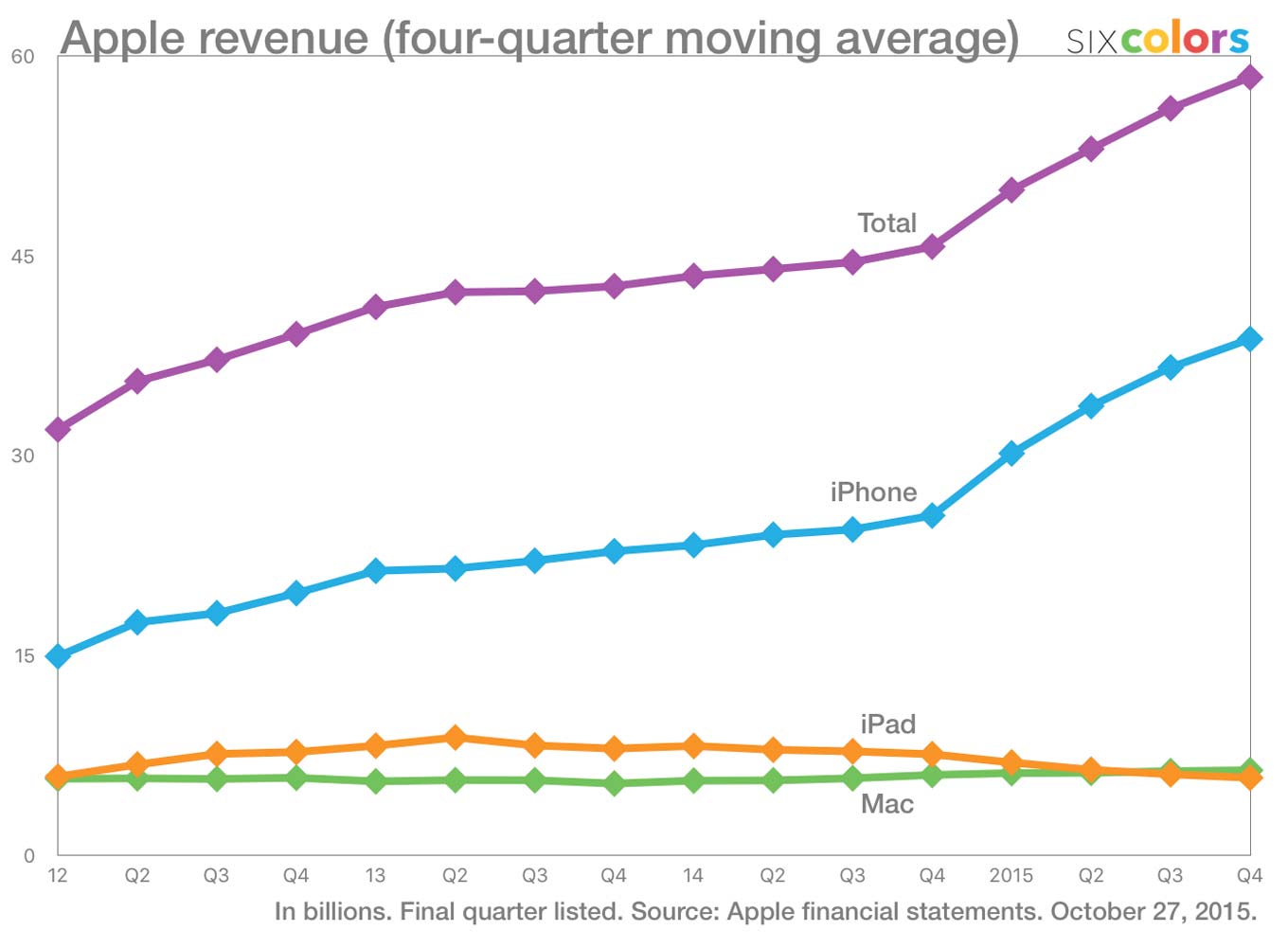
Like clockwork, three months later we’re back here with more quarterly financial results from Apple. (Every three months is a quarter. This is how calendars work. Pay attention.)
The numbers continue to be so big that they’re hard to understand—$11.1 billion in profit, and $51.5 billion in revenue. But beyond the numbers, this is the day where Apple has to disclose a bit more about itself than it does on any other day, outside of a product-launch event. Between the numbers it releases and the discussion on its hour-long call with financial analysts, there are usually some interesting tidbits that indicate where Apple’s going and what its management team is thinking. So here’s my list of the most interesting things to come out of Tuesday’s quarterly results.
Developer Ryan McLeod recounts his work creating Gravity, an app that uses the iPhone 6s/6s Plus’s 3D Touch feature to turn the phone into a digital scale:
With the force values linearly correlated to weight, turning any force into a weight was going to be as simple as recording the force of known weights and creating a linear regression. It’d even be possible to use some statistics to predict how well the calibration went (there are many factors that can throw off a calibration). We opted to use coins for calibration, with a framework that made it easy to internationalize in the future.
To make a long story short the final answer over the phone was that the concept of a scale app was not appropriate for the App Store.
We were–and still are–bummed to say the least, but we understand some of the reasons Apple might not be allowing scale apps at this time.
To McLeod’s credit, he takes the rejection pretty well, even noting that apps that bend Apple’s API for unexpected uses often aren’t accepted right away. But it is a shame, because it’s a clever implementation and Apple should be encouraging developers to think outside the box.
Really, what Apple needs is a small group within the App Store review team to flag apps that are pushing the envelope in smart, respectful ways; work with those apps’ developers; and present overall recommendations to App Store leadership–perhaps even reporting directly to Eddy Cue. Blanket rejections get you nowhere, and they increase the frustration of developers who are legitimately trying to do cool things that delight users–just as Apple aims to do.
Note: This story has not been updated for several years.
Of the many games I’ve been keeping an eye on, No Man’s Sky ranks near the top. The latest trailer has done nothing to curb that hunger, and it attaches a date, too: June 2016.
This massive title has been created by a relatively small studio, Hello Games, and features as its selling point an enormous universe that is entirely procedurally generated.1 It’s a fascinating counterpart to something like Destiny, which has a grand scope but a relatively small actual playground. According to its developers, No Man’s Sky will have around 18 quintillion planets. (This is definitely not a game for completists: it would be impossible for a single player to visit every single planet, taking on the order of 584 billion years if you only landed for a second.)
Much of No Man’s Sky seems to be focused on exploration rather than combat, though this trailer definitely spends some time on the latter. The developers have been closemouthed about what exactly the narrative of the game is, though they have said that there is one.
But it’s the immersive nature of the title that has me sitting up and taking notice. For years I’ve wanted a game where you could fly out of a spaceship, land on a world, and get out, all without jumping to cutscenes or feeling like a strange mishmash of clumped together games, and it seems like No Man’s Sky might actually deliver on that. No more planets that just hang in the background like a matte painting—if you see one, you can land on it. You may be the first person to discover it, or the thousandth.
More to the point, it seems like something different to me. I enjoy first-person shooters and third-person sandboxes as much as the next guy, and while this has some of the traits of both of those, it also seems like a surprisingly non-conventional game, especially for the attention it’s getting. And that, to my mind, is a good thing for game players and a good thing for the industry.
About the only downside for me is that the game launches on PlayStation 4 and PC, neither of which are platforms that I own. I may have to make an investment between now and then.
That is to say that a planet is basically created from scratch when someone first lands on it, complete with flora, fauna, resources, and so on. ↩
[Dan Moren is the East Coast Bureau Chief of Six Colors, as well as an author, podcaster, and two-time Jeopardy! champion. You can find him on Mastodon at @dmoren@zeppelin.flights or reach him by email at dan@sixcolors.com. His next novel, the sci-fi adventure Eternity's Tomb, will be released in November 2026.]
Note: This story has not been updated for several years.
The new Apple TV offers one choice that we haven’t had to contend with on the set-top box previously: storage capacity. This time around Apple is offering either a 32GB model for $149 or a 64GB model for $199.
Not since the original Apple TV, which initially shipped with a 40GB hard drive—later upgraded to 160GB, has storage capacity required a decision. The second- and third-generation Apple TVs had onboard flash storage, but it was a static 8GB that wasn’t exposed in any way to the end user.
It’s thus a little bit peculiar to me that with the new Apple TV, the company’s take a step backwards and made storage something users have to think about. What makes that even more perplexing is that storage space will continue to be something moderated by Apple’s onboard OS rather than by the end user, as it is on iOS devices. That management is even more aggressive, thanks to the aforementioned App Thinning.
In some ways, App Thinning reminds me a little bit of Apple’s approach to multitasking and memory management: that is to say, it’s a message to developers to not get too attached to anything. While the Apple TV, with its always-on power and networking connection, is not as constrained by circumstance as mobile devices are, Apple is clearly doing its utmost to take worry out of the hand of the consumer. Which isn’t surprising at all, given Apple’s tendency to create devices that abstract the nuts and bolts of technology away from users.
So I keep coming back to why the company offers two storage tiers for the Apple TV. The company does acknowledge the difference: when you click through to the buy page for the Apple TV, there’s a link for “How much storage is right for you?” Click that and you get an explanation:
If you plan to use your Apple TV primarily to stream movies, TV shows, and music or to play a few apps and games, you’ll probably be fine with 32GB of storage. If you plan to download and use lots of apps and games, choose the 64GB configuration. Keep in mind when making your decision, that some apps, when in use, do require additional storage.
One could almost argue, then, that the 64GB version of the Apple TV is the “game console” version, with the 32GB primarily targeted as a “set-top streaming box.” The 64GB version is also for customers who want to not worry about running out of storage or want to feel like they bought the best Apple TV available. And, as with the 16GB model of the iPhone, perhaps the 32GB model is there to stake out the low ground, and convince customers on the fence that it might be worth it to spend the mere $50 to upgrade to 64GB.
Me, I ended up ordering a 32GB Apple TV with no hesitation whatsoever. The capacity issue is largely predicated on how many apps you might end up using, and while I have no doubt that I’ll be downloading my fair share—for testing and reviews, if nothing else—the Apple TV is still an unproven category. Given the nature of App Thinning and on-demand resource loading, I’m not too worried about storage ultimately. Part of that is because I’m not sure exactly how many apps I’ll even install on the Apple TV—right now, I don’t anticipate very many, but that pronouncement may tempt fate a little too much. After all, nobody has ever needed more than 640K of RAM, right?1
Yes, I’m aware this quote is largely considered to be misattributed. ↩
[Dan Moren is the East Coast Bureau Chief of Six Colors, as well as an author, podcaster, and two-time Jeopardy! champion. You can find him on Mastodon at @dmoren@zeppelin.flights or reach him by email at dan@sixcolors.com. His next novel, the sci-fi adventure Eternity's Tomb, will be released in November 2026.]
Indifferent to the excitement and the trepidation, the new Apple TV will begin shipping this week. Though few who plug in their set-top boxes will know it, they’ll become test pilots for a series of technologies that could provide a new paradigm for distributing and managing storage on computers, whether they sit in your lap, rest in your hand or live tethered to your TV. And if it works, it might have a lot to teach gaming consoles like the PlayStation 4, Xbox One and Wii U.
This shouldn’t be surprising. After all, this is Apple. It’s an opinionated company, confident in making controversial decisions that it believes will benefit its customers. Since its founding, Apple has been a company that loves nothing quite so much as creating small technological wonders that are drop-dead simple to use. Why would it be any different when Apple set its sights on TV?
I always feel that gaming on iOS was a surprise hit for Apple, which has never really known what to do with games. The Apple TV is a conscious decision to move into that space and it’s not hard to see the box as “a gaming console done Apple’s way.” The gaming features aren’t a primary seller for me, as an Xbox One owner, but I can certainly see the appeal for the millions of people who play and enjoy iOS games.
Note: This story has not been updated for several years.
Apple began taking orders this morning for the new, (presumably) app-laden fourth-generation Apple TV. I ordered mine right after my plane touched down in Phoenix during my trip back from last week’s Release Notes conference and a visit with family in southern Indiana.1
Apple claims my Apple TV is going to arrive early next week, so expect more on that from Six Colors in a week’s time.
My mother just left for a week-long trip to Europe. Before she went I set up her phone on AT&T’s international data plan, reminding me once again just how outrageous international data charges are. On AT&T, $30 gets you a pool of 120MB of data for international use. At home, $50 gets you 5GB. Hardly proportional.
In large part, we have the wireless carriers to thank for this: because of the prevalence of locked phones–which not only prevents customers from easily switching carriers domestically, but also from using local SIM cards in the countries they travel to–the telecom companies have long had a pretty tight grip on how customers can access the Internet while abroad.
But in an interview with the UK’s EveningStandard earlier this month, Apple senior vice president Eddy Cue–ostensibly there to talk about music–let drop an interesting tidbit.
Note: This story has not been updated for several years.
Apple’s spent the last couple years beefing up its web-based apps–the other week, the web-based iWork trio officially lost their “beta” label; this week, Find My Friends makes the jump.
I’ve long been a big fan of the Find My Friends app on iOS; it also got a Notification Center widget in OS X El Capitan. The web app looks like a pretty decent implementation, though I did notice one bizarre detail: when I loaded it up earlier today, it didn’t display any of the names of my contacts–or their icons. Instead it just showed me their email addresses. Kind of bizarre, since I certainly have contact information for all of these people.
It also lacks some of the niceties of the mobile app, such as the ability to easily plot directions to a friend’s location, or set up notifications, or control sharing settings on a more granular basis. So it’s not really a replacement for Find My Friends on iOS–just a handy way to see where that friend you’re meeting is, if the kids are home from school, or whatever you use Find My Friends for.
[Dan Moren is the East Coast Bureau Chief of Six Colors, as well as an author, podcaster, and two-time Jeopardy! champion. You can find him on Mastodon at @dmoren@zeppelin.flights or reach him by email at dan@sixcolors.com. His next novel, the sci-fi adventure Eternity's Tomb, will be released in November 2026.]
Dan does not want to talk about the Star Wars trailer: https://www.youtube.com/watch?v=sGbxmsDFVnE
Tim Cook says you can order a new Apple TV on the 26th of October: http://www.macworld.com/article/2995441/gadgets/tim-cook-shares-apple-music-subscriber-numbers-and-apple-tv-ship-date.html
And he said some other stuff.
Lex bought a TiVo Mini: https://www.tivo.com/shop/mini
The Tesla has some self-driving feature: http://www.bloomberg.com/news/videos/2015-10-16/tesla-adds-self-driving-features-to-model-s-sedan
Xiaomi is making a hoverboard: http://www.pcmag.com/article2/0,2817,2493420,00.asp
Thanks to FanDuel, the leader in one-week fantasy football with more winners and more payouts than any other site. Go to fanduel.com and click on the microphone in the upper right hand corner. Use the code “REBOUND” and they’ll match your first $200. Fanduel.com where every day is a new season.
Our thanks also to Softlayer (http://softlayer.com), the cloud built to compete. You deserve cloud resources that meet your unique needs. Softlayer is one of the only cloud providers that provisions bare metal servers and virtual servers from a single, seamless platform. Go to http://softlayer.com/podcast and get your first $500 free.
Kyle Orland puts Microsoft’s $150(!) souped-up controller through its paces:
Microsoft’s effort throws a lot of ideas at the proverbial wall, and a few of them stick well enough that we’d like to see them integrated into every handheld controller going forward. At $150, though, the price of entry to try out Microsoft’s view of the controller’s future is a bit too steep for all but the most competitive of gamers.
My Xbox One is still more or a less a dedicated Destiny-playing machine, so there are some features of this controller–the underside buttons that you can trigger without taking your thumb off the thumbtacks–that are particularly appealing. All that said, I’m not sure I’m ready to spend the premium just for that, especially given Ars’s caveats.
My gut feeling is yes: I’ve been waiting for Apple to make a great set-top box, and everything I’ve seen of the Apple TV—including my brief interactions with it at the September 9th event—suggests that this is it.
The reasons I abandoned the Apple TV in the first place were several: flaky performance, lack of Plex support, and the Fire TV’s handy voice search. The Apple TV’s newer, speedier hardware will hopefully resolve the first; Plex has already announced that it will be in the Apple TV App Store on day one; and the Siri features seem to go above and beyond what my Fire TV currently offers.1
The only potential pothole that I see is the lack of Amazon Prime support for the Apple TV. These days, the video sources I frequent are—in rough order of use—Hulu, Plex, Netflix, Amazon Prime, and iTunes. The Apple TV looks to have native access to four out of five of those—in addition to a couple of other one-offs, like HBO Go and Disney XD—as well as indirect access to Amazon via AirPlay on the iPad.
I’m hopeful that Amazon will actually choose to make an app for the Apple TV, but there’s also this whole kerfuffle to consider. In the end, I still can’t fathom why Amazon would shoot itself in the foot by not making an app for the Apple TV. Don’t get me wrong: I’m a Prime subscriber and a fan of the service, but it’s not so good that I will buy into Amazon’s ecosystem just in order to have access to it. In this, I feel that Amazon should be drawing its inspiration not from Apple, but from Microsoft and Google: put your business on as many popular platforms as possible. Give everybody a reason to consider being your customer.
So, hopes for the new Apple TV are high. My time with the Amazon Fire TV has been great—I don’t regret it. But the lure of an Apple-designed set-top box is just too sweet a siren song to ignore.
There is support for Alexa, Amazon’s voice-based intelligence, coming to my older Fire TV in a software update at some point, but it hasn’t yet materialized, and I’m not sure if it will be able to match Siri. Rest assured, I’ll give it a try when it shows up. ↩
[Dan Moren is the East Coast Bureau Chief of Six Colors, as well as an author, podcaster, and two-time Jeopardy! champion. You can find him on Mastodon at @dmoren@zeppelin.flights or reach him by email at dan@sixcolors.com. His next novel, the sci-fi adventure Eternity's Tomb, will be released in November 2026.]
Note: This story has not been updated for several years.
Before and after clean-up
We’re used to cruft accumulating in all sorts of unwanted places in our lives, but among my least favorite is the Finder’s Open With contextual menu. You’ve probably run into this: you go to open a file with an app that isn’t the default, and you’re presented with a list of options as long as your arm—many of them duplicates (see above, left).
What gives? Well, when you install an app on your system, it registers that it’s willing to handle certain filetypes—”Oh, JPEGS? Yeah, no problem!” That information is stored in the Launch Services database, so when you right-click on a JPEG and choose Open With, the Finder rounds up a list of viable candidate applications.
Unfortunately, over time, this database accumulates that aforementioned cruft: old versions of applications don’t get cleaned, or even programs you’ve long removed. Fortunately, this handy tip—courtesy our old friends at Mac OS X Hints—can help you whip that database into a lean, mean, contextual machine.
Fire up a Terminal window and paste in the following command:
/System/Library/Frameworks/CoreServices.framework/Versions/A/Frameworks/LaunchServices.framework/Versions/A/Support/lsregister -kill -r -domain local -domain user
That uses lsregister—the Launch Services command-line tool—to rebuild OS X’s internal database, throw out outdated entries, and make sure that everything’s all up to date. When you’re done you’ll need to relaunch Finder, which you can either do from the command line—enter killall Finder—or by option-control clicking on the Finder icon in the Dock and choosing Relaunch.
Next time you use that Open With dialog box, it’ll be much, much cleaner (see above, right). Now, if only there were a similar command for those couch cushions.
Update: Whoops, the previous version of the command was for pre-10.8. This version should work with newer versions of OS X.
[Dan Moren is the East Coast Bureau Chief of Six Colors, as well as an author, podcaster, and two-time Jeopardy! champion. You can find him on Mastodon at @dmoren@zeppelin.flights or reach him by email at dan@sixcolors.com. His next novel, the sci-fi adventure Eternity's Tomb, will be released in November 2026.]
Note: This story has not been updated for several years.
Software updates, get yer software updates! Apple’s got piping hot patches for all its devices coming right up. Here’s the important things you need to know.
Emoji: All three updates support over 150 new emoji, including the important emoji you didn’t even know you need like tacos, unicorns, tacos, squirrels, tacos, the middle finger, and did I mention tacos?1
Live Photos: If you enjoy taking Live Photos that end with your feet, then iOS 9.1 is not the update for you. Apple says your iPhone can now tell when you raise or lower it and not include that in the photos.
Bug Fixes: Game Center not launching in iOS 9? Fixed. Problems with Office 2016 on El Capitan? Banished. Stalling software updates on your Apple Watch? Thing of the past!
Improved stability and performance: You like those, right? Yeah! Those too!
This update sponsored by the Taco Council Of America (TCOA). Damn it, someone call Troy down in Acronyms–he had one job! ↩
Okay, there’s also an iTunes 12.3.1 update but it doesn’t really do much, so don’t get too excited. ↩
[Dan Moren is the East Coast Bureau Chief of Six Colors, as well as an author, podcaster, and two-time Jeopardy! champion. You can find him on Mastodon at @dmoren@zeppelin.flights or reach him by email at dan@sixcolors.com. His next novel, the sci-fi adventure Eternity's Tomb, will be released in November 2026.]
Note: This story has not been updated for several years.
Siri is pretty smart: it can figure out the weather in far off lands, find local restaurants, and even do math calculations.1 But one curious omission to the virtual assistant’s magical powers is its inability to interact at all with other devices on my network. Case in point: AirPlay.
I’ve got an Apple TV hooked up in my living room, and on occasion, I use it to play music from my iPhone—yes, I can play that music directly from the Apple TV, but the interface is much less friendly. But what would be great, especially now that the iPhone 6s lets me trigger Siri from across the room, is if I could tell it to start playing a song on my Apple TV.
This isn’t complete off-the-wall crazysauce du jour. One of my absolute favorite features of the Amazon Echo is “Alexa, connect my phone.” As long as my phone has at some point gone through the pairing process, I don’t need to navigate into the Bluetooth settings and manually connect to the speaker—the Echo can do it all on its own. That means that if I’m in the kitchen, washing dishes, I don’t need to dry off my wet and soapy hands to play any song on demand; I just have to go through the slightly ridiculous process of telling the Amazon Echo to connect to my phone, then telling Siri to play a song.2
Perhaps some of this most first-world of problems will be alleviated when the new Apple TV ships with its own implementation of Siri. Granted that doesn’t solve problems if you wanted to use a similar feature with, say, an AirPlay speaker3. And in general, I think it would be handy to have Siri be aware of other devices in my home. After all, what’s a virtual intelligence for if not managing your surfeit of technological gadgetry?
[Dan Moren is the East Coast Bureau Chief of Six Colors, as well as an author, podcaster, and two-time Jeopardy! champion. You can find him on Mastodon at @dmoren@zeppelin.flights or reach him by email at dan@sixcolors.com. His next novel, the sci-fi adventure Eternity's Tomb, will be released in November 2026.]