Six Colors
Six Colors

Apple, technology, and other stuff

This Week's Sponsor

Clic for Sonos: The fastest native Sonos client for iPhone, iPad, Mac, Apple Watch, Apple TV, and visionOS.

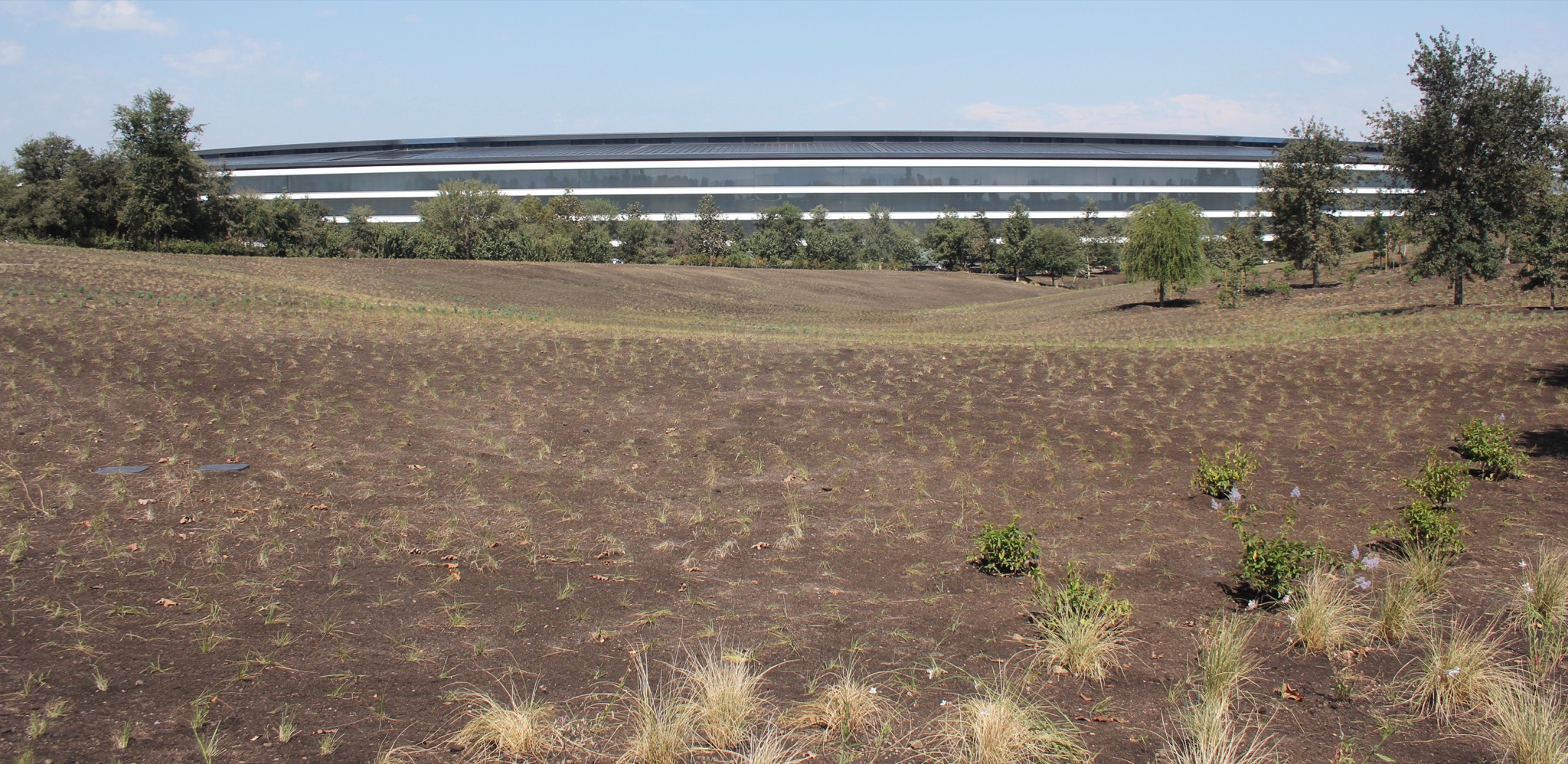
Apple Park's main building as seen from the Steve Jobs Theater.

By Jason Snell

A visit to Apple Park

Note: This story has not been updated for several years.

Tuesday was a big day. iPhone X. iPhone 8. Apple TV 4K. Apple Watch Series 3. But the biggest product unveil of all? No contest: It was Apple Park.

I’ve told more than one Apple PR person that I could get to Infinite Loop in my sleep. And on some early mornings it’s felt like I almost have. But this time, I bypassed the De Anza Blvd. exit on Interstate 280 South and instead went down another exit, to Wolfe Road. (That’s right, the two campuses are one freeway exit apart. It’s about a 1.5-mile drive between them on surface streets.)

There’s a lot of construction still going on on the periphery of Apple Park. As I drove down Wolfe Road, I noticed that there’s a main entrance at “Apple Park Way” that’s blocked off entirely. On Homestead Road, there are small single-family houses right across the street from Apple Park—or more accurately, from trees and a sidewalk and more trees and a fence and more trees and a berm and then Apple Park. But still, if you wanted to live literally right across the street from Apple Park, you could.

Attendees of the event were asked to park at the new Apple Park Visitor Center, which is at the corner of Tantau and Pruneridge. Beneath the building is a multi-story underground parking garage. The building itself is a glass-walled box that’s very much recognizable as an Apple building. It is, in fact, an unusual sort of Apple Store.

Roughly three-quarters of the building is indeed devoted to Apple Retail: It’s a full-on Apple Store. But like the Apple Store at the Infinite Loop campus, this store has a few special extras, including six colors of Apple Logo and Apple Park t-shirts. Through a pair of glass doors on either side of a divider wall is the other quarter of the building, which is a small cafe complete with coffee bar and wooden tables and chairs, all in the same design style as the Apple Stores themselves.

I wonder what the vibe in the cafe will be? And I wonder if Apple Retail head Angela Ahrendts might use it as an experiment to see if some lessons learned there could be exported to the rest of the Apple Stores around the world. In any event, it looks like if you visit Apple Park, you’ll be able to get a coffee, at least.

Across the street from the Visitors Center was a glass building (yes, they’re apparently all this way at Apple Park) that functions as an entry gate. From there, we went up a gently winding path that took us to the top of the hill that houses the Steve Jobs Theater.

The lobby is an all-glass-walled circle with no visible supports other than the glass itself, which is pretty nifty. It was devoid of furniture when we were there, perhaps out of a concern for crowds. Outside there’s a very nice view across a field to the main Apple Park ring, which is enormous even when seen from a distance. It’s very clearly a newly-planted landscape, however. There are trees and plants placed everywhere, with room for them to grow and spread, and the smell of fertilizer was extremely strong.

Once they began seating the theater for the event, we were allowed to go down two curved stone staircases that led below ground level. At the bottom of the stairs, we entered the theater itself—from the very top, at the back of the theater. So if you wanted to get down to the stage itself, you’d be walking down another flight of steps.

Steve Jobs Theater.

The Steve Jobs Theater had that new-theater smell, thanks to its thousand leather seats, each with a power outlet in a foot below. I sat in the upper sections, where there were armrests between seats. Down in the flat section at the very bottom of the theater, seats appeared to be more bench-like (or pew-like?), with fold-down arm rests. It’s not as big a space as some of the ones Apple has used for launch events, but it’s still quite big, and it’s entirely controlled by Apple. (I’m happy to report that the leg room in the Steve Jobs Theater is much, much better than at the small Town Hall conference center Apple had previously used for on-campus media events.)

The presentation’s slides and videos were played by a 4K HDR projector, according to Eddy Cue, and the screen looked great—and sounded great, too. It would be, as John Gruber pointed out on Twitter, a great place to see a movie.

At the end of the presentation, the doors at the top of the theater popped open, revealing that there’s a room on that level that can be hidden (via a turning circular divider) from people coming down the stairs from the entry lobby. With that divider spun around, it was a bright, open area containing the hands-on area showing off all the new Apple products that had just been unveiled.

Hands-on area.

Because if you’re Apple and you’re custom-building your own event space, of course you’re going to have a secret hands-on area. How could you not?

Another view of the hands-on area.

The fact is, the Steve Jobs Theater and the entire Apple Park campus are Apple products. Of course they look like Apple Stores. Of course they have custom-designed stone staircases and beautiful wood furniture. When you’re a company that has built its entire identity around design and style, from hardware to software to the contents of retail stores, it’s awfully hard to just build a glass office tower and call it a day. If you’ve ever imagined what an Apple Store would look like if it sprawled over 175 acres, well, it’s called Apple Park.

When all was said and done and seen, I went upstairs and outside and sat down on one of the wood benches that surround the lobby. I wrote a quick article for Macworld while about five different live TV interviews happened behind me. It was warm, much warmer at the top level than it was down in the theater. Then it was time to head down the sloping, curving path, back to the Visitor’s Center.

A panorama of the Apple Park Apple Store.

One of these days I’d like to see the main building at Apple Park. But as Tim Cook suggested Tuesday, it may be a while before everyone’s properly settled in. Maybe I’ll get my chance. But I realize that most people never will. Infinite Loop has become a destination for Apple fans who visit the Bay Area, so much so that Apple has tried to take steps to adjust to that, like adding some customer parking and converting the Company Store into a proper Apple Store.

T-shirts are available, of course.

With Apple Park, Apple has built the assumption that people will want to visit right into its plans. You could call the existence of an Apple Park Visitor Center presumptuous or arrogant, but I think it’s really pragmatic. The visitors are going to come. So Apple has built them a pretty destination… and put it just across the street.


By Jason Snell for TechRepublic

With A11 Bionic, Apple’s iPhone takes another big performance step forward

Apple introduced three new iPhones on Tuesday, and while most of the discussion is about the iPhone X, the announcement with perhaps the biggest impact on productivity yesterday is something that’s inside all of these smartphone models: the Apple-designed A11 Bionic processor.

Apple has been designing its own processors for iOS devices for some time now. Part of Apple’s secret sauce is that it controls the processor road map, the operating system, and the phone hardware itself. And as we’ve seen over the last few years, Apple has managed to continue increasing processor and graphics capabilities at a pretty rapid rate.

Packing more power into a phone isn’t just good for bragging rights, nor will it make you prioritize your email faster. But that added processor power enables new features that Apple and app developers will take advantage of—and while games will always make for fun demos, there are also productivity-based applications for new technologies like augmented reality and advanced imaging based on depth-sensing technology.

Continue reading on TechRepublic ↦


By Jason Snell

Cellular frees the Apple Watch Series 3

Note: This story has not been updated for several years.

watch_series_3_ceramic_newband

I’ve been surprised by the negative reactions I’ve seen to the idea of embedding cellular connectivity in an Apple Watch. Sure, there are plenty of reasons you might not need it—from the added cost (both of the device and in terms of monthly carrier-access fees) to the desire to leave your phone behind and be truly disconnected from the world.

But for a lot of people, I suspect that having an Internet-connected Apple Watch is going to be freeing. Up until now, the act of leaving the house without your iPhone has also meant dumbing down your Apple Watch. With all connectivity and its iPhone buddy gone, you can still use the Apple Watch, but it’s not nearly as good.

(Now, is watchOS 4 a capable enough operating system to provide apps enough power and flexibility to run independently of an iPhone? Everything I’ve read and heard suggests that it’s still not. This needs to be an area of focus for watchOS 5.)

I take my iPhone with me everywhere I go when I leave the house. It’s how I communicate with my family and friends. I can call for help in case of an emergency. I refuse to be away from home without it, not for a second.

Now picture that world with a cellular Apple Watch Series 3 in the picture. All of a sudden, my Apple Watch is no longer just an accessory that’s always wirelessly tethered to my iPhone. If I’ve got my watch on—and I generally do, all day—I can choose whether it’s worth bringing my phone with me to wherever I’m going.

If I’m going on a run, I’d love to be able to stop having my phone bouncing in my pocket. (I’m never buying one of those arm-band things.) I can walk to the store to buy some milk (with Apple Pay, so I can leave the wallet at home too) without my iPhone. I can walk the dog without my iPhone. And in a future where I’ve got a cellular Apple Watch, I will do those things. My iPhone will no longer be obligatory—and if I don’t think I’ll use it, I’ll leave it behind.

Now, there are a lot of details that need to be filled in with actual use of the Apple Watch Series 3. Is the microphone as good as it sounded from the demonstration stand-up paddleboarder Apple placed on the shores of Lake Tahoe? Will the connectivity with my iMessage account and phone number truly be seamless? Will my watch apps get very confused when they lose connection with my iPhone? How sad will I be when I start paying $10 per month to add my watch to my AT&T wireless plan? And, yeah, will I kill my Apple Watch battery life if I use it for a phone call for more than a few minutes?

We’ll see. But this is a huge step forward for the Apple Watch. The next step is to make sure watchOS and its apps are powerful enough that I don’t end up bringing my iPhone with me anyway—not because of a need for connectivity, but because my watch won’t properly play podcasts or let me participate in a Slack conversation.


By Dan Moren

Apple bumps prices on higher capacity iPad Pro models

Note: This story has not been updated for several years.

It’s pretty rare for Apple to raise prices on a product midstream, but that’s just what’s happened with the iPad Pro. As first reported by MacStories, the higher capacity 256GB and 512GB models of the 10.5-inch and 12.9-inch have all gone up by $50: the 256GB 10.5-inch model at $799 (up from $749), the 512GB at $999 (up from $949), the 256B 12.9-inch model at $949 (up from $899), and the 512GB 12.9-inch at $1149 (up from $1099)—cellular models have moved commensurately, maintaining the $130 price gap. The 64GB models of both the 10.5-inch and 12.9-inch iPad Pro remain the same at $649 and $799, respectively.1

Why the pricing change? Simple: memory is expensive. And it’s not that it wasn’t expensive before, it’s that it’s gotten pricier recently. In Apple’s most recent quarterly earnings call, the company mentioned “a more difficult memory pricing environment this year than a year ago.” NAND flash, which Apple uses for pretty much all of its product lines, is in short supply this year. Everybody needs it, and there’s not enough.

Samsung, which is still one of the major if not the major producer of flash memory, has been attempting to transition to a new “3D” or “Vertical” NAND technology that should allow for higher density and other benefits. However, that transition has apparently run into some challenges that prevent 3D NAND from being manufactured on the needed scale at cost effective prices. This transition has also led to a decline in conventional NAND supply.

This move also brings the pricing of the iPad storage tiers more into line with comparable devices—which is to say, the newly announced iPhones. In each case, jumping from 64GB to 256GB brings a $150 price tag. Older iPhones, like the 7 series, 6s series, and SE, see a $100 price increase when jumping from their lower 32GB capacities to higher 128GB capacities. Both are 4x storage increases, but the floor and ceiling pricing is higher already, due to bigger chips.

Because I was curious, here’s a chart of all the iOS devices Apple sells with their respective storage tiers and prices.

iOS and watchOS device capacity and price chart

  1. Bottom line: I guess I’m glad I bought a 10.5-inch 256GB iPad Pro back in June, because looks like I saved $50? 

[Dan Moren is the East Coast Bureau Chief of Six Colors, as well as an author, podcaster, and two-time Jeopardy! champion. You can find him on Mastodon at @dmoren@zeppelin.flights or reach him by email at dan@sixcolors.com. His next novel, the sci-fi adventure Eternity's Tomb, will be released in November 2026.]


By Dan Moren

iTunes 12.7 ditches iOS App Store, app syncing

Note: This story has not been updated for several years.

Goodbye, App Store

iTunes has become infamous for being a bloated, everything-and-the-kitchen-sink kind of app, and many of us had resigned ourselves to it being that way forever. But Apple’s taken the first steps to slimming down the behemoth with the quiet introduction of iTunes 12.7, which removes both access to the iOS App Store and the ability to sync apps to iOS devices.

Fear not! You can still plug in an iOS device and sync media to the device, as well as transfer files into apps. But after nine years, Apple has made the right call in deciding that we’re all pretty used to installing apps from the App Store on our phones. App syncing was a good idea in the days when cell connections were pretty slow, but with LTE and prevalent Wi-Fi, there’s little reason to sync apps from a Mac. (Plus, plenty of people don’t have a Mac. And iTunes on Windows is still less than popular.)

It might make sense to have the iOS App Store still available on the Mac—perhaps integrated into the Mac App Store app? That could definitely use an overhaul, as it stands. Even if you could simply click Buy on an app to have it downloaded to your iOS device, that would be pretty handy—not to mention for Apple journalists looking to grab links to iOS apps while writing stories on their Macs. ahem

The other major casualty is the ringtone store, which Apple points out you can now access via the Sounds section of Settings on iOS. You can still copy ringtones to your iPhone or iPad via iTunes, but you do so by connecting the device and clicking on Tones item in the iTunes sidebar, and then dragging .m4r files in:

Tones section of iTunes

I still think that there are plenty more improvements to be made here. I continue to think device syncing should be in its own app, relegating iTunes strictly to media management, but this is certainly a step in the right direction.

[Dan Moren is the East Coast Bureau Chief of Six Colors, as well as an author, podcaster, and two-time Jeopardy! champion. You can find him on Mastodon at @dmoren@zeppelin.flights or reach him by email at dan@sixcolors.com. His next novel, the sci-fi adventure Eternity's Tomb, will be released in November 2026.]


By gartenberg

Gartenberg: Apple raises the bar

Note: This story has not been updated for several years.

It was a major keynote for Apple. The first one in the new Steve Jobs Theater on the Apple Park campus… a more intimate setting than most of the recent iPhone events. The beauty of the setting almost eclipsed the event. Almost. But not quite.

Despite some very detailed leaks, none really told the story of the day. This was easily one of the biggest Apple product launches in recent memory. So let’s get to it.

Apple Watch. A major upgrade—not in form factor, but in function. The star of the show was the LTE Apple Watch. This is really important. It means users, in theory, can now leave their phone behind and stay connected. They can walk around without anything in their pockets and still take phone calls, deal with messages, and stream music—and those are some of the applications that are enabled by this functionality.

Other competitors—Samsung, for one—have tried this on their own watches, but their feature set and usability have come nowhere close to Apple’s. This might be the smartwatch that truly is for the rest of us. This product is really important to Apple. This is a post-post-PC device.

Apple TV. The current Apple TV is a great product, but hardly delivers the vision that I suspect Apple wants to ship. This new model does take Apple’s vision one step further, with support for 4K and HDR. (By the way, those are terms that are not nearly consumer-friendly enough.)

All that high-quality video is great, but until the content kings get fully onboard, Apple TV will be device number two (at best) on our televisions. And even with improved apps and better games, Apple TV is not a game console replacement, either.

Which brings us to the main course….

iPhone 8 and iPhone 8 Plus. These are amazing phones. Apple has once again raised the bar in terms what a smartphone is. The new form factor is wonderful, adding support for wireless charging. This really feels beyond what an iPhone 7s would deliver. The new augmented-reality demos blew me away. This is Apple’s vision of AR, and it’s real, it works, and it opens up a whole new level of functionality and fun. That is, if developers step up.

But the star of the show was iPhone X. It’s arguably the most beautiful product ever made by Apple and the jewel in Apple’s crown. The aesthetics must be seen to be appreciated. This is something Apple competitors aren’t even close to. If the iPhone 8 raises the bar, iPhone X raises the bar so high it can’t be seen. This is, quite simply, the best smartphone money can buy.

The screen is beautiful. A seamless piece of glass that users interact with in so many new ways. Face ID takes facial recognition and makes it seamless, becoming invisible in use. The new functionality it enables is groundbreaking. No doubt, this is the device that Steve Jobs envisioned more than then ten years ago. I expect the lines to purchase the iPhone X will exceed what we’ve seen before.

Now to the price. Price points are what they are—and the bottom line is that the iPhone X will be aspirational for many. People may go into a store and see an iPhone X but leave with an 8. But implicit in Apple’s message is that all iPhone X technology will be available for the rest of us… someday soon.

To those who say Apple is no longer in the business of innovation, I’d point them at Tuesday’s event. And then I’d probably quote Phil Schiller: “Can’t innovate, my ass.”

[Michael Gartenberg is an independent analyst, former Apple executive, and Contributing Analyst at Six Colors.]


By Jason Snell for Macworld

iPhone X: Hands-on and first impressions with Apple’s new iPhone

The iPhone X is real, though it won’t be arriving in customers’ hands until November. I got to use one for a few minutes Tuesday at the Steve Jobs Theater after Apple wrapped up its latest media event.

My first impression is that, in many ways, this is the iPhone that Apple has always wanted to build—one where the front face is almost entirely covered by a screen. And what a screen—a bright, colorful OLED display that Apple claims is the best by far that it’s ever put on an iPhone.

Continue reading on Macworld ↦


By Dan Moren

Today’s Apple event: the little details you might have missed

Note: This story has not been updated for several years.

Apple Event

As always, with the deluge of information from an Apple event, some details fall through the cracks. Fortunately, we’re here to sweep them up and collect them in the dustpan of our—you know what, I think this metaphor has gotten out of hand.

Anyway, here are a few things I picked up as I was trawling Apple’s site after today’s announcements. If I come across more, I’ll update this post.

Face ID pays attention: As predicted, Face ID goes beyond just unlocking your phone. Apple’s iPhone X page says because Face ID can tell when you’re paying attention to the phone, it can “also reveal notifications and messages, keep the screen lit when you’re reading, or lower the volume of an alarm or ringer.” As someone who has always had message text displayed on the lock screen, this is a nice middle ground between turning it off for more privacy and security and the convenience of not having to unlock your phone.

Face ID failure on stage: While we’re talking about Face ID, let’s address that failure on stage. There’s an excellent piece at The Verge detailing why the failure is kind of misleading. Like the author, I noticed that it looks a lot like the notice you sometimes get about Touch ID being disabled until you enter your passcode. Which is to say: it’s not a bug, it really is a feature. (But somebody’s probably in trouble for not making sure it was properly prepared for the show anyway.)

NFC with reader mode: Both the iPhone 8/8 Plus and iPhone X specs specifically call out “NFC with reader mode”, whereas the iPhone 7/7 Plus specs say only “NFC.” However, I’m told that the 7/7 Plus can read NFC tags via third-party apps under iOS 11. But might this perhaps enable person-to-person Apple Pay or person-to-vendor Apple Pay using an iOS device and no add-ons?

Apple Pay delayed

Person-to-person Apple Pay delayed? Speaking of person-to-person Apple Pay, it’s been absent from the betas thus far. The iOS 11 preview site now lists it as “Coming this fall,” suggesting it will arrive in a separate update. Maybe along with Messages in the Cloud?

High Sierra ship date

High Sierra ship date: Speaking of things only mentioned on Apple’s website, macOS High Sierra got zero screen time at today’s event, but Apple’s preview page now confirms a September 25th ship date.

iPhone Sizes

iPhone sizes: Curious about how the iPhone sizes stack up? The X is a little bigger than the iPhone 7, and reasonably smaller than the 7 Plus. The 8 and 8 Plus, meanwhile, are only microscopically different from their predecessors—so much so that Apple is billing its cases as working for both.

New Leather folio: Speaking of cases, I believe this $99 iPhone X Leather Folio, which comes in four colors, is a new style that incorporates a wallet design. Apple also confirms that wireless charging works through the case.1

Apple Watch Series 3 exclusives: Two exclusives to the Cellular version of the Apple Watch Series 3: the Explorer face, which shows the cellular signal strength via four dots above the hub of the watch face, and the red dot on Digital Crown, which appears to be for purely stylistic purposes?2

Apple TV Remote redesign

Apple TV remote “redesign”: Yes, Apple heard our complaints about the Siri Remote for the Apple TV and redesigned it…by putting a white circle around the menu button. Seriously. That’s it. (We’re going to have to have a whole different conversation about the pricing. Gah.)

AirPlay 2 on Apple TV: On the topic of Apple TV, Apple’s press release says “Apple TV can control multiple AirPlay 2-compatible speakers as well as your home theater speakers to create the ultimate home music experience.” I’d read that as including HomePods, since they’re the only AirPlay 2 speakers we officially know about? But it’s unclear to me whether both the 4K and current Apple TV will support it. (Oh, and AirPlay 2 is, like Apple Pay, “coming later this year.”) Update: Here’s a handy article with more about AirPlay 2, including third-party companies on speaker compatibility.

So, that’s what I’ve spotted? Have I missed anything? What have you noticed?


  1. It’s wireless—it’d better. 
  2. Though it does take me back to my favorite pre-Apple Watch conspiracy theory

[Dan Moren is the East Coast Bureau Chief of Six Colors, as well as an author, podcaster, and two-time Jeopardy! champion. You can find him on Mastodon at @dmoren@zeppelin.flights or reach him by email at dan@sixcolors.com. His next novel, the sci-fi adventure Eternity's Tomb, will be released in November 2026.]


By Jason Snell

Apple iPhone Event blog and photos

Note: This story has not been updated for several years.


By Dan Moren

J.J. Abrams to return to Star Wars franchise for Episode IX

Note: This story has not been updated for several years.

The Force is reawakening, apparently. After news of Episode IX director Colin Trevorrow’s dismissal last week, Lucasfilm said it would have details on who would replace him, and while many had hoped for a new face, it’s hardly a surprise that the company is going with a proven choice in J.J. Abrams, who will both write and direct the new film.

Abrams wouldn’t have been my first choice, though he’s unquestionably a safe bet. The Force Awakens was a big hit, and despite my quibbles–some of which you can hear about on the recent Not Playing episode that covered the show–I love the movie. But Lucasfilm has shown itself to be conservative when it comes to picking directors, and it seems to be all the more gunshy after having to recently replace the upcoming Han Solo movie’s directors, Chris Miller and Phil Lord, mid-production with veteran director Ron Howard.

As I see it, the pros of bringing Abrams back are obvious: he’s got familiarity with the franchise and the characters, he’s a name director who a lot of people have positive associations with after Episode VII, and, most importantly, he’s a known quantity. There have been reports that he clashed with Lucasfilm head honcho Kathleen Kennedy (in a way that Episode VIII director Rian Johnson has not), but Abrams may have come in with some extra leverage.

Abrams isn’t without his cons though. For one thing, as I said, I have some frustrations with Episode VII, mainly having to do with some storytelling conveniences and liberties taken along the way. More importantly, though, this has solidified the main Star Wars movies into an all-white-male affair, which is disappointing. Just as Episode VII–under Abrams’s hand, to be fair–brought women and people of color into the franchise’s foreground, it seemed like Episode IX would have been a good time to branch out a bit.

But as Lucasfilm is surely looking to bring the trilogy to a satisfying close that ends the franchise on a strong note and positions it well for the future, it’s no surprise that they went with the safe choice.

For more on who I, and several of my fellow Incomparable panelists, would have picked, check out our recent Episode IX director draft podcast.

[Dan Moren is the East Coast Bureau Chief of Six Colors, as well as an author, podcaster, and two-time Jeopardy! champion. You can find him on Mastodon at @dmoren@zeppelin.flights or reach him by email at dan@sixcolors.com. His next novel, the sci-fi adventure Eternity's Tomb, will be released in November 2026.]


By Dan Moren

iPhone Upgrade Program may allow delivery, trade-in by mail this year

Note: This story has not been updated for several years.

I noticed the other day–and a few other sites have also picked have also noted–that Apple’s iPhone Upgrade Program page now seems to suggest you can have a new phone delivered and then trade in your old phone via mail.

As a customer of the iPhone Upgrade Program since its inauguration, this is a huge improvement in a system that has gotten better every year. For the last couple years, you’ve had to reserve a new phone online and then go into the Apple Store to swap your old phone out. (Listeners of the Six Colors Secret Subscriber podcast will remember last year’s memorable episode recorded live from an Apple Store while waiting for my new phone to activate.)

iphone-upgrade-program

Here’s the relevant language (pulled from Google’s cache as the iPhone Upgrade Program page is on the Apple Store section of the site, which is currently down ahead of this afternoon’s event). The one exception appears to be those customers on T-Mobile, who will still have to go to an Apple Store.

Going into the Apple Store on iPhone launch day is often a frustrating experience, involving lines, lots of waiting, and running down the battery on your current iPhone from boredom, so I’m happy to skip it this year if possible. Gazelle and similar service have done trade-ins via mail for years now, so I’m sure Apple can handle that process. We’ll find out the exact details later today, but I am sure looking forward to sitting in the comfort of my home and having a box show up on my doorstep.

[Dan Moren is the East Coast Bureau Chief of Six Colors, as well as an author, podcaster, and two-time Jeopardy! champion. You can find him on Mastodon at @dmoren@zeppelin.flights or reach him by email at dan@sixcolors.com. His next novel, the sci-fi adventure Eternity's Tomb, will be released in November 2026.]


Nintendo revives NES Classic, bolsters SNES Classic production

Kotaku’s Brian Ashcraft:

After disappearing from store shelves, the NES Classic is returning next year. But that’s not all: the Super NES Classic will continue to be shipped through 2018. In Japan, the Super Famicom will still get shipped after October, and the Famicom Mini is going back into production. Hot damn.

Is this an end to the bizarre saga of the NES Classic? Nintendo’s retro console was hard to find last holiday season thanks to insane popularity, but the company announced back in April that it was discontinuing the device, and focusing on the SNES Classic.

Now, it seems, you’ll have your choice of which classic Nintendo game system to buy.1 Or, let’s be honest: buy both.


  1. Perhaps the success of the Switch has helped embolden the company. 

Two iOS 11 security measures will make it harder to get at your data

At Wired, Andy Greenberg details two changes in iOS 11 that will make it harder for another user—whether it be someone snooping on you, a thief, or law enforcement—to get at the data on your device:

But in iOS 11, iPhones will not only require a tap to trust a new computer, but the phone’s passcode, too. That means even if forensic analysts do seize a phone while it’s unlocked or use its owner’s finger to unlock it, they still need a passcode to offload its data to a program where it can be analyzed wholesale. They can still flip through the data on the phone itself. But if the owner refuses to divulge the passcode, they can’t use forensic tools to access its data in the far more digestible format for analysis known as SQLite.

That’s a good change and an easy one to make. As the article points out, it doesn’t stop someone from getting at your phone if they have your fingerprint—which you can be compelled to give—but it makes it a lot harder to sift through the data.

But wait! That works in conjunction with another iOS 11 feature:

Apple’s developer beta for iOS 11 also reveals a more straightforward protection against searches of a seized iPhone, too, in the form of a new iOS feature called “S.O.S. mode.” Tap the phone’s [sleep/wake] button five times, and it will launch a new lockscreen with options to make an emergency call or offer up the owner’s emergency medical information. But that S.O.S. mode also silently disables TouchID, requiring a passcode to unlock the phone.

Put those two things together and they make it much harder to access the data on your phone.


By Jason Snell

iPhone Event: The set list isn’t the performance

Note: This story has not been updated for several years.

So huge swaths of tomorrow’s Apple media event appear to have been leaked. It’s happened before—the chrome-arm iMac, the iPhone 4, the body of the original iPad, and many more.

I’m not going to list what we think we know. It’s a lot. Instead, let’s consider what we probably don’t know going into Tuesday.

In terms of raw facts, we don’t know prices and storage tiers. We don’t seem to know if any new iPhone models will support inductive charging via an add-on accessory. Any deals being made with content providers for the new Apple TV are probably still secure. There are probably a few other bits that aren’t gleanable from the complete contents of an iOS 11 firmware package, but it’s not a huge list.

Still, it’s a little like saying that reading a set list is a replacement for attending a concert. The appeal of an Apple product launch is not a product’s spec sheet, it’s the reveal. (If you want to test this, refuse to watch an Apple product launch sometime and limit yourself to the Tech Specs pages. Good luck.)

An Apple product reveal is pure marketing. It’s the opportunity for Apple to tell its story, and yes, it’s trying to convince the media, the world, and you personally to buy what it’s selling. For me, the most interesting thing about an Apple product launch is not what the PC industry used to call the “speeds and feeds”—the specs and prices and other technical details—but the stories Apple tells around the products it’s selling.

Stories are compelling. The famed Steve Jobs Reality Distortion Field wasn’t about blazing specs, it was about telling a story that put you and a new Apple product in the center of a miraculous future that had just arrived in the present.

Even if you roll your eyes at that, consider this: The way Apple describes its new products says something about how Apple views those products itself. Which features is it emphasizing? Who is being targeted? When Apple announced the HomePod in June, one of the most notable things about the roll-out was that the company pushed audio quality hard while spending almost no time on Siri. That was notable.

As a product reviewer, I’ve found it incredibly valuable to understand how a company pitches a product. That doesn’t mean that I’ll agree with their attempt, but it lets me understand something about the market the product is meant to serve. Generally, products are best evaluated through the lens of what they’re intended to be—not what we unrealistically wished they were. Not every product is designed for me, and I need to keep that in mind when I’m writing.

There are also the product demos. Sometimes these can be crashingly boring, but sometimes they’re the highlight of the day. Apple is riding high on the hype generated from the ARKit announcement in June, and I expect ARKit to get a big demo that will generate even more hype. What major developers have been spending this entire summer working on augmented-reality apps that will blow us away? I’m sure Apple had a pretty decent group to choose from.

And of course, with the new iPhone X (assuming that’s its name), how does Apple explain the new features and why they’re worth the price? How does Apple contrast the OLED screen in that iPhone with the LCD screens in the other models? How does Face ID work in practice? How does Apple describe the value of 4K and HDR video in rolling out the Apple TV 4K?

Apple is a big enough company that if it wanted to release all its products by press release, it could. It puts on a two-hour show several times a year because it wants to tell the story around the products. Reading a plot synopsis isn’t the same thing as watching the movie. To be sure, there are some people who read plot synopses and consider it good enough—but most of us like to see the story unfold. Placing all the technology in a proper human context (that, not coincidentally, makes those humans desperately want to buy Apple products) is what Apple media events are all about.

And that’s why I’m still excited about tomorrow’s Apple media event—and why you probably should be, too. We probably know most of the songs the band’s going to play, but it’s no replacement for seeing how the band plays them.


The War on Buttons

Alyssa Bereznak, writing for The Ringer about Apple’s eternal quest for hardware simplicity:

If you want to know how deep Apple’s hate for buttons goes, look no further than the very first iPhone announcement. It was a little more than a decade ago when Steve Jobs—resplendent in a black turtleneck, dad jeans, and white New Balance sneakers—introduced his company’s flagship product by first launching into a tirade against the feature.

In the article I share the single dumbest joke about Steve Jobs wearing turtlenecks, but the design philosophy is real and if there’s no home button on the next iPhone, it’s just one more step along the path.


Amazon’s merging the Fire TV with the Echo

AFTVnews has the scoop on two new Fire TV models coming from Amazon this year, but it’s the high-end model that’s going to get the attention:1

The second new Fire TV is a cube shaped set-top box that will be Amazon’s new flagship model. It has far-field microphones, a built-in speaker, and an LED light bar that give it the same functionality as an Amazon Echo Dot for hands-free Alexa interaction and control. It also has an IR emitter which allows it to control your television and other A/V equipment.

Given Amazon’s position in the smart speaker market and its pretty successful set-top box, it makes sense it would be the first to try combining these two great flavors into one device. Google and Amazon have both been moving in this direction for a while now–the remaining question is how well it works.

The addition of an IR emitter is a nice thought too. Right now, I use the Harmony Hub to control my A/V setup by voice, but it’s still somewhat limited in what it can control, and it would be nice to have one less random box on the shelf. (Really, it’s always felt like a bit of a stop-gap.)

Controlling your TV setup by voice is here, and it isn’t going away.

(via Joe Steel on Twitter)


  1. Speaking of leaks, this reads to me as a deliberate leak from Amazon, not least of all because it’s a day before Apple announces the 4K Apple TV update it’s rolling out–which has itself already been leaked, and will probably seem a bit underwhelming comparatively. 

By Dan Moren

Does the iOS 11 firmware leak ruin Apple’s big day?

Note: This story has not been updated for several years.

Apple’s going to have to remove its chief weapon of “surprise” from its arsenal. Friday night saw the leak of the Golden Master version–which is to say what, in ordinary circumstances, would be the final shipping revision–of iOS 11. MacRumors and 9to5Mac were both able to download and install the software, and pretty much all of Apple’s plans for the mobile OS have been laid bare. You can go read all about them there or on developer Steve Troughton-Smith’s Twitter feed–I’m not going to rehash them.

Earlier this year it seemed like whatever Apple had been doing to put an end to leaks had gone pretty well, but with this news following on the heels of leaked HomePod firmware last month, it seems like any attempt Tim Cook once made to double down on secrecy hasn’t really paid off.

The bigger question is: does it matter?

To Apple? I’m sure it upsets the company and its executive team. It certainly steals their thunder for tomorrow’s event. But for all of that, the long-term detriment is low. The majority of people who have read the leaks are probably still going to watch the event anyway; the mainstream media and average potential Apple consumer, well, they probably haven’t even heard about the leak–nor would they necessarily care if they had.

But Apple isn’t in it for the eyeballs: it’s in it for the cold hard cash of selling its products. It’s hard to fathom how a leak could affect that at this point: everybody was going to find out about these features in a few days anyway, at which point they’d be making the same decision about what to buy. (And, of course, there are still lingering questions, like price points.)

I’m sure there are plenty of Apple engineers and other personnel who’ve worked really hard on the final products, and for them, yes, I can understand some disappointment that this didn’t come out in the manner it was intended to. But their products are more than just the hour spent introducing them–it’s about people using them every day for years to come. The tail here is pretty long.

From a purely entertainment standpoint, I can express a little bit of disappointment. I like watching Apple events, if only because it’s one of the few times in this job that there’s still an opportunity for surprise and delight. But no, it’s not quite like having the season finale of Game of Thrones spoiled for me–there, the telling of the story is all there is. Here, there’s plenty left once we get the full story about the products and then, again, when we actually get our hands on them.

So, no, these leaks aren’t the end–they’re just the beginning.

[Dan Moren is the East Coast Bureau Chief of Six Colors, as well as an author, podcaster, and two-time Jeopardy! champion. You can find him on Mastodon at @dmoren@zeppelin.flights or reach him by email at dan@sixcolors.com. His next novel, the sci-fi adventure Eternity's Tomb, will be released in November 2026.]


By Jason Snell

Built to last

Note: This story has not been updated for several years.

The other day Michael Tsai pointed out that numerous Mac apps and developers are celebrating their 25th anniversary this year, most notably BBEdit, PCalc, and the Omni Group. (Default Folder‘s also been around 29 years, and the Omni Group for 25.)

(Five years ago I wrote this anniversary piece about BBEdit.)

I started writing about Apple 24 years ago, so these apps all have a leg up on me. Still, I clearly remember discovering and using Default Folder in 1991, and I was not very far into my career in tech before someone (probably Stephan Somogyi) sat me down and explained that I needed to use BBEdit whenever possible. I reviewed DragThing, James Thomson’s app that is not a calculator, circa 1995.

Older people like to accuse the modern world of being disposable, as opposed to back in the past, when things were built to last. But most of the software from the 90s is long gone. Surviving this long is extremely rare. It takes a bunch of factors to last as a product. The product has got to be good, it’s got to be financially successful, and then… well, then it’s all about the secret sauce. Some combination of persistence, perseverance, stability, doggedness, stubbornness, and adaptability allows a few hardy souls to survive.

Most of these long-lived pieces of software are inextricably linked with their creators. I don’t think that’s a coincidence. Creating, growing, and maintaining software requires a personal commitment—like the ones Rich Siegel, James Thomson, and Jon Gotow have made to BBEdit, PCalc, and Default Folder respectively.

Selfishly, I hope their careers and commitment to their products continue for a long, long time—specifically, as long as I’m using their software! I want Rich to have a happy and long retirement someday—but only when I’m finished using BBEdit, and not a moment sooner.


75: September 8, 2017

Appreciation for iOS 11 and anticipation for the Apple media event.


By Jason Snell for TechRepublic

Why Apple’s new iPhones may delight and worry IT pros

Apple is set to introduce new iPhone models on Tuesday at a special event on its new campus in Cupertino, CA. Leaks suggest that the new iPhones will include a high-end model that’s dramatically different from any previous model. But what does that mean for the professionals who rely on the iPhone as a key part of their business life?

Continue reading on TechRepublic ↦


Search Six Colors