Six Colors
Six Colors

Apple, technology, and other stuff

This Week's Sponsor

Clic for Sonos: The fastest native Sonos client for iPhone, iPad, Mac, Apple Watch, Apple TV, and visionOS.

The mystery of “white spots” on Apple trade ins

The Verge’s Nick Statt has an in-depth story on customers who have run into mysterious “white spots” when trading their devices in to Apple via its partner Phobio:

The situation soon changed after his laptop arrived for inspection. Suddenly, McGloin was told his MacBook was worth just $140, less than half what Apple originally quoted. The mysterious culprit: “display has 3 or more white spots,” the Apple Store app told him. It’s a defect McGloin doesn’t remember ever seeing, and one that he should have noticed: typically, white spots on an LCD display are evidence of serious damage or burn-in and are clearly visible. In McGloin’s estimation, however, the laptop was in “excellent” condition, he tells The Verge, and he didn’t see any white spots when he packed it up.

I’ve used Apple’s trade in program a few times in the past, and while I haven’t run into these issues, there does seem to be an odd recurrence of this “white spots” problem—all the more puzzling because several cases, customers have declined the trade in, gotten their devices returned, and been unable to discern the problem described.

It doesn’t seem particularly great, but given that we’re mainly hearing about people whose experience didn’t go well—which, of course, tends to be more vocal than those whose experiences went fine—it’s possible that the issue is localized to one particular set of personnel or facility?

Either way, it’s certainly not the experience that Apple probably wants for its customers, especially since many if not most of the people trading in old Apple products are using the money towards the purchase of new Apple products. But because Apple doesn’t highlight the fact that its returns are done through a third-party, it’s Apple that gets the blame—and it’s the one that needs to fix any issue here as well.

By Jason Snell

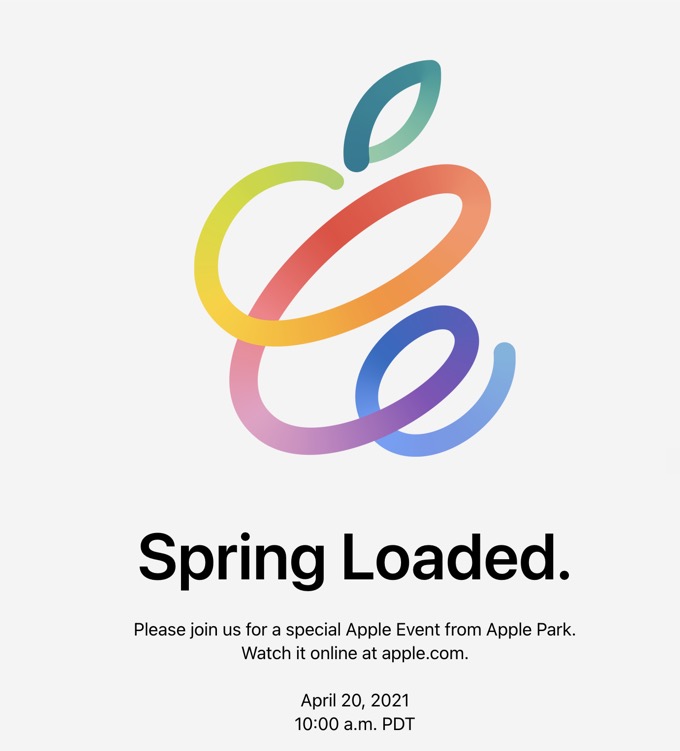
It’s official: Apple Event on April 20

Note: This story has not been updated since 2021.

Spring Loaded

Apple announced (and pre-announced) that it’s holding a virtual event next Tuesday at 10 a.m. “Spring Loaded” is the tagline.


Report: Siri spills on April 20 event

MacRumors reports that the beans have been spilled on the upcoming spring Apple event from an unlikely source:

Upon being asked “When is the next Apple Event,” Siri is currently responding with, “The special event is on Tuesday, April 20, at Apple Park in Cupertino, CA. You can get all the details on Apple.com.” The event will likely be a pre-recorded affair without media in attendance and should be live-streamed on Apple’s website and YouTube channel.

Weird. Usually Siri pretends to not understand my questions. (I assume it’s pretending.)

While this didn’t work on my phone, it did work on my HomePod mini. There’s still a chance this is old data, or the event might be delayed, but we’ll likely know by later today. Describing it as an event happening at Apple Park suggests that there will be a stream, and Apple will likely want people to tune in.


by Jason Snell

We’re cobblers

Ben Smith of the New York Times wrote an excellent piece about the rise of writers building their own businesses, most prominently newsletters based on the Substack platform. This part, about competitors to Substack, struck me for some obvious reasons:

Ghost isn’t the only alternative, of course. Twitter recently bought the newsletter platform Revue, and Facebook is developing ambitious plans for a rival that will provide a platform for local journalists, among other writers. The left-wing commentary site Discourse Blog moved to a rival platform called Lede. Others, like the tech analyst Ben Thompson, cobble together email, blogging and payment services to be what he calls “sovereign writers.”

Like Ben Thompson, we here at Six Colors are cobblers. We have used Memberful, MailChimp, WordPress and Stripe to build a membership program that lets us post free stories as well as members-only content, and then bundle it all up into an end-of-week newsletter.

Would I move to Substack if I were leaving my job at IDG today? Possibly, though it’s more limited in form than what I’ve been able to put together here. But that’s kind of the point of services like Substack—not everyone wants to be a cobbler. In fact, most independent writers who are likely to benefit from moving to a platform like Substack are probably not well versed in all the technical details of going independent and shouldn’t waste their time figuring it out when they should be writing:

Substack and its backers are alert to the risk that the service could be replaced by someone charging a few dollars a month. But they note that many writers simply don’t want to be bothered with anything other than writing, and happily pay the premium for that. (“I don’t have time to sit around trying to figure out platforms,” [Roxane] Gay said.)

Roxane Gay’s got it exactly right. Substack’s “secret sauce” is that it’s easy for independent writers to get up and running with a few clicks. Great if you’re a writer, maybe not great if you’re Substack—because countless other companies are busy replicating the model. (That competition, in turn, will also be good for writers. In the next few years you will find that many of the writers on Substack will abandon it for other platforms that will take a smaller cut of the proceeds. Others will pay experts to build something a bit more custom and to their liking. Or, alternately, Substack will be forced cut the share it takes in order to retain them.)

In any event, the die is cast as far as we’re concerned. I’m pretty happy with what we’re doing here. But then again, we’re cobblers.


This week we ponder Apple’s moves both outdoors (additions to the Find My network) and in (possible new smart home products). Apple’s also launching new original podcasts tied to Apple TV+ projects, and we discuss why some of Apple’s product launches this year may have been delayed.


First, do no Harmony

Late on Friday, as befits disappointing news, Logitech announced that it would be discontinuing its Harmony remote line:

While Harmony remotes are and continue to be available through various retailers, moving forward Logitech will no longer manufacture Harmony remotes.

We expect no impact to our customers by this announcement. We plan to support our Harmony community and new Harmony customers, which includes access to our software and apps to set up and manage your remotes. We also plan to continue to update the platform and add devices to our Harmony database. Customer and warranty support will continue to be offered.

This is real shame. I love my Logitech Harmony remote, and have bought them for my family in the past as well. This isn’t to say that the Harmony was awesome, just that it was better than any other option I’d tried.

But this demise has probably been a long time coming: a lot of people have fewer devices hooked up to their TVs now, many bundled remotes can control multiples devices, and technologies like HDMI-CEC have helped eliminate some needs for universal remotes.

Meanwhile, rumors have it that Apple is redesigning the Apple TV remote. In the past, the company designed its remote to essentially work as though the Apple TV was the only thing of import connected to your TV; thus it could control the volume of the system it was attached to or turn it on and off…but that was about it.

Personally, I’ll be clutching tight to my Harmony remote for a while yet. Earlier this year, when my Logitech Smart Control remote’s left d-pad button stopped working, I went to try and replace it and noticed they were out of stock on Amazon. Instead, I bought a competing device that was…not great. Luckily, my pal Lex Friedman had the exact same remote as me that he wasn’t using, shipped it over, and now I expect I’ll be able to get a few more years out of this.


By Dan Moren for Macworld

Apple is running out of chances to get gaming right

Apple has made several attempts to make a go of the game market over the years—anyone remember when Apple had Game Evangelists? Pippin? Game Sprockets? And each and every time, just like boss battles in classic Nintendo games, those efforts have largely been futile. Gaming has so often seemed like an afterthought for Apple, paid lip service while the company focused on other areas that it clearly felt more passionately about, like music.

With iOS, it seemed as though Apple had finally struck gold, providing a platform for hundreds of games that millions of people obsess over. But while the company’s mobile platform has proved to be profitable for gaming, there’s only so much of that success that can be laid directly at Apple’s own feet. After all, we’re talking about a company that initially eschewed the idea of even allowing third parties to build native apps for its smartphone.

The company’s latest foray into the gaming arena has been Apple Arcade, and while it started out promising, interest has largely died off until just a couple of weeks ago, when Apple made a change that might prove a shot in the arm for the company’s efforts—or could very well prove to be yet another instance of a stopped clock being right twice a day.

Continue reading on Macworld ↦


April 9, 2021

No AirTags, driving to the Apple Store, and why you might not need your own wiki.


Apple adds support for third parties to Find My network

Apple Newsroom:

Apple today introduced the updated Find My app, allowing third-party products to use the private and secure finding capabilities of Apple’s Find My network, which comprises hundreds of millions of Apple devices. The Find My network accessory program opens up the vast and global Find My network to third-party device manufacturers to build products utilizing the service, so their customers can use the Find My app to locate and keep track of the important items in their lives. New products that work with the Find My app from Belkin, Chipolo, and VanMoof will be available beginning next week.

Interesting move. We’ve long been expecting Apple’s first-party solution—the much rumored AirTags—but part of me wonders if Cupertino has scuppered that idea entirely, in favor of letting third parties build solutions. It always seemed like a somewhat odd and peripheral—literally and figuratively—market for the company to enter.

Find My is a very powerful service, given that it can harness the network of Apple devices around the world, and it potentially saves other companies a lot of time, effort, and money to not have to build out a competitive system that, ultimately, won’t be very competitive.

Several people have noticed that the biggest current competitor, Tile, isn’t yet part of this, and has taken a rather more hostile stance to Apple, having joined Epic’s Coalition for App Fairness. I wonder if that stance will last in the wake of this announcement: seems like Tile might be shooting itself in the foot.


Apple’s latest Arcade updates, LG exits the smartphone market, rumors of an iMac with a bigger display, and our automation and Stream Deck experiences.


by Jason Snell

The perfect to-do system is a mirage

Here’s Brent Simmons on chasing the perfect organizational system:

Here’s what you need to know: it’s a mirage…. There’s no getting out of this fact: these apps are all going to take more constant input from you than you’d wish for. They don’t take away the need for some amount of self-discipline to use them effectively.

I’m not going to say this is true for everyone. I know a lot of people who have approaches that work for them, and I admire that. But I figured out a long time ago that any attempt I made to make myself more productive by using someone’s system or app ended up costing me more time—in setup, in fiddling around with the details, in creating tags and categories, and in remembering to use and maintain the system—than it ever saved me.

Simmons’s post isn’t just for people like me, though. It’s really addressing wherever you are on the organizational-system spectrum. You can chase perfection forever, but it doesn’t exist. Hopefully you get more out of whatever system you use than what you put into it. That’s the most important measure.


By Stephen Hackett

Safari is the Loneliest Browser

A few years ago, I switched from Chrome back to Safari, wanting a more fluid experience between my Macs and iOS devices. While I now enjoy having my bookmarks, tabs and history everywhere I go — as long as iCloud is working — there is one Chrome feature that I wish Safari would swipe: multiple profiles.

Profile Switching in Chrome

In short, this feature is designed to let you have multiple instances of Chrome, all with their own settings, bookmarks, history and more. This comes with a bunch of obvious potential benefits.

If you want to use Chrome for both personal and work browsing, creating a separate profile for each means you can be logged into the same website with multiple accounts but never accidentally be in the wrong one. As someone who uses Gmail for both personal and work email, this can be a real lifesaver. You can also keep work bookmarks and history separate, keeping your personal data nice and tidy.

This is basically how I use this Chrome feature. I have my main account, which has a few bookmarks for things I prefer to do in Chrome, but then two additional ones.

The “Relay” profile is a pretty basic one that is logged into a specific Google account for using the admin tools for Google Podcasts. I rarely need to interact with this, so I don’t stay logged into that particular account in Safari.

My final Chrome profile is for managing the 512 Pixels YouTube channel. The Google account I use to log in for publishing videos is only used for publishing videos; there is a complete firewall between it and my main accounts. As such, it not only has its own profile, but its own theme as well. As it’s for dealing with YouTube, I’m using one that is all red and black. It’s hideous, but I know without a doubt when I’m looking at a Chrome window that belongs to that user.

Apple’s iCloud is mostly focused on individual users, but I think this concept would still fit within that framework. Being able to have different sets of browser settings for different tasks is a nice productivity feature where Google is simply ahead of Apple.

[Stephen Hackett is the author of 512 Pixels and co-founder of Relay FM.]


When technology won’t let you forget

Really great read from Lauren Goode at WIRED about the persistence of digital memory, even in the face of things you might prefer to forget:

Of the thousands of memories I have stored on my devices—and in the cloud now—most are cloudless reminders of happier times. But some are painful, and when algorithms surface these images, my sense of time and place becomes warped. It’s been especially pronounced this year, for obvious and overlapping reasons. In order to move forward in a pandemic, most of us were supposed to go almost nowhere. Time became shapeless. And that turned us into sitting ducks for technology.

Some technology companies, including Apple, have tried to make these photo-surfacing technologies sensitive to these kinds of issues, but it’s a hard problem to identify how we feel about a picture, and one that definitely merits further improvement.


It’s a big news week! Myke and Jason break down Tim Cook’s podcast interview with Kara Swisher, and discuss some big changes at Apple Arcade. There’s also WWDC 2021 and Apple’s rumored augmented-reality headset to talk about.


by Jason Snell

Kara Swisher interviews Tim Cook

Kara Swisher of the New York Times interviews Tim Cook on her podcast this week:

In this episode of “Sway,” Ms. Swisher presses Mr. Cook on the motivations behind Apple’s privacy push, the power the company has over app developers, and potential future Apple innovations, from augmented-reality headsets to autonomous cars. They also discuss the decision to remove Parler from the App Store after the Capitol attacks — and why Mr. Cook hopes that the right-leaning social media company will “come back.”

Swisher is a great interviewer and she and Cook clearly have a rapport. Most headlines will be about Cook’s comments regarding Facebook, tracking, and privacy—that’s a hot story and Cook’s answers are forceful. But as always, there’s stuff to be gleaned by how Apple’s CEO approaches specific topics.

Apple’s recent reduction of the fees it takes in from smaller App Store developers clearly helps his talking points. Just as in the run-up to the announcement of the Apple Watch (in which the wrist was an “area of interest”) Cook did not shy away from endorsing categories that Apple is heavily rumored to be building new products in. He’s excited about AR (sounds like a man with a product getting close to being a reality) and enthusiastic but noncommittal about smart cars (sounds like a man investing a lot of money in the category, but not yet convinced there’s a product there).

Perhaps most notably for Apple watchers, Cook felt comfortable in saying that he doesn’t expect to be CEO of Apple in a decade. Cook would be 70 in 2031, and as he points out, a decade’s a long time. But Cook also said he can’t see the end in sight, which should quiet down talk of succession planning at least somewhat. I don’t think anyone will begrudge Cook his chance at retirement when he takes it.


By Dan Moren for Macworld

These three annoying Apple problems finally have fixes on the way

Let’s all say it together: Apple’s not perfect. As good as the company is at creating products, even the folks from Cupertino are not immune from the occasional misstep. Nobody bats a thousand.

Sometimes those choices are quickly corrected—the brief reign of the third-generation iPod’s weird touch controls, for example—but sometimes they can linger on for some time, like the trash can Mac Pro or autocorrect’s odd choices. The truth is, sometimes these issues aren’t quick fixes, but bigger problems that require a more in-depth consideration of how to come up with a solution that not only corrects those issues, but also the problems those mistaken decisions were intended to handle in the first place.

Recently, reports have surfaced of a few changes to upcoming Apple software intended to fix some persistent issues, and which ought to to help improve the experience of Apple users everywhere. And some of those fixes may arrive pretty soon, to boot.

Continue reading on Macworld ↦


Search Six Colors