

By Jason Snell
Inside the iPad mini: OLED at the center, versatility all around, and a… vibrating display?
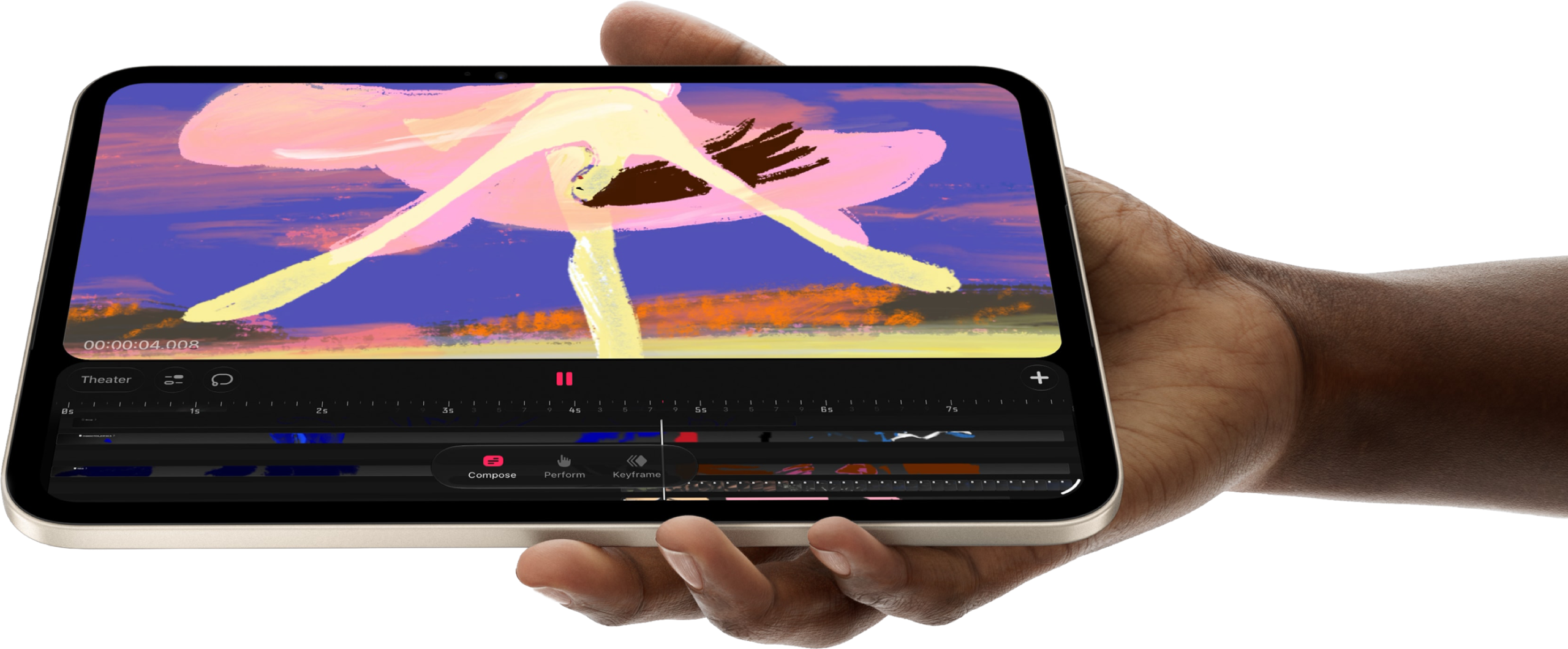
In the midst of Apple shipping a foldable iPhone and announcing its first touchscreen laptop, you might have missed an oft-overlooked l’il gadget that also got a load of love last week: the new OLED iPad mini.
But I didn’t miss it. In fact, last week in Los Angeles I sat down with Apple VP of Mac and iPad Product Marketing (and friend of the show) Tom Boger and Apple VP of Hardware Engineering Dave Pakula to dig into the new version of Apple’s beloved small iPad.
Who is the iPad mini for?
I’ve always been struck by the level of enthusiasm iPad mini users feel for the device, but also by the diversity of use cases they bring to the party. Maybe those are connected, and the iPad mini is so intensely loved because it fits (metaphorically and literally) into so many different niches.
“What a lot of people don’t realize about the mini is, it’s used by an incredibly diverse set of users,” Boger said. And while the iPad is generally embraced for its portability, the iPad mini is the most portable of them all. “From the pilot who straps it to their leg in a helicopter, to a doctor who’s doing some serious stuff with an iPad mini that just fits perfectly in their lab coat, to field service technicians. And for them, something like IP671 is huge for them.”
(That’s the iPad mini’s dust and water ingress rating, a first for the iPad product line. It means there’s less concern about taking the iPad mini out into the field, whether it’s raining or dusty or—thanks to the new nanotexture display option—very, very sunny.)
But just to be clear: the new iPad mini is not meant to be a water toy. Boger said that someone he spoke with was excited about using it to read in the bathtub, and Boger’s expression as he told that story suggested a little unease. This is not a product meant to be dunked.
“Using it in the bathtub was definitely not a grounding recommendation for us,” Pakula said. “This is really just about giving people more confidence in the ways many of them already want to use their iPad today. You don’t need to have your iPad under the umbrella. You don’t need to worry about it if your kid spills a glass of water or if it gets a little bit messy while you’re cooking. But please don’t throw it in the pool.”
A design driven by OLED
This new iPad mini has a load of new features compared to the older model. Not just that IP67 rating, but a new audio system, an OLED display, the same A20 Pro processor found in this fall’s iPhone Pro and iPhone Duo… oh, and it’s thinner and lighter, too. It’s a wholesale change for a product that hadn’t been updated in two years and deserved some love and attention.
According to Boger and Pakula, the driving force behind all the design decisions this time around was the display change.
“OLED is unquestionably a better display experience than LCD in so many ways,” Pakula said. “You’ve got the incredible contrast ratio… We’ve got much higher peak brightness, going up to 1,200 nits. What I also really love about this display is that it goes all the way down to 1 nit.” That’s great for pilots in the cockpit at night, but also for people who want to read in bed and not disturb their partner.
That decision made, “from an integration standpoint, it opened up all sorts of really cool doors for us,” Pakula said. “We were able to make the product thinner because there’s fewer layers in the display stack and the OLED panel itself is thinner. We were able to make the screen go from 8.3 inches to 8.5 inches in the same footprint because of the narrower borders of OLED… Once we flipped the switch and said, we’re going to do this thing on OLED, it opened up a tremendous number of opportunities and everything got better because of it.”
For example: “There’s not a single use case that doesn’t benefit,” Pakula said. “Reading outdoors with 1,200 nits and nanotexture, reading in dark environments… watching movies with a high contrast ratio, everything gets better.”
Sounding out the Acoustic Display
One major change in this new iPad mini’s design is the fact that its two side speakers are gone, leaving long stretches of smooth metal around the frame that usually had speaker grille holes. Instead of traditional speakers, Apple built what it’s calling the Acoustic Display, which uses the iPad’s screen itself as part of the audio system. And while Apple makes water-resistant devices that still have traditional speakers, Pakula says that the whole journey started with that water and dust resistance in mind.
“That is a huge project,” he said. “There are thirty-five different seals we needed to manage and design and validate…. The first thing that we did, is you look at all the openings in the enclosure and you say, ‘Are there any of these we could get rid of?’ And we had some brainstorming sessions and one of the things that came to light with talking with the acoustic folks is actually that because of the very specific size of iPad mini, the cover glass and the enclosure actually resonate in the audible range, around mid-range frequencies, so you can get bass and mid-range acoustics transmitted through them.”
A larger slab of glass would’ve lowered the frequencies to inaudible ones, and a smaller one might have boosted them too high, but the iPad mini was in the sweet spot—so they went for it. “We built these special drivers that sit underneath the display and they couple through the display and transmit the mid-range and the bass directly through it without needing speaker ports,” Pakula said.
Unfortunately, higher frequencies wouldn’t pass through the display, so they needed an additional piece of hardware. “We designed these two little tiny tweeters, one at the top of the product and one at the bottom, and [there are] these little tiny hidden ports that are squeezed between the aluminum [frame] and the glass [bezel], you can’t even see them,” he said. “For a device of this size, it’s a surprisingly good audio experience.”
An iPad is an iPad
Every time I’ve reviewed the iPad mini, I’ve been struck most by how it is ultimately… just a small iPad. Apple refuses to build a device that’s only halfway an iPad, or is incapable of doing what the platform as a whole does. I have edited complex podcasts using Ferrite Recording Studio on the iPad mini, and it has never let me down.
“When we’re talking about the mini, the one way we like to describe it is, ‘It’s the full iPad experience in the palm of your hand,'” Boger said. Is it looking to attack specific use cases? “The answer is really no. The answer is this celebration of the diversity of how people use it. It’s so many different ways that people use it. And the trick is to enable as many of those capabilities as possible.”
He continued: “And if you kind of look across the industry, there’s nothing like the Mini, right? Anything that typically has been in that size form factor, it’s been very low-end, very just consumer oriented—watch some movies, throw it in the back of the car with your kids. The iPad mini is used by such a diverse group of people that it has to be incredibly capable. The hallmark of iPad in general, especially the mini, is versatile. And so this made it even more versatile. And any time we can make the iPad more versatile is a good thing.”
- IP67 means complete protection against dust over extended time and protected against short periods of immersion in water while under pressure between 15cm and 1m. ↩
If you appreciate articles like this one, support us by becoming a Six Colors subscriber. Subscribers get access to an exclusive podcast, members-only stories, and a special community.