

By Jason Snell
September 24, 2025 12:19 PM PT
Charting the path of the A19 Pro

One of the first things I did when I got the new iPhones into Six Colors global HQ was to get the iPhone 17 Pro Max up and running and run Geekbench 6. (I know there are a lot of Geekbench scores out there, but I like to run my own, just because.) Because I’m curious about the pace of Apple silicon innovation.
The A19 Pro chip in the iPhone 17 Pro is presumably using the next generation of CPU and GPU cores that will also appear later this year or early next year in the M5 processor. So it’s not just a view into how the chips have progressed for the iPhone, but also an indication about where gains will be made in the next generation of Macs.
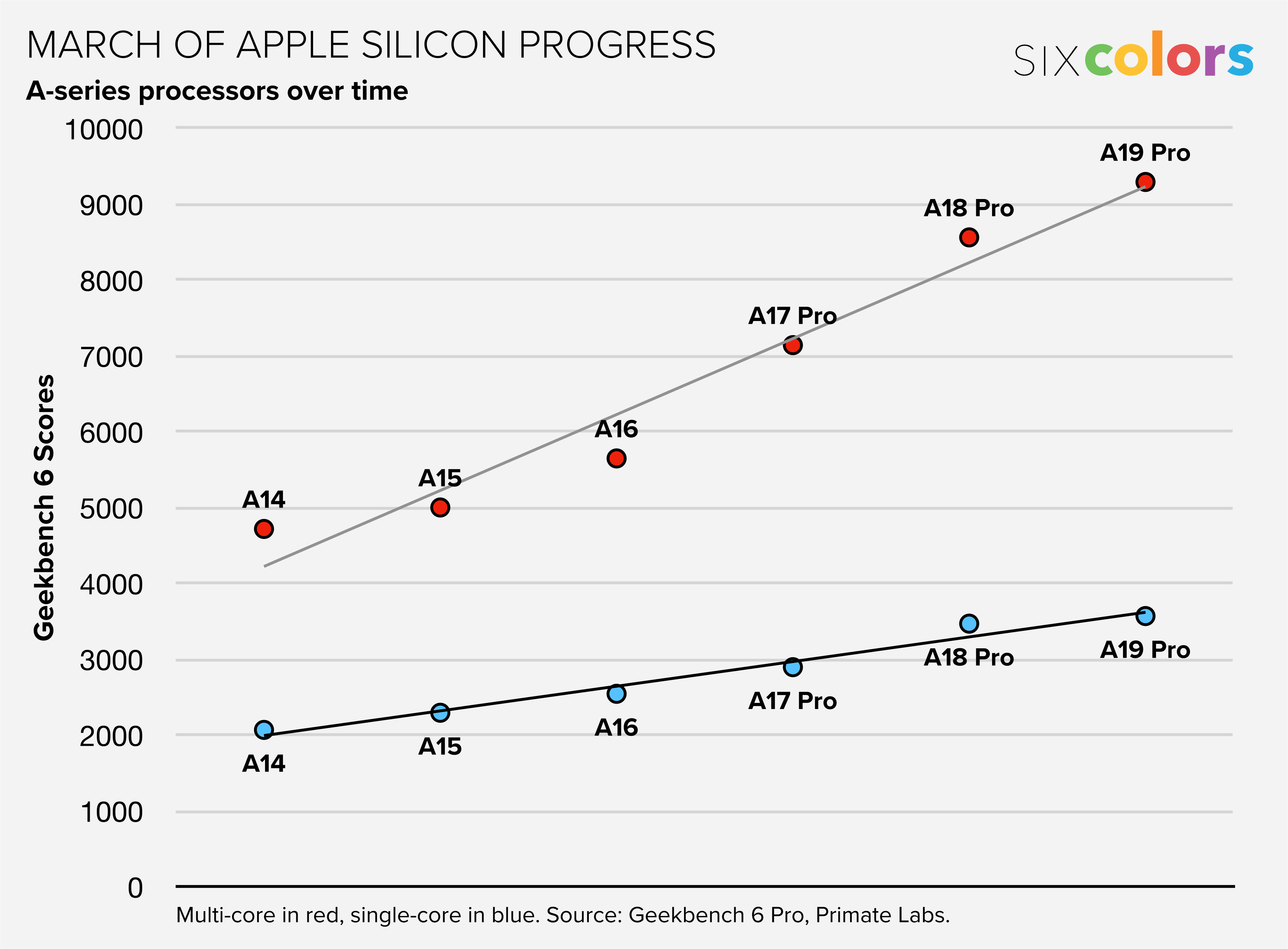
In terms of CPU, the step from A18 Pro to A19 Pro seems smaller than normal, though there may be extenuating circumstances. Single-core performance in Geekbench only increased 3% in my preliminary tests, which is the lowest gain I’ve seen in years. Multi-core performance, on the other hand, went up by 9%—much better, even if it’s a less impressive gain than any in the last four generations.
One of the tricky things in judging raw performance on an Apple silicon chip is that it’s not a single thing, but a collection of things. The A19 Pro chip on my iPhone Pro Max has six CPU cores, only two of which are high-powered “performance cores.” The other four are power-efficient “efficiency cores,” a name that implies unimpressive cores designed for the weakest of tasks.
But over the last few years, Apple has really improved its efficiency cores. Efficiency cores may not help a device conquer the most brutal processing tasks, but the faster they are, the less likely it is that the big, bad performance cores need to be kicked into gear. The more work that can be done on efficiency cores, the better—but that work is often invisible to things like benchmarks that seek to measure maximum performance.
It’s rare to see the percentage improvement of single-core scores and multi-core scores as divergent as they are this generation. I suspect what I’m seeing is the added power of four improved efficiency cores contributing to a high multi-core score, even if the performance cores on the A19 Pro aren’t a spectacular leap forward.
If you’ve been following the progress of Apple silicon the last few years, this shouldn’t be too unexpected. From generation to generation, Apple shows love to specific parts of their chips while leaving other parts alone. Some years, it’s a revamped Neural Engine (this year with the A19 Pro, in fact) or an upgraded GPU core design. Other years, it’s all about the CPUs. It varies, and the net result is forward progress over time—but not necessarily in every area, every year.
Speaking of which, this year’s GPU scores are way up.

This is the biggest increase in the overall GPU Compute score in six generations, and even longer if you divide the score by the number of GPU cores available. The A19 Pro generates Geekbench GPU Compute scores 65 percent faster than the A17 Pro of just two years ago, with the same core count. It’s been an impressive couple of years on the GPU front.
What does this augur for the M5 processor? You never know if Apple has a trick up its sleeve, and the M5 will have an innovation not integrated into the A19 Pro, but it sure looks like the trend this year is a more efficient CPU and a big boost to the GPU. The addition of AI accelerators on the GPU and the updates to the Neural Engine also suggest to me that these new chips will do really well on AI benchmarks.
Also, for the record, these numbers don’t really change the numbers much if we’re talking about if Apple used an A-series processor in a low-cost MacBook. Either the A18 Pro or A19 Pro could be used to power a MacBook that would match the M3 in single-core and surpass the M1 in multi-core and GPU.
As always, there’s much more to come at Six Colors as we dig into these iPhones and also await the arrival of the M5 chip, whenever that happens!
If you appreciate articles like this one, support us by becoming a Six Colors subscriber. Subscribers get access to an exclusive podcast, members-only stories, and a special community.