Note: This story has not been updated for several years.
The iMac Pro, unlike the 4K and 5K iMacs (but, strangely like some previous iMac models), comes with a stand but can be converted into a VESA-mountable version through the purchase of the $79 VESA Mount Kit Adapter for iMac Pro.
My previous 5K iMac was a VESA version, because I like my iMac to float above my desk rather than sit on it. For the iMac Pro, I bought the VESA mount adapter and made a video of the installation procedure.
Note: This story has not been updated for several years.
It’s probably not too much of a surprise to reveal that I’m a dyed-in-the-wool fan of John Williams, the man behind many of the most iconic movie scores of the late 20th century (and more than a few of the early 21st)–chief among them his scores for the entire Star Wars saga. Even in the lackluster prequel installments Williams managed to imbue the stories with depth and grandeur well beyond their measure.
If I have one complaint about the more recent Star Wars scores, it’s that they’ve only been released in partial form. The album cuts of both The Force Awakens and The Last Jedi clock in at 78 minutes each, despite films that are more than two hours in length. That means there’s a lot of material that hasn’t made its way out into the wild.
However, there are every once in a while legit opportunities to catch material that’s not been previously released. As Academy Awards time approaches, movie studios often put out packets for those who will be voting on said awards. Disney actually has a pretty extensive site with extras for a lot of its films, including The Last Jedi.
And among those offerings is a For Your Consideration cut of The Last Jedi score. Though it’s mostly pretty similar to the official album that was released, it does feature a few unreleased tracks and some alternate versions of existing cues. And you can stream it via your browser from Disney’s site. (There have also been FYC versions of The Force Awakens‘s score and Michael Giacchino’s Rogue One score released in 2015 and 2016, respectively.)
Personally, I’m hoping that Disney gets around to releasing complete scores for all the movies, as Lucasfilm did with the double-disc sets of the original trilogy. But the last Star Wars film to get the deluxe treatment was The Phantom Menace, for reasons that are probably pretty apparent. But I’d be certainly be first in line to bolster my Star Wars score collection.
[Dan Moren is the East Coast Bureau Chief of Six Colors, as well as an author, podcaster, and two-time Jeopardy! champion. You can find him on Mastodon at @dmoren@zeppelin.flights or reach him by email at dan@sixcolors.com. His next novel, the sci-fi adventure Eternity's Tomb, will be released in November 2026.]
This is the screen that set off the ballistic missile alert on Saturday. The operator clicked the PACOM (CDW) State Only link. The drill link is the one that was supposed to be clicked. #Hawaiipic.twitter.com/lDVnqUmyHa
In Mailchimp… you are asked to manually type in the word “DELETE” as a confirmation for deleting a template (an action a tiny bit less consequential than sending out a ballistic missile launch alert).
That menu is a really dangerous bit of interface design and adding an “oopsie, we didn’t mean it button” doesn’t help. The employee made a mistake but it’s not his fault and he shouldn’t be fired for it. The interface is the problem and whoever caused that to happen — the designer, the software vendor, the heads of the agency, the lawmakers who haven’t made sufficient funds available for a proper design process to occur — should face the consequences. More importantly, the necessary changes should be made to fix the problem in a way that’s holistic, resilient, long-lasting, and helps operators make good decisions rather than encouraging mistakes.
A sleepy employee did not cause this alert. It happened because whomever paid for, designed, and approved this interface didn’t give design a moment’s thought. The creators of this system are complicit in its complete failure.
Note: This story has not been updated for several years.
Ten years ago, Steve Jobs and Apple pulled a laptop out of an envelope, and the MacBook Air was born. Stephen Hackett writes about it in great detail over at MacStories, and also created a nifty video about it.
I have used the MacBook Air since the very beginning. In fact, I reviewed the first model and most of the subsequent ones.
The MacBook Air ended up as the Mac laptop with the broadest appeal, but it sure didn’t start out that way. The original Air, thin enough to fit in that envelope, was full of compromises. Start with the weird flip-down port door, which concealed a single USB port, no FireWire, and a nonstandard video port that wouldn’t ever make its way to any other Mac model. We early MacBook Air users could carry our laptops with confidence—we knew we wouldn’t be attaching them to any external display or projector unless we brought the adapters with us.
Then there was the processor itself, so underpowered that the MacBook Air was slower than Mac laptops released several years before. I believe we clocked it as the slowest Intel Mac laptop ever, despite the fact that the Intel transition was long over. Worse, the processor had the unfortunate trait of turning off one of its two processor cores when it got too hot, making the entire system unresponsive. There were obscure utilities to change the processor timing in attempts to make it more usable, but the fact was, if you were using the MacBook Air in a warm room—and this happened to me every afternoon in my office at Macworld, which had west-facing windows—it would start to slow down. It was a great laptop to use in a meat locker, though.
The storage options were ridiculously small. I had to delete a massive amount of data from my previous Mac before I could migrate my data to the original Air’s 80GB hard drive. (There was also an optional 64GB SSD model, for an extra $999!) There was no internal optical drive. The battery wasn’t removable. And of course, the original price tag—$1799—brought bottom-of-the-line performance to the top of the price charts.
And yet my affection for the MacBook Air was legitimate! It was so much thinner and lighter than any laptop I’d used before. It felt like the future. And the truth is, this is the biggest legacy of the MacBook Air: It predicted the future of laptops and then brought that future into being. It created an entire category for PC laptops, Ultrabooks, which was loosely defined as “PC laptops kind of like the MacBook Air.”
Today’s Mac laptops look an awful like the MacBook Air. Fortunately, the Air also evolved in the intervening time, adding ports and losing that drop-down door in a second-generation hardware redesign that introduced the ultimate form of the device, the 11- and 13-inch MacBook Airs that most people think of today when they think of the MacBook Air.
But in turning every Mac laptop into a MacBook Air, the Air made itself obsolete. The new MacBook is clearly its spiritual successor, and its days seem numbered. But when you chart the history of the laptop from 2008 to 2018, it’s hard to argue that the most influential model during the past ten years is anything other than the MacBook Air. Happy birthday, little buddy.
Note: This story has not been updated for several years.
One of these disks is from the 21st century. The rest are not.
I used an Apple IIe computer throughout high school and into my second year in college, before I bought a Mac SE. That following summer I sold the Apple IIe and everything that came with it—the monitor, floppy drives, and dot-matrix printer—and pocketed the cash1. What I was left with were two boxes containing two dozen 5.25-inch floppy disks.
I could’ve thrown the disks away—I had already transferred all the files I cared about to the Mac2. But for some reason I saved them instead. And the two dozen floppy disks stayed in two battered boxes for the next 27 years.
Every now and then I would find them in whatever storage box they’d been hidden in, as they moved from the house I grew up in to various apartments and ultimately the house I’ve lived in for the last couple of decades. In 2001 my curiosity and a feeling of nostalgia got the best of me and I decided I’d try to copy them so I could run them in an emulator on my Mac, so I bought an Apple IIc on eBay3 and an Apple IIc to Mac Serial connector cable.
The Apple IIc and some disks, mid transfer.
Whatever motivation I had to excavate my late-80s life faded with the 9/11 attacks and vanished a couple months later when my daughter was born. The IIc went in the box with the disks and there they sat until December, when I decided I was going to finally finish this project, once and for all—if the disks hadn’t rotted in the intervening 16 years.
In the intervening decade and a half, the Mac Serial-to-USB adapter I had counted on (I have two of them!) fell out of compatibility; the most recent driver I could find for it was compatible with Snow Leopard. I actually pulled a Core 2 Duo Mac Mini off a shelf and installed Snow Leopard on it, but plugging in the adapters only resulted in a kernel panic.
Fortunately, there are sites out there to help people like me with problems like these. I ended up buying a couple of cables from RetroFloppy, one that connects to the Apple IIc modem port and has a standard PC serial plug on the other end, and a PC serial-to-USB adapter that has modern Mac drivers.4
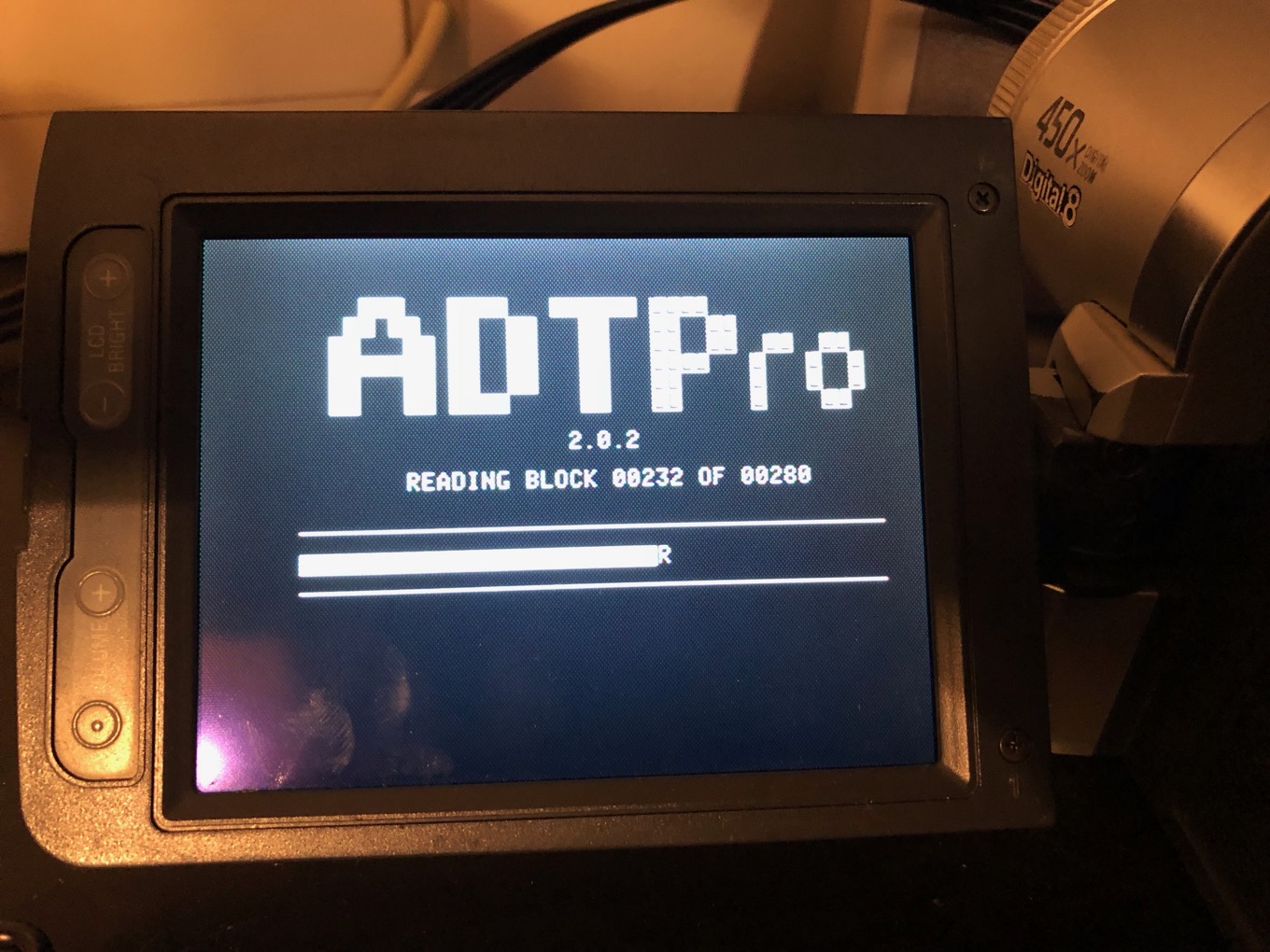
Since I was placing an order with RetroFloppy, I also bought a copy of David Schmidt’s ADTPro for Apple II (on 5.25-inch floppy disk!) because I needed a copy of it anyway. ADTPro—short for Apple Disk Transfer ProDOS—is the go-to software for copying files off of an Apple II.
The next step in the process was figuring out how to see anything on my Apple IIc. That computer’s stock video-out port is a single composite RCA plug, the kind you’d plug into any TV or VCR back in the day. Unfortunately, since 2001 almost every single video device in my life has been replaced with one that doesn’t offer composite video ports. I was concerned that I was going to have to buy an adapter, but then I realized that I still have my old digital camcorder, which has composite ports and which I have used (via a FireWire daisy chain of epic proportions5) to convert old VHS tapes from an old VCR into digital files on my Mac. Yes, I ended up booting an Apple IIc and using a Sony Digital 8 camcorder as the external monitor.
With that all set, it was time to run ADTPro on my Mac. It’s a Java app and therefore not the prettiest thing, but it did the job—I was able to connect to the Apple IIc and boot into ADTPro, at which point I could simply start inserting disks one by one and watch as they were transferred (at a surprisingly fast rate—less than a minute) across the serial cable to my Mac, where they were saved as 143K Apple II disk image files. Talk about anticlimactic. Imaging took less than an hour. There were no bad disks, nearly 30 years later.
Sending a file using ADTPro. As seen on my camcorder-monitor.
After the imaging was done, it was time to read them on my Mac using Gerard Putter’s Virtual II emulator. The disks with DOS or ProDOS on them booted just fine. There’s even a Quick Look extension for Virtual II that would display the contents of a disk in the Finder when I pressed the space bar. How civilized.
Then came a new problem: How do you get text files out of a virtual computer? The answer seems to be the same as with a real one: you “print” the files, and Virtual II’s virtual printer can generate a PDF or put text on the clipboard. But to print a text file, you need to load it into a program. Fortunately, I found a disk image of my preferred word processor—Apple Writer II—in an archive of old Apple II software on the web, and was able to boot up that program and load all the disks that I had formatted in the ProDOS disk format.
Quick Looking an Apple II disk image in the High Sierra Finder.
But a lot of my disks were in DOS 3.3 format instead, and couldn’t be read. How to get the files off of there? Apparently there exists no bootable disk image of Apple Writer II for DOS 3.3 out there—every single version I found failed to boot on Virtual II—so I had to try some other techniques.
One thing I tried was to create a “bootstrap” version of the disk converter utility, ADT, on my Apple IIc. This didn’t end up proving a fruitful avenue—turns out my own copy of Apple Writer II for DOS 3.3 was also impossible to copy to a disk image—but it did provide the most hilarious moment of this entire project.
You might be asking yourself, how would this project have gone if I hadn’t given in and ordered that floppy disk containing ADT Pro from RetroFloppy? The answer is that you can bootstrap an Apple II from nothing but a serial connection back to your Mac. You type a couple of commands into the Apple II, and then ADT Pro proceeds to use the serial connection to type in an entire program in machine code that you can run to begin transferring files or even initialize a bootable disk. Bananas.
The bootstrapping! Or a ghost who knows machine code.
In the end, how did I get the text files off of the DOS 3.3 disks? I tried to remember how I did it when I made the switch to ProDOS back in the day, and with a couple of Google searches the answer was revealed: There was a disk utility, Copy II Plus, that would transfer files from a DOS 3.3 disk to a ProDOS disk6. So I downloaded the right Copy II Plus disk image from a web archive of Apple II software, inserted a virtual blank disk into my drive, and transferred all those files from DOS 3.3 to ProDOS—retracing steps I had taken in 1988.
One final thing I wanted to do was run the my old computer bulletin board system, which signed off for the last time when I went to college in the fall of 1988. I still had the disks. Unfortunately, they just don’t work—the BBS program was built to work with a specific modem, the Apple-Cat II, that Virtual II can’t emulate. Without that modem, the BBS wouldn’t run.
Fortunately, all of its data files were simply saved on the floppies as text files—so I could read the contents of the BBS, but not actually run it. In any event, I posted my findings to my Facebook page and that led to an impromptu reunion of the people who were on that BBS 30 years ago, many of whom I’m friends with on Facebook today. (The contents of the BBS itself? Nothing special or memorable—the files are all basically Twitter posts made a couple of decades before Twitter existed.)
Oh, Apple Writer. Oh, 1989 me.
As for those text files that I had saved for 30 years, and plotted to revive since 2001? It turns out the journey, through old computers and transfer cables and disk images, was the true reward. Nobody needs to see the term papers they wrote in high school 30 years after the fact. I did discover some of the earliest short stories I wrote, which were more terrible than I’d even imagined.
Most distressing was all the stuff I’d written that I have absolutely no memory of. The real lesson of my spelunking through my disks from the 1980s is that out of the dozens and dozens of essays and stories that I wrote back then, I only really remember a handful of them today. The rest faded from view, largely because they were irrelevant and deserved to fade from view. But I’d be lying if I said it wasn’t a little sobering to be shown a clear snapshot of my life in 1988 and fail to recognize a huge amount of it.
Am I glad I did this project? I am. It was a huge amount of fun to revisit an era of computing that I just don’t think about very often. These were the days when you booted off a disk, loaded the program on the disk, and then took the disk out of the drive—because once the program was in memory, you didn’t need the program disk anymore!
From the perspective of 2018 I’m also not impressed with the user interfaces of the 80s. To load a new file into Apple Writer, I have to type control-N (to make a “new” editor without the previously loaded file), type “y” to confirm and hit return, then type control-L, and then type the filename of the file I wish to load—including its volume name. If I want to see a directory listing of a disk, that’s a different command nested in a list of menus based on a different keyboard shortcut.
Ugh. No thank you. Nostalgia is great, but progress is greater.
I kind of regret not keeping it, but can’t really picture myself hauling that thing around for all these years. ↩
I bought a 3.5-inch drive for my Apple II, and I could copy files off of that disk and onto my Mac’s hard drive with an Apple-built transfer utility. ↩
So far as I can tell from an etching on the side, it was originally owned by NCTRC. ↩
But device proliferation is at an all-time high: I’ve got devices that range in size from an Apple Watch all the way up to a 5K iMac. There’s a place and purpose for each and every one of these devices; they serve distinct and specific niches in my work and play. I’d be hard-pressed to part with any of them.
Still, part of me yearns for the simplicity of accomplishing all the same tasks, but with fewer things. Maybe one device could take the place of multiple devices? Blasphemy, perhaps, especially when Apple makes so much of its money on hardware. But there’s precedent for both the technology industry and Apple creating one device that can operate in more than one context.
Our apologies: Lex recorded this episode inside a tin can.
The power went out at CES: https://slate.com/technology/2018/01/the-power-went-out-at-ces.html
Apple investors urge the company to do something about kids and screens: https://www.nbcnews.com/tech/apple/apple-investors-urge-action-iphone-addiction-among-kids-n835866
The App Store preferences panel can be unlocked with any password: https://www.macrumors.com/2018/01/10/macos-high-sierra-app-store-password-bug/
Jimmy Iovine denies he’s leaving Apple: https://www.theverge.com/2018/1/10/16873398/jimmy-iovine-apple-music-denies-leaving
Dan is a textbook example: https://twitter.com/ItMightBeKyle/status/951032824491995137
Panic suspends sales of Transmit for iOS: https://panic.com/blog/the-future-of-transmit-ios/
Lex likes Infuse for iOS: https://firecore.com/infuse
Our thanks to Casper (https://casper.com/therebound) for sponsoring this episode. You spend about a third of your life sleeping, make sure it’s on a good mattress. Go to casper.com/therebound to start your 100-day money-back trial. You’ll get $50 off by using the code “REBOUND”.
Our thanks as well to The Art of Charm, an iTunes top 50 podcast that is packed with wisdom in the truest sense of the word. Go to (http://TheArtOfCharm.com/podcast) or search for The Art of Charm on iTunes or wherever you listen to podcasts, and start taking your life to the next level.
“At what point is it just trying to one-up things and at what point is it to thwart law enforcement?” FBI forensic expert Stephen Flatley said yesterday while speaking at the International Conference on Cyber Security in Manhattan, according to a report by Motherboard. “Apple is pretty good at evil genius stuff.”
Flatley also used the word “jerks” to describe Apple and its approach to iPhone security, according to Motherboard.
I guess it’s like the old saying goes: one person’s “evil genius” is another’s “champion of personal privacy.”
2017 was a pretty great year for iOS. A whole lot of my wish-list items for iPhone and iPad got checked off. And yet, like a kid who got a bike under the tree and still immediately begins assembling a birthday wish list, it’s my job as a columnist to immediately ask Apple what it’s done for iOS lately. Ungrateful, I know, but life goes on: Here’s what I hope to see from Apple in the world of iOS in 2018.
Note: This story has not been updated for several years.
If you spend as much time in Slack as I do1, you get used to some of that app’s idiosyncrasies. In particular, typing a colon followed by an emoji name has become second nature to me, especially because it’s often much faster than hunting for the same emoji in iOS or macOS’s character palettes.2
More than once, then, I’ve found myself starting to use the same syntax to summon an emoji in Messages or Mail on my Mac, only to be frustrated when I accidentally send :smiley: instead of, you know, 😃.
That is, until I stumbled across Matthew Palmer’s Rocket, which fills a void that I’ve been dreaming of: Slack-style emoji throughout macOS. The basic version of the app, which is free, lives in the menu bar and simply pops up a palette whenever you type a trigger character–by default, the colon. You can then start typing the name of an emoji, using Tab to auto-complete it, or the cursor keys and return to select a different item from the list. It also means not having to take your fingers off the keyboard in order to type emoji.
There are a few customization options in the basic Rocket, including the color of the pop-up palette, the trigger key, and default skin tone, and you can also disable it in specific apps or on specific websites.
For $5, you can also unlock a variety of Pro features, including full emoji search, the ability to send GIFs and stickers, and custom shortcuts for emoji and GIFs.
On the whole, I’m pretty pleased with Rocket. One feature, however, that I wish it had was the ability to have distinct trigger characters for emoji and GIFs. By default Rocket is set up not to work in Slack, so as not to collide with Slack’s own emoji key, but I’d love it if I could use “\” or something in order to still use Rocket to insert GIFs.
Other than that, though, Rocket definitely earns itself ðŸ‘ðŸ‘.
I’ve got a ridiculous eighteen that I’m a registered member of, though many of those are largely inactive. ↩
That said, let’s be clear that Slack is way behind in the emoji game. Where’s my vampire? ↩
[Dan Moren is the East Coast Bureau Chief of Six Colors, as well as an author, podcaster, and two-time Jeopardy! champion. You can find him on Mastodon at @dmoren@zeppelin.flights or reach him by email at dan@sixcolors.com. His next novel, the sci-fi adventure Eternity's Tomb, will be released in November 2026.]
It didn’t take long to realize that I had made a mistake. Even during the migration, I could hear the new iMac’s fan blowing, and once I was logged in, it was even louder… the Core i7-powered iMac on my desk seemed to ramp up its fan far more often than my older i5, and when it did, the noise was noticeably louder than before….
Even under load, this iMac Pro is silent. The fans seem to spin all the time, but Apple has the machine tuned in such a way that they don’t really ever speed up; the exhaust air just gets a little warmer. With my microphone less than a foot away, I don’t have any fan noise in my recordings. That’s a big win for me.
It is striking to use a computer that, when under extremely heavy loads, doesn’t rev up its fans like a jet engine.
Let me count the ways my latest MacBook Pro is not suitable for professional use, but before I do that, you should know that I’ve been buying and recommending Macs since 2001. I’ve spent a fortune on them. I love them, but I only like my latest MacBook Pro (a 2016 model with the Radeon Pro 460). I write this with a heavy heart and a malfunctioning keyboard. This is a story about unrequited hardware love.
This is a pretty solid summary of the sentiment against the most recent MacBook Pro redesigns.
The Wi-Fi Alliance has announced WPA3, a new standard of Wi-Fi security features for users and service providers. This is welcome news, given that a Wi-Fi exploit was uncovered late last year which affected all modern Wi-Fi networks using WPA or WPA2 security encryption, letting attackers eavesdrop on traffic between computers and wireless access points. The new WPA3 features will include “robust protection” when passwords are weak, and will also simplify security configurations for devices that have limited or no display interface.
Obviously good news in light of the problems with WPA2. There are some cool potential features in WPA3, including “individualized data encryption”, which in theory means that different devices on the same network will utilize different encryption schemes–so if somebody compromises a network, they don’t automatically get access to all the other traffic running through it.
Presumably existing devices will be able to reap the benefits of these improvements, but it’s unclear at present. The Wi-Fi Alliance is making some enhancements to WPA2, as well, which hopefully means better security for our many and varied Wi-Fi-enabled devices.
In one of CES’s stranger announcements, Nanoleaf has introduced what’s essentially a giant 12-sided die that controls your home. You just set the die down, and it’ll set your smart home gadgets to some predetermined configuration.
I love this product announcement. It is quintessentially CES. It’s kind of baffling, not actually shipping, and yet brilliant and cool in some ways. I think the general idea of using the positions of real-world objects to control devices has some merit, even though this one is kind of bananas.
The world is another step closer to a single unified wireless charging standard, with news that Powermat has joined the Wireless Power Consortium (WPC), developers of Qi wireless charging. Powermat is best known for developing the PMA/Airfuel standard – the only major outstanding rival to the dominant Qi brand.
As the article suggests, Apple throwing its weight behind Qi pretty much put the nail in the coffin for PMA/Airfuel, but this is a serious plus for the adoption of wireless charging technology. At least until “real” wireless charging comes along.
Transmit iOS made about $35k in revenue in the last year, representing a minuscule fraction of our overall 2017 app revenue. That’s not enough to cover even a half-time developer working on the app. And the app needs full-time work — we’d love to be adding all of the new protocols we added in Transmit 5, as well as some dream features, but the low revenue would render that effort a guaranteed money-loser. Also, paid upgrades are still a matter of great debate and discomfort in the iOS universe, so the normally logical idea of a paid “Transmit 2 for iOS” would be unlikely to help. Finally, the new Files app in iOS 10 overlaps a lot of file-management functionality Transmit provides, and feels like a more natural place for that functionality. It all leads to one hecka murky situation.
This is a real bummer for me personally, because Transmit is a huge part of my iOS workflow. Whether it’s editing HTML files on my web server, uploading images to reference in Six Colors articles, or uploading podcasts to a content-delivery network, Transmit (and its integration with Workflow) is a tool I rely on. It’s also frustrating to see a professional-level tool fail to catch hold on iOS.
David Letterman has amassed an all-star roster of guests for his Netflix talk show series, titled My Next Guest Needs No Introduction with David Letterman. The 60-minute show will stream monthly with the first episode launching on Friday, Jan. 12 and the additional five episodes streaming, one a month, after that.
Letterman will kick off the series with a chat with Barack Obama, serving as the former president’s first talk show appearance since leaving office. Other guests set for Letterman’s series are George Clooney, Malala Yousafzai, Jay-Z, Tina Fey and Howard Stern.
Each episode will be centered around one person Letterman finds fascinating, with the two engaging in in-depth conversations both inside and outside a studio setting. The show will also feature field segments with Letterman embarking on trips related to the guest featured in each episode.
A monthly pace seems just about right for a retired talk-show host. I’m really looking forward to this.
Late last year, Apple announced that it would delay the promised release of its HomePod smart speaker to early 2018. It was a disappointment for those customers hoping to score one for the holiday season, but in an interview with Dutch site Bright.nl, Apple senior vice president Phil Schiller said Apple needed “more time to make it right.”