

By Dan Moren
September 14, 2026 10:17 AM PT
iOS 27 Review: Little things mean a lot
By now you’ve probably heard the promise of iOS 27: it’s a Snow Leopard-like year where Apple spent a lot of time not on big marquee features, but on smaller fixes and enhancements throughout the operating system. And that’s largely true—and largely to the benefit of the platform—but it’s also not the whole story. Because there is, of course, at least one major feature that comes to iOS 27 (and Apple’s other platforms) this year, and it’s a doozy: Siri AI.
The result is an OS that feels like a marked improvement over its predecessor, in everything from design to performance to capabilities. That’s not to say there isn’t still room for improvement—software is a living thing, and those of us who have been using it throughout the beta period this summer can attest to the fact that Apple is constantly at work trying to refine its experiences.
The promise of iOS 27 is that it’ll not only unlock new capabilities but also make your existing workflows smoother and quicker. That’s not a bad proposition for the device that many of us carry more than any other—as long as it can deliver.
Siri & AI: Two okay tastes that taste great together?
The call for Apple to do a major overhaul of Siri has existed almost as long as Siri as existed. Heck, I wrote a story about it back in 2015, more than a decade ago and only four years after the first version of Siri debuted. But even as competitors emerged and Siri moved to more Apple platforms, the voice assistant improved only in relatively small, targeted ways—a testament, perhaps, to the limitations of its underlying technology. With the recent rise of chatbots backed by large language models, it quickly became apparent how much Siri had fallen behind, and so drastic measures were necessary to bring it up to speed.

The good news is that Siri AI is capable: impressively so, at times. In the lowest of low bars, it certainly beats the pants off the previous incarnation of Siri, but its access to your own personal data and all of the apps on your phone also unlocks a host of new possibilities.
But it’s also not without the pitfalls that underlie all LLM-powered chatbots: errors in understanding, hallucinations, and so on. Perhaps the biggest challenge of Siri AI will be getting people who have written off Siri as a limited feature, only to be used for trusted tasks—setting timers, checking the weather, playing music—to be more ambitious about what they ask the assistant.
New Siri is integrated throughout iOS, whether you access it via the traditional press-and-hold of the side button or by saying the wake word, or in its new home integrated with the Spotlight search when you swipe down on the home screen. That last interface is available systemwide, in any app, by swiping down from the center of the top of the screen. The search interface has a new look too: a black liquid glass bubble with silver overtones. You can ask Siri questions by voice, or by simply typing to it.
There’s also a new standalone Siri app that stores all your conversations (with some exceptions). The app itself is pretty barebones, letting you view those conversations in List or Grid layouts, select multiple conversations to delete them, and pin or rename any single conversation. In Settings : Siri, you can choose to either open to the overview or to a new conversation and decide whether old conversations are kept for 30 days, 1 year, or forever. It’s a little strange that one-off queries (“What’s the average height of the Norwegian World Cup team?”) are stored alongside more involved conversations (“Can you help me build a specific RSS feed for this site?”); I also tend to end up with a few orphan blank “New conversation” and “New photo” entries, but it’d be nice if you could filter to find those. Conversations are fully searchable and sync between devices via iCloud.

I’ve had a couple of real “wow” moments with the feature in the months that I’ve spent with the beta. For example, early on I was on a rare long solo car trip when I realized that I wanted to listen to a specific episode of a podcast. This wasn’t a podcast that I listen to regularly or even subscribe to, and to make matters more challenging, it was an older episode. Hard enough to find in the Podcasts app when you’re not driving down the highway, but something I would never have even attempted with old Siri. But hey, now’s the time to give it a shot, so I asked Siri AI, via CarPlay, to play the episode of “The Rest is History” about the American Revolution.
After a moment of chugging—like most of those AIs, the process isn’t exactly fast—Siri came back to report that it had found one episode of the podcast about the American Revolution. “Play that,” I said…and it did. No need to specify the precise title of the episode, which I certainly would not have remembered from earlier in our conversation.
Moments like that make me feel like a Star-Trek-computer-like voice interface is here now. In large part because it does leverage the great strength of Apple’s AI implementation (and I’m not going to spend the time dithering about models and distillation and all that jazz, because the question to me is how do people use it and how does it work). But that strength is that the AI isn’t siloed off in its own website or app, but on your device with all the information that entails.
The same went for when I asked it about the date for a pool party my wife had texted me about, and who would be there. (It even correctly identified an attendee with an ambiguous name based on proximity to their partner’s name.) And when I was viewing a webpage with an upcoming flight that I asked it to add to my calendar. It was also able to identify a movie from an image in a brochure for a local movie theater, give me the performance of the Red Sox over their last ten games1, and help me figure out which model of IKEA curtain rods I was dealing with. None of them things that I would have even thought about using Siri for prior to this incarnation.
And because of Apple’s integration, your Siri AI experience works right via your AirPods. As I was walking down a hill near my house, I found myself wondering how far away the downtown skyscraper I could see was. Without even pulling out my phone, I asked Siri via my AirPods. After a moment, it gave me back an answer, but I realized it had plotted directions, so I replied “How about as the crow flies?” and it not only understood me, but gave me back a reasonable-sounding answer. And even better, it was completely correct.
Unfortunately, not every moment is like that. Like any LLM-based chatbot, Siri AI sometimes misunderstands or gives confidently wrong answers. For example, when I asked it about when my neighbor said they’d be back from vacation, it found the relevant text message but said that no return date had been mentioned, despite the fact that it was right there in the message. I took a screenshot and asked it to add a bunch of listed panels that I was speaking on to my calendar, and it added only one of them, at the wrong time and in the wrong timezone.2 Sometimes it mishears things, as the time I was using my AirPods to tell my wife I was walking past Dunkin’, and it asked me if I meant Duncan.
It’s at times unsettling to realize this is the new normal for dealing with computers in 2026. Is that better or worse than having old Siri’s frequent habit of shrugging at things it simply couldn’t do? I’m not sure that’s an easy qualitative call. In the end, it’s a mode shift: a different experience of how we interact with our voice assistants and chatbots, and we’ll have to see how people adapt.
All of that said, one thing I do appreciate about Siri AI’s implementation is that Apple has done a good job of, for the most part, making sure that the traditional things that Siri has always been good at—setting timers, playing media, adding reminders, controlling smart home accessories, and so on—are, in my experience, no worse than under old Siri. From what I can tell, Siri is mediating these requests and handling those things locally rather than handing them off to the cloud. That also means not every request to turn on lights or play your podcast gets logged into the Siri app as a separate conversation, which is I think the right approach: I certainly don’t need to save a dozen conversations where I’m setting my five-minute tea timer.
In general, I’m bullish on the future of this new enhanced Siri, and fascinated to see what happens as it rolls out to more and more users. Will it be able to sway the habits of those who’ve been using Claude and ChatGPT? Perhaps not for advanced uses like coding—though Siri AI will whip up a Python script for you if you ask it—but for your run of the mill world knowledge queries? That seems eminently plausible. And, more to the point, for questions about your life, contacts, and data? As newly minuted CEO John Ternus pointed out as this year’s iPhone event, to get the same results from one of those competing AI chatbots, you’d need to hand it access to all your data. Is that really a better alternative?
One caveat, however. As always, the future is not evenly distributed: on the iPhone side, Siri AI’s only available on the iPhone 15 Pro and Pro Max or later and the iPhone 16 or later. And, of course, due to Apple’s ongoing disagreement with the European Union, it won’t be available there.
All roads lead to Siri

While Apple Intelligence is still apparently a going concern, much of that brand has been subsumed by the “Siri” identity in iOS 27. For example, any time you put a blank cursor in a text field, you’re prompted with a Write with Siri button hovering aboard the keyboard. (Once you start typing, you get the usual word suggestions, and Siri is reduced to just an icon.) As someone who is perfectly happy writing their own text messages and emails, this prompt sometimes feels a little bit aggressive, and I wish you could disable it without turning off all of Siri.
There’s also a Siri mode in Camera, which replaces the previous Visual Intelligence interface. Now it’s just something you swipe to, like Video or Photos. In this mode, the Siri icon replaces the shutter button; snap a picture with that and it’ll attempt to tell you what you’re looking at; there are also image search and ask buttons which, respectively, query a search engine for image results and attach an image of what you’re looking at to a more targeted Siri query. But this mode essentially is just a front end for the Siri app—you can attach an image in a new conversation there too, including snapping one with the camera.
It’s also worth noting that Apple has also ramped up Siri’s vocal stylings, if you’re on an iPhone Air, iPhone 17 Pro or later and use the English voices with either the American or British accents. You can now tweak both the pace and the “Expressivity” of the voices with sliders, choosing the ones that sound best to you.
I’ve stuck with my standby British Voice 4 at the default “middle” pace, but I dialed the expressivity way up. Does that make me a sicko? Maybe! The good news is it’s my Siri, not your Siri, so I can do whatever I want. As can you. In general, I don’t find the new voices to be groundshakingly better, but there are improvements, and I hope the company quickly rolls out this option for other languages and accents.
Liquid Glass half full
To call iOS 26’s Liquid Glass redesign contentious is an understatement on the proportion of saying that Lionel Messi is good at kicking a ball. In iOS 27, Apple has made two major moves: first, tweaking the overall look and feel of Liquid Glass, and second, providing a way to further fine-tune that look yourself.

In general, the iOS 27 incarnation of Liquid Glass is far easier on the eyes, dialing down the transparency in favor of legibility. Apple’s also imposed some distinction between user interface elements and content. For example, in list views like in Messages and Mail there are now much clearer “toolbar” areas at the top when you start scrolling, even if they still have some degree of translucency. App icons have also gotten a face lift; they’re sharper, and feel more vibrant.
In case you still aren’t happy with the default look, Apple also offers an option for adjusting the glass effect without resorting to the classic accessibility tweaks that can often have unintended design consequences. Settings: Appearance: Liquid Glass offers a slider that goes from More Clear to More Tinted, with a stop at the Default or anywhere in between. You can see right in the scrollable pane above the slider how your choice will look in a live interface, which is a nice touch.3

It’s a rare concession from Apple that there is no one true way that the UI should appear, but given that the company has in recent years allowed far more interface choices (for example, Mail, Safari, and Phone all offering toggles between older styles and newer interfaces), this feels like par for the course. While the most stringent Liquid Glass detractors will likely never be satisfied, the improvements and ability to tweak further thus far feel as though they will satisfy most users.
Performance, no anxiety
Tempting as it might be to spend this entire preview piece talking about Siri AI, there are indeed other things in iOS 27 that are worth your time. Exactly which improvements they are depends on how you use your phone.
That’s because one of the odd things about looking at iOS 27 is that there’s just a ton of small stuff—those “quality of life” improvements that chip away at little frustrations and annoyances. Being able to send a text message while a photo or video attachment is still sending. Faster switching from Wi-Fi to cellular when you walk out of range of your house. The ability to change volume on your alarms independently from system volume.

All of these are just nice enhancements, sanding off rough edges and just generally making things work better. But because they’re so niche, lots of people are going to have different experiences with iOS 27, because it depends on what’s important to them. For example, is anybody going to be as excited as I am that Shortcuts now offers an “else if” option? No, probably not! But that’s okay, because I’m happy enough for all of us.
The good news is there are some places where things are just better across the board. In general, iOS 27 feels peppy. I know, we always talk about snappiness, but given the time Apple has spent on improving performance and removing bugs with this release, it’s reassuring to see that it’s borne out by my experience. Apps launch quickly, photos sync faster via iCloud, AirDrop transfers are especially rapid, browsing my NAS via the Files app was downright speedy compared to earlier versions.
Apple also touted improvements to search, particularly in Mail, an app that I use daily, which has always been a bit lackluster in that regard, especially when compared with Gmail. I do find it improved in iOS 27, even though I do have an inbox of more than 144,000 messages going back nearly 25 years. I have mostly been able to locate emails, even obscure and old ones, within a relatively short amount of time, which is definitely a nice improvement. (That’s also one place that I find Siri AI particularly handy, since it can often find emails that I struggle to locate.)
I’m most intrigued to see how this affects the experience of those using older iPhone models. Apple says that it’s brought its optimized CPU scheduler to devices all the way back to the iPhone 11, which ought to noticeably improve performance even for those who don’t have one of the latest and greatest iPhones.
Photo fit and finish
If there’s one app that always seems to get some love from Apple in its yearly updates, it’s Photos. No surprise there: our cameras document everything about our lives and we take pictures constantly.
The filter menu now lets you choose between sorting by when photos were added versus when photos were captured, as well as providing quick access to photos that were captured by you (as opposed to photos taken by others that you imported). I’m not exactly sure what the rubric there is—when I used that filter, it only showed me images back to 2017, when I have surely been capturing photos—and even just iPhone photos—for a decade before that.
There are some big improvements, particularly in Shared Albums, which now let you share pictures as full resolution, quickly download all photos from an album, and even respond with emoji other than just thumbs up. Keep in mind, though, that all members of a Shared Album will need to be upgraded to iOS/iPadOS/macOS 27 in order for anyone to use the new features.
Ad hoc slideshows have gotten improvements too. When you select a bunch of photos and play them as a slideshow, you can adjust timing and duration as well choose the transition.

For those who missed being able to assign star ratings and keywords to their pictures (shades of iPhoto!), good news, they’re both back. Keywords are accessible by swiping down in the detail view, whereas star ratings need to be specifically turned on in Settings: Photos: View Options, where you’ll find a Show Rating Controls options. To assign a rating, you’ll need to look for a tiny star icon at the top right while looking at a photo (if you have the spatialize feature on, it’s next to that).
There are some smaller niceties too. For example, you can now save out a frame of a video as an image, rather than jumping through hoops of screenshotting or exporting it to a Mac. And you can adjust the metadata on photos both individually and in bulk, if you need to correct the date, time, or location.
And, although Apple has touted that photos will upload to iCloud faster, there’s a new option for those of us for whom that still might not be fast enough. In Settings: Photos: Sync Immediately, you can tell Photos to prioritize syncing new photos over conserving battery life—for the day. Not unlike the AirDrop “Everyone for 10 minutes” option, it’ll turn the feature back off after the day is over. (In a nice touch, when you turn it on, it shows a counter of how many hours are left before it deactivates.)
But of course, Photos isn’t immune to the expansion of AI, either. Previously we got Clean Up, the tool that lets you remove unwanted elements from your photos. Apple says it’s improved that in iOS 27: you can now choose between Fast and High Quality modes, the latter slower but more powerful. The default Auto mode chooses the best option for you based on what edits you’re making.
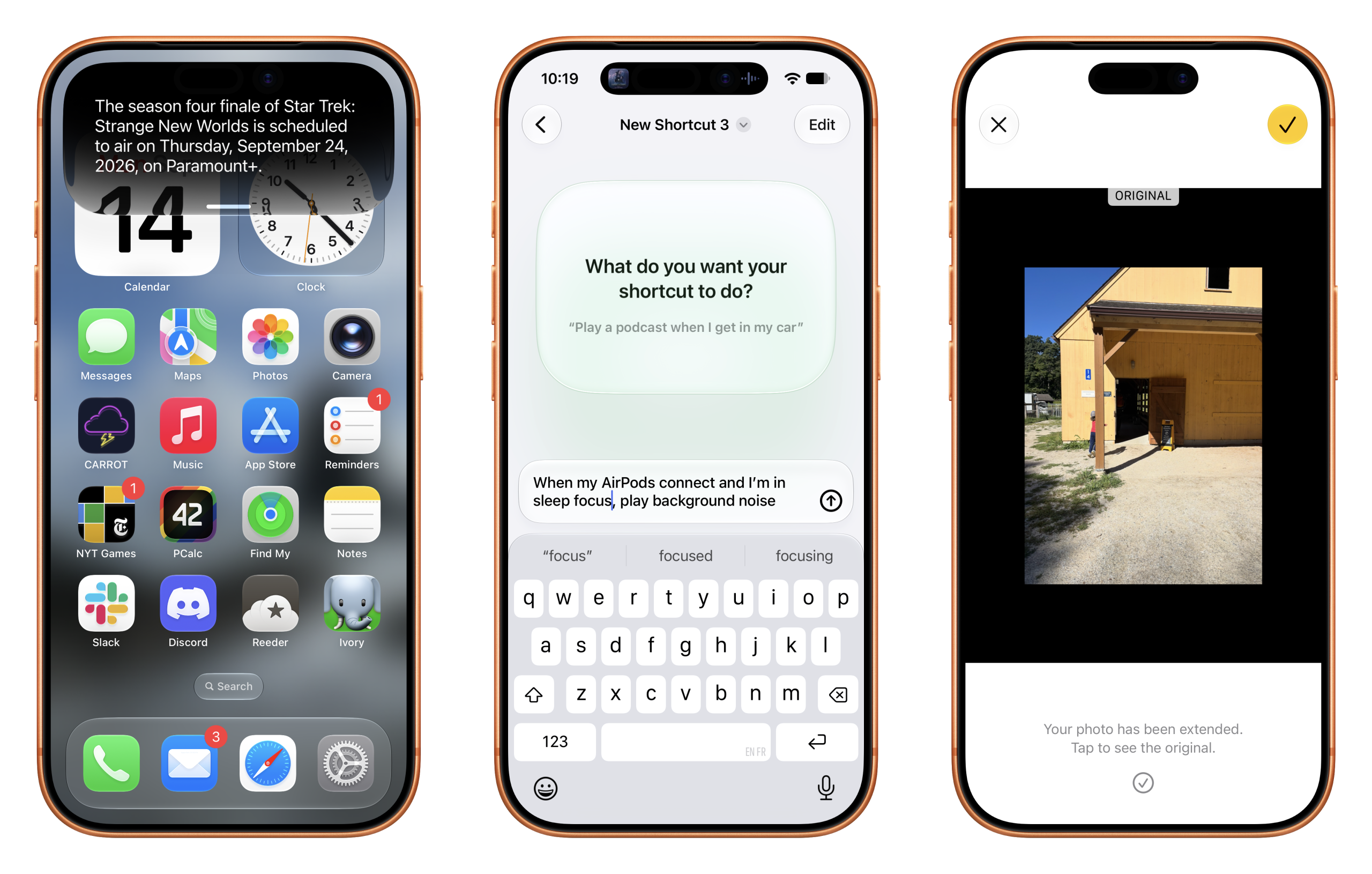
There are also a pair of new AI features: Extend and Reframe. The former is easier to understand: if you want to zoom out of a photo, whether because you’re trying to fit in a particular shape or simply to tweak the framing of a shot, Extend can generate a little more background, extrapolating from what’s already there. It works best on smaller adjustments with backgrounds that are uniform or predictable. Go too far and you’ll end up with totally invented elements, which can look strange or out of place.

Reframe is a bit harder to grok. Think of it as being able to move the camera after the picture’s been taken. Using the same features the company leverages for creating spatial scenes, it tries to separate out the foreground subjects and the background, and then adjust the perspective. Some pictures work better than others; it seems to help if there’s a clear delineation between foreground and background. Like Extend, it tends to work best for smaller adjustments; go too far and you can end up with some odd-looking artifacts. As tools, they have their utility, though it’s perhaps best used sparingly.
Just browsing

Having had a big year in iOS 26, Safari’s updates are somewhat more modest this year. It has not escaped the application of AI-powered features, with a new automatic tab organization scheme that can group your tabs based on similar themes. The good news is, this is a feature you can turn on or off, though you might have to poke around to find it. When viewing all your tabs, tap the Filter button in the top left. That’ll give you a list of topics it thinks it detects; tap any of those to just see the relevant tabs. Below that in the filter menu, you’ll see an Organize Tabs sub-menu that lets you turn on the automatic grouping.
I found it somewhat helpful, but also kind of random in its groupings. For example it described one set of nine tabs as “Crossword Puzzles,” despite the fact that only one of them was actually a crossword puzzle (all nine, however, were from the New York Times or affiliated sites). Occasionally, I have seen groups rearranged or renamed as you add or remove tabs, which is odd. But I do appreciate that you can quickly close all the tabs in a single group or move them all to a different Safari Tab Group4; you can also just drag any tab into or out of one of the automatic groups if you don’t agree with Safari’s decisions. You cannot, however, change the name of an automatic tab organization group.
A new Notify Me feature allows you to set an alert on a page for when content changes. This is a really handy feature, and I like the way Apple implemented it: when you set up an alert, it asks you what it’s looking for. So, for example, if you want to know when tickets go on sale for an event, or an item is back in stock, you just type that in. Then you can choose how often it checks, from hourly to monthly, including on what day or days of the week and what time. That’s it; you’ll get an alert when the thing happens. The only downside is that hourly being the option that checks the most frequently, it might not be fast enough to catch certain high-demand items. I appreciate, though, that whenever you visit the page for which you’ve set an alert, it shows it in a little banner at the top, along with an Edit button. You can also see a full list of the items you’ve got notifications for in Settings: Safari: Notify Me, along with the ability to edit them and, handy, information on the last time it checked.
Finally, there’s a big new Describe an Extension feature in Safari that allows you, as the name suggests, to create an extension just by typing a few lines. It’s a powerful application for bespoke needs—that website that never quite displays the way you want it to, or that feature that nobody’s ever implemented. I appreciate that if you describe functionality offered by an existing extension in the App Store, Safari will suggest that to you to check out—always nice to give a nod to third-party developers. I honestly struggled to find a need for an extension, but that may be just because I’ve already developed most of my own workarounds over the years; but I’m glad this feature exists and that Apple is recognizing that users want to take their customization to an additional level.
What’s the matter, never taken a Shortcut before?

It’s been a little while since Shortcuts got some time in the limelight, but iOS 27 brings a few much appreciated improvements to the automation system, along with one big new feature.
Let’s start with the big news: Describe a Shortcut. Like Safari’s extension feature, this simplifies the process of making shortcuts by allowing you to describe in plain language what you want it to do—Shortcuts then goes and builds it. I’ve been impressed what it can manage for simple workflows, which it can build more or less on its own. I particularly like that the system will ask you questions if it needs clarification, and that it can refine the shortcut with further prompting.
For more complicated Shortcuts, or ones that involve actions from third-party apps, the describe system doesn’t really work, but it can still provide a good jumping-off point. I wanted to see how much of one of my more complex automations it could duplicate, and the resulting basic functionality was much more straightforward in some ways that what I’d designed5, so I ended up rebuilding my automation around what Shortcuts had generated.
Despite its limitations, some of which I imagine will be eliminated in future updates, I think this is a great tool that hopefully broadens the appeal of making shortcuts—which, in turn, will hopefully mean more time and attention spent on improving Shortcuts.

Speaking of which, there are a number of smaller improvements too. I already mentioned the existence of an Otherwise If option, which is huge for those of us with complex shortcuts; the editor itself is also speedier and more usable. And automations are now directly integrated into the shortcuts themselves, rather than just being isolated in a separate part of the app. That makes those shortcuts easier to understand and troubleshoot.
Apple’s also added the ability to store persistent data, which even syncs across iCloud, a huge boon to those who want to make more complicated shortcuts without relying on third-party tools. And, in another much appreciated move, there’s a streamlined approach to privacy and permissions, which are now all viewable in a single place within the shortcuts info panel. This should help avoid the pesky repeated prompts for access that could make shortcuts fail.
While there are still issues left to address in Shortcuts, I’m very pleased by the improvements in iOS 27, and even more heartened by the fact that they happened. Shortcuts feels like it’s been lying fallow for some time, and I’m glad to see that Apple has remembered it’s a vital and useful part of its operating systems.
Other features
Apple’s made a big push on child safety across its product lines for the 27 updates. Some small improvements ought to really make the process more usable, such as the ability to convert an Apple account to a child account, default settings for time limits developed in conjunction with the American Academy of Pediatrics, and a much-requested option to lock the Screen Time section of Settings on a device. Taking advantage of some of these features will require you to update all the compatible devices in your family, but you can still use the on-device improvements.

I really love the new button above the keyboard that appears when you’ve copied something to your clipboard, showing you a preview and letting you tap to paste it, though it’s taken me some time to circumvent my deeply ingrained muscle memory of holding to bring up the context menu to paste. (It’s also vastly more useful than the overly aggressive “Write with Siri” prompt that appears when above an empty entry field. I’m not that desperate when I’m writing a text message, guys.)
While Apple announced new Pro photo features for the Camera app on the recently introduced iPhone 18 Pro, the rest of us do still get a nice feature update: you can now edit the controls you want to appear at the top of the app. By default, you get Flash, Live Photo, and Shared Library, but if you tap the controls button to the right of the shutter, you’ll see an Edit button appear at the top of the screen. Tap that, and you’ll be able to remove items from the top menu, or add any of the others for quick access. It’s a nice way to streamline the app or to make sure the features you want available are always there.
Image Playground now has improved image generation and the ability to generate photo realistic images. While some of those results are better, many of them are…unsettling. Even after a couple years, I personally find this feature misguided and off-putting.
During the beta period, Passwords offered an agentic AI feature that would scan your list of compromised passwords and then present you with a list of the ones it believes it can update for you. Apple’s removed that feature for the 27.0 release, saying it will return later. That’s good because, in my experience, it needed a little more time in the oven. Only a handful of the ones it found could be successfully updated. That said, it’s a very cool utility, and should hopefully see improvements as the technology progresses.

If you’ve ever been on a customer service phone call and needed to look up salient details like a flight confirmation number, the Phone app will now surface relevant info during the call. I haven’t been able to thoroughly test this yet, but it seems to be a real potential timesaver. And fun fact: if you call someone on their birthday (assuming you have it in Calendar or Contacts), you’ll get a little animation and note about it.
In a “better late than never” improvement, Calendar now has natural language input when creating new events. Third party apps like Fantastical and Google Calendar have done this for years. I would appreciate if it were a little smarter about some things, such as picking up timezone from a specified location. If you see the event I’m scheduling is in San Francisco and I’m in Boston, maybe at least prompt for which timezone I’d like to use. But I get it: timezones are hard.

For those who love endlessly looking at 3D imagery of cities, Maps gets an improved flyover view with better 3D modeling of buildings and landmarks. Buildings do admittedly look less warped when you get in close, with sharper detail. For some reason, though, the new maps in Boston appear much, much darker than the iOS 26 counterparts; I didn’t see the same results in New York City, for example. Not sure what’s going on there.
FaceTime now lets you show the person you’re talking to your front and back cameras simultaneously. No more endlessly flipping back and forth!
You can also now put an extra large widget—i.e. one that takes up an entire screen—on your home screen. I tried this with Weather for a while and it was…interesting, but ultimately not for me. Still, it feels like the age of the home screen that’s just app icons is slowly dying off.
Conclusion
Every year, I come to the end of the review and have a moment of introspection. Who precisely is such a review for in this day and age? People don’t really need to know if an update is worth installing. Apple’s own stats say 86 percent of iPhones introduced in the last four years are on iOS 26, and 79 percent overall. (And that was for a very divisive year.) For better or worse, the vast majority of people just hit update.
So I think the role of the reviewer has evolved. Consider this less of a review of whether you should get iOS 27, and more as an overview of what to look for, what to try—what works well, what could still use some tweaking. In an update like iOS 27, which has a lot going on, that’s more important to ever. Even I’ve missed features here and there, or found ones that I just haven’t had the time or opportunity to try.
Despite being put forth as a year of small updates, there’s quite a lot in iOS 27, even without including the massive overhaul that is Siri AI. Apple had found itself on its back foot after its first attempt to integrate Apple Intelligence, but my experience is that Siri AI largely delivers on what the company promised—albeit a couple of years later than intended.
But I’m also very bullish on the enhancements and quality of life updates throughout the operating system. The improvements may be small, but they add up. Every time you don’t have to go searching for an email while you’re on a call or a photo shows up faster in your library or you find exactly what you’re looking for in search, well, I’m not going to say an angel gets its wings, but you get less frustrated. And that’s not nothing. In fact, that’s everything. The goal of technology should be to work for us and make our lives easier.
- This was mid-July and, to be honest, I did think it was lying there for a minute. ↩
- I’ve had more than a few issue with timezones and events, but I get it: timezones are hard! ↩
- And a whimsical Easter egg! Scroll down far enough you’ll see “Moof!” appear, followed by an image of the beloved Clarus the dogcow. ↩
- We now have topic groups that can live inside Tab Groups which can live inside different profiles and I’m starting to get dizzy. ↩
- In particular, I was impressed by how simple the prompt it generated for the Use Model action was. AI tools are good at writing AI prompts, what a surprise! ↩
[Dan Moren is the East Coast Bureau Chief of Six Colors, as well as an author, podcaster, and two-time Jeopardy! champion. You can find him on Mastodon at @dmoren@zeppelin.flights or reach him by email at dan@sixcolors.com. His next novel, the sci-fi adventure Eternity's Tomb, will be released in November 2026.]
If you appreciate articles like this one, support us by becoming a Six Colors subscriber. Subscribers get access to an exclusive podcast, members-only stories, and a special community.