

By Glenn Fleishman
July 20, 2026 10:00 AM PT
When Find My doesn’t help with separation anxiety

I dispense what might be called valuable insight to my friends, as well as in this public forum. My friends know the danger: they might become the topic of a column, which is true for my buddy Jeff, who left a bag containing his passport behind at a hotel. Fortunately, he had an AirTag in his bag. That was, however, just the beginning of the journey. (Jeff gave me permission to share his story.)1
To avoid suspense, I’ll tell you that Jeff doesn’t have his bag back, but will soon.
Grate news
Jeff was out of town on business for a few days—he’s one of those nearly extinct creatures called a “full-time technology reporter“—and was carrying his passport to Texas not because it’s another country (it hasn’t seceded yet), but because he lacks a Real ID-upgraded driver’s license. He had a small bag with a few items, including the passport and an AirTag, that he didn’t need to carry, so he used the hotel safe. There have been many articles written about how unsafe hotel safes are, but it feels as if you’re in a decent hotel, it’s still another bar for someone to get through to steal your stuff.
Leaving in a bit of a rush, Jeff didn’t retrieve the bag from the safe. When he realized it wasn’t with him, thousands of miles later, he was peeved. Shouldn’t the “left behind” feature in Find My have alerted him? Find My showed the bag’s location, however. For some reason, it appeared as if it were in the hotel parking lot. I catastrophized with him, assuming it was stolen. He called the hotel, which said it wasn’t in lost and found.

A staff member went out, looked in the parking lot, and said the rough location was a grate—perhaps the bag had been stolen and someone had found the AirTag and dropped it through the slats? Which would imply that a hotel employee or a thief had managed to get into Jeff’s room after he left, open the safe, leave the hotel, and rummage through the bag in the parking lot before absconding.
That wasn’t the case (or valise). The hotel called back the next day. The previous staffer didn’t know, for some reason, that valuable left-behind items were tagged and placed in a safe in the basement, presumably below or near the parking lot. His bag, containing his passport and other items, would be sent back to him.
Jeff’s experience reveals several aspects of the Find My tracking system that you can take advantage of in advance or use if you’ve lost something or left it behind.
Don’t leave me!
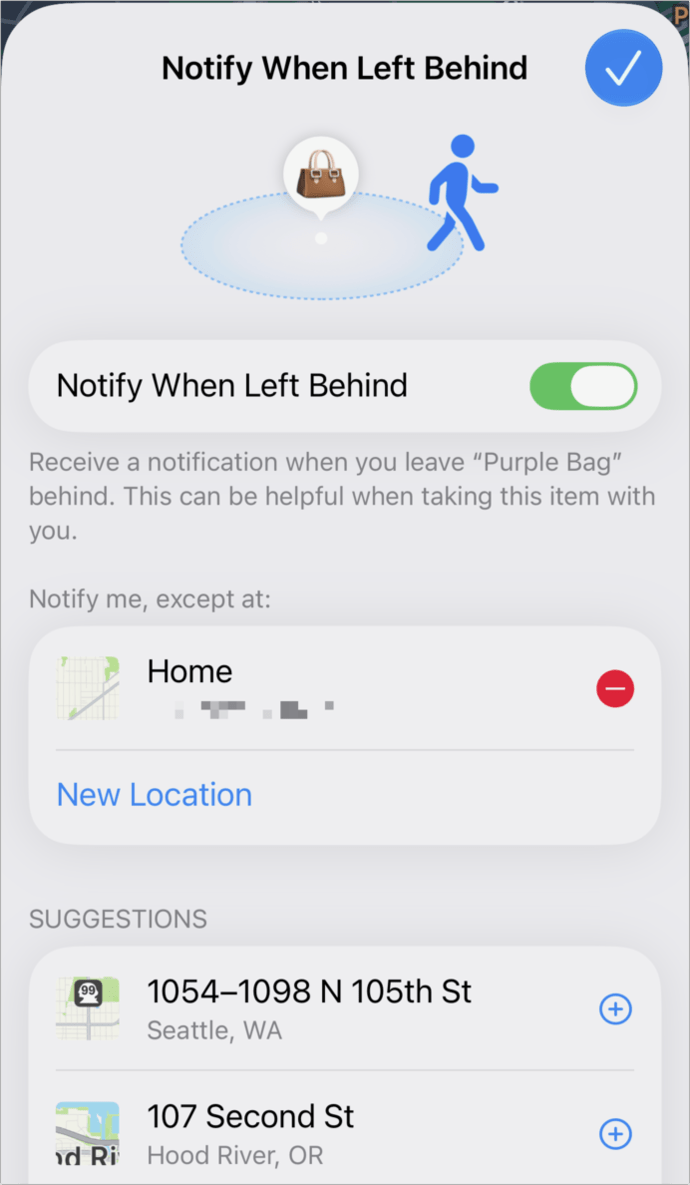
Every device and item you have can be set to alert you when you “leave it behind.” I believe this setting is enabled by default, though Apple’s documentation isn’t clear on this point. All of my devices and items have it enabled, and Jeff found it was turned on for all his gear. Here’s how to check:
- In a native Find My app, select the device (like a Mac) or an item (an AirTag or other Find My network item) in the list of such things.
- On an iPhone, iPad, or Apple Watch, the action sheet appears. On a Mac, click the info (i) icon next to the item’s name on the map. In the upcoming version 27 operating system releases on all platforms, tap or click the More (…) button that appears when you select the device from the list.
- Tap or click Notify When Left Behind, which should already show On. (In the 27 releases, tap or click When Left Behind.)
- If disabled, turn it on.
Here’s a crucial detail: examine the “Notify me, except at” list. You can manually add to this set of locations (tap or click New Location). However, it primarily grows when you’re notified by an item or device being left behind, and then you tap or click in the notification to ignore it at that location. You are presented with the option to just exclude that item or device from that location or all of your equipment.
It’s very easy to approve that exclude-all button. (Jeff did not; his list didn’t include the hotel.) This can be convenient when you’re at a hotel, a friend’s house, or another location for a few days or frequently, and sometimes leave Find My-tracked stuff there. But once you ignore the location, you won’t get notified in the future. You can modify the list by hand, too.
Jeff may instead have been tripped up by the safe acting as a Faraday cage—a metal mesh or box that shields electromagnetic signals from passing through. The AirTag and other Find My items use Bluetooth to broadcast a rotating identifier at regular intervals.2 If the safe blocked that signal, Jeff’s iPhone lost contact with the AirTag the moment the bag went in—a few days before he left. With no fresh separation between the phone and the item at departure time, the alert may have lacked the necessary trigger. Jeff was on the verge of sharing the location with the hotel when they found it.

Apple says this takes longer than the few days Jeff was on his trip: “You can see its last known location for up to seven days in the Find My app.” After seven days, the device or item’s location will appear as “No location found” or “Offline.” Jeff could see the item’s location, which made the lack of notification seem like a bug.
Now for the grate part (not great part): once Jeff’s bag was removed from the safe in his former room, it would have been carried through the hotel and detected by every iPhone, iPad, or Mac nearby. When it reached the hotel’s lost-and-found safe, the rough location would likely still be relatively close before it entered that particular Faraday cage. At which point, when Jeff looked at Find My, he saw it at (or under) the parking lot.
Sack attack
The hotel works with a service that handles the return. Jeff paid both a whopping and reasonable $60 to have it sent two-day air back to him. Fair enough! Unfair enough, days after he paid, the bag is still at the hotel (as I write this). Jeff will, of course, follow its progress via Find My.
[Got a question for the column? You can email glenn@sixcolors.com or use /glenn in our subscriber-only Discord community.]
- Just so he doesn’t feel bad, I’ll note the time back in the day of paper airline tickets when I couldn’t find my tickets and had to rush to a United counter (in a hotel!) to get them reissued. When I came home, I put them in the secret place where I keep all my important stuff, where I also found my original “lost” tickets. ↩
- The identifier is broadcast as the Bluetooth network name. To avoid being associated with an individual, Apple frequently rotates or changes the name. ↩
[Glenn Fleishman is a printing and comics historian, Jeopardy champion, and serial Kickstarterer. His current books in preparation, which you can pre-order, are Flong Time, No See, and That One Matt Bors Comic. Other books include Six Centuries of Type & Printing and How Comics Are Made.]
If you appreciate articles like this one, support us by becoming a Six Colors subscriber. Subscribers get access to an exclusive podcast, members-only stories, and a special community.