

By Jason Snell
Apple in the Enterprise: A 2026 report card

In 2021, device-management startup Kandji (now Iru) approached Six Colors to commission a new entry in our Report Card series focusing on how Apple’s doing in large organizations, including businesses, education, and government. We formulated a set of survey questions that would address the big-picture issues regarding Apple in the enterprise. Then we approached people we knew in the community of Apple device administrators and asked them to participate in the survey. We are especially grateful to the members of the Mac Admins Slack for their participation.
This is our sixth year doing the survey. Over the last few weeks, we took the temperature of about a hundred admins, half of whom report that they manage more than a thousand devices. They rated Apple’s performance in the context of enterprise IT on a scale from 1 to 5 in nine broad areas.
Below, you’ll see the survey results, plus choice comments from survey participants. Not all participants are represented; we gave everyone the option to remain anonymous and not be quoted. Though Iru commissioned this survey—and we thank everyone there for doing so again—it had no control over the survey results or the contents of this story.
Overall scores
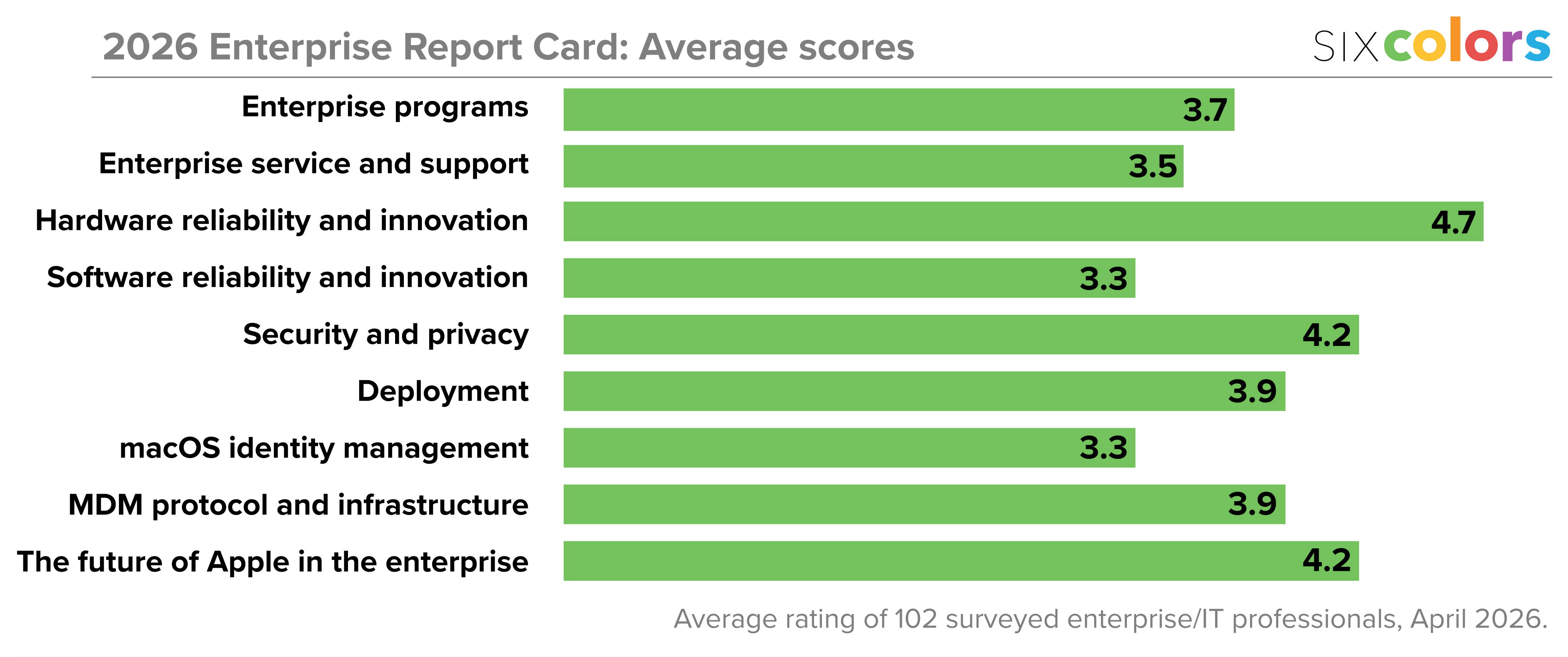
There weren’t too many radical changes in this year’s survey. Respondents are most positive about Apple’s hardware, with another strong score honoring its commitment to security and privacy. And optimism about the future of Apple in the enterprise skyrocketed, up half a point to tie for second-highest score in the survey.
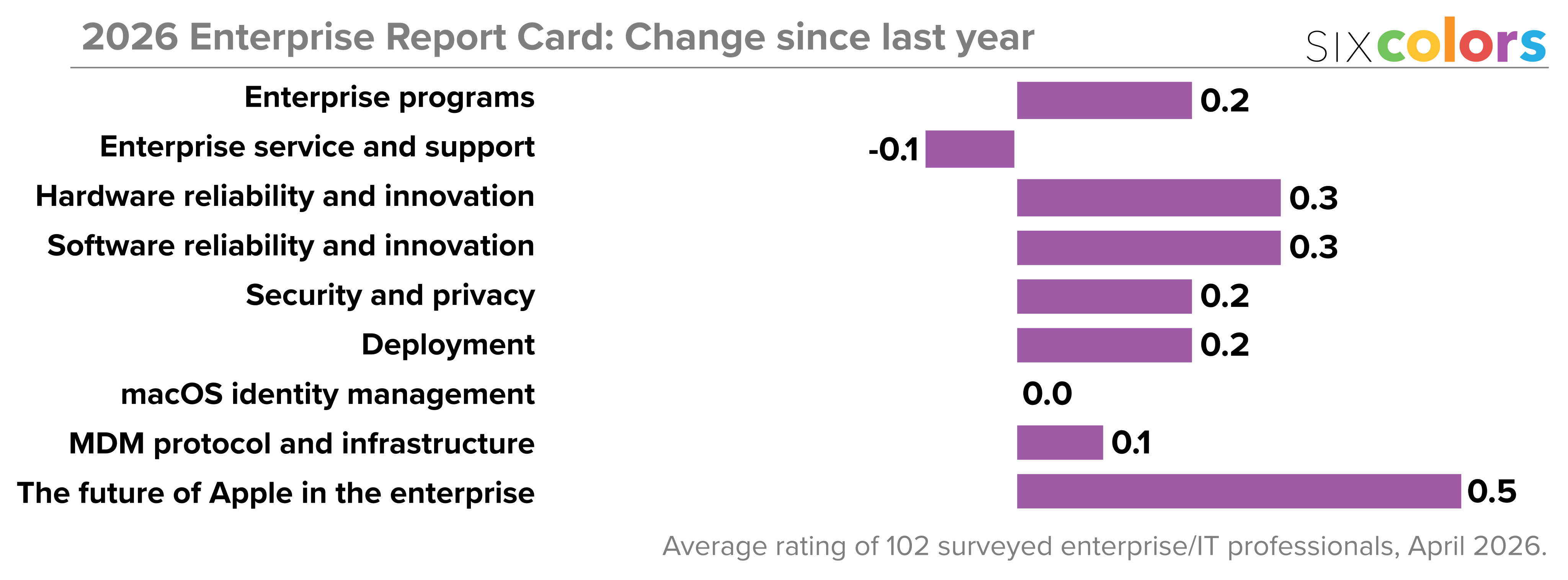
Most scores didn’t move as much as the future did, but trends were generally positive, even in the software category—a bit of a surprise, given all the grousing around this cycle from the user-experience perspective. The only score that trended down was enterprise service and support.
For the fifth straight year, we also asked about the pace of operating-system adoption.

Speaking of software surprises, half of the respondents felt that this year’s OS adoption pace was more or less the same as usual. Only 17% felt this was a slower year, up slightly from last year. What’s interesting is that there’s been a two-year trend in this category, with “quicker than usual” and “about the same” switching places. Perhaps the pace of change has just become the new normal.

Last year, we asked a lot of questions about Apple Intelligence, and as a sign of how well that rollout went, this year, we asked more broadly about AI in general instead.

Only 8% of panelists reported that AI is not allowed in their organizations. More than half specified that AI was only allowed from approved vendors, while another quarter were willing to take requests. And 13% were loosey goosey—use whatever AI you want!
In terms of where our panelists’ organizations are in terms of AI adoption, it looks like uptake is fairly strong: 39% are all in, and 43% are actively trying it out.

We next turned the spotlight on our respondents to check if they are finding AI features useful to their own jobs. (This wording is designed to make it explicitly about utility, rather than measuring which organizations are forcing AI on their employees.) Essentially, 84% say they are, and the rest say they aren’t.

We asked this same question last year, and the changes are fascinating. The “Yes, it’s somewhat useful” number grew 5%, and the “Yes, it’s very much useful” number grew a staggering 24%. Meanwhile, “Mostly not useful” dropped 19% and “Definitely not useful” dropped 11%. This strongly suggests a rapid uptake and embrace of AI among the Apple pros in our survey group.

Read on for category-by-category scores and comments from participants.
Enterprise programs
Grade: B (average score: 3.7, last year: 3.5)

After a step back last year, this category continued on its generally rising path for the life of our survey. Large sites and businesses felt better about the category than smaller sites and education.
Panelists were enthusiastic about some specific new features, but there are still long-standing gaps that generate frustration. And what’s Apple Business, anyway?
Praise for AxM API:
- “Apple took a major step forward this past year by adding an API to Apple Business Manager and Apple School Manager…. The ability to enforce device management system migration for the 26 series of operating systems is a game changer.” — Tom Bridge
- “This year we got two features Mac Admins wanted for a long time: Apple Business Manager public API and automated migration between MDMs via ABM with Automated Device Enrollment.” — Michal Moravec
So… Apple Business, huh?
- “Apple Business’s web interface feels more like an early prototype than a production-level system. The launch was most likely rushed and not very well coordinated between various teams at Apple.” — Michal Moravec
-
“The introduction of new access controls for device management … [is] helpful. [But the] April 14th [launch] introduced many controls (Brands/Ads) which shouldn’t be mixed with Device/User controls in my opinion.” — Marian Albers
-
“At first blush, I’m not impressed — but we’ll see.” — Alex Meretten
Subscriptions and VPP
- “Apple still does not provide managed volume purchases and deployment for App Store subscriptions and in-App purchases.” — Armin Briegel
-
“It is still not possible to purchase subscriptions for VPP. Which is really weird and annoying, as Apple pushes subscriptions from its own Creator Studio suite… and admins can’t purchase them for their company’s employees!” — Guillaume Gète
-
“Weird gaps chronically remain, like an inability to buy IAPs and subscriptions even to Apple’s own software like Creator Studio.” — Bob McGillicuddy
Privilege and role problems
- “Privileges and roles remain a vulnerable spot in Apple Business Manager and Apple School Manager. There’s no way to scope read-only access for third-party integrations with the API, and built-in roles like Device Manager lack meaningful guardrails against bulk device changes.” — Brian LaShomb
Enterprise service and support
Grade: B- (average score: 3.5, last year: 3.6)

After hitting a high in 2023-2024, the service and support category has dropped slightly in two consecutive years. In this category, smaller sites seem happier than bigger ones. Panelists whose organizations have direct Apple account reps or active relationships seem to feel better about the whole thing, but those relying on Feedback Assistant or AppleCare are far more likely to despairingly refer to a “black hole.” Structural issues with enterprise AppleCare were also singled out for criticism.
Woe is Feedback Assistant
- “Feedback remains an area of concern for Mac Admins. Unless you have an expensive support contract, you might as well write your concerns down on a piece of paper, fold it into a paper airplane, and sail it south of Salesforce Tower toward Apple Park.” — Tom Bridge
-
“The beta programs are always helpful, but any response to real feedback is nonexistent. It feels like a placebo.” — Craig Cohen
-
“I still have feedbacks I wrote ages ago that are not fixed, or things that have been fixed for which I got no notification of the fix in Feedback Assistant!” — Guillaume Gète
AppleCare frustrations
- “AppleCare for Enterprise has a broader reputation problem in the administrator community. Being allocated a small number of support ticket credits per year, only to be told you’ve run out when you raise an issue, is a terrible experience.” — Michael Jon
-
“The few times I have had to reach out to support, it has been convoluted to get to the enterprise support team. I have spent plenty of time in the non-enterprise support queue to only be handed off when we get through the laborious basic troubleshooting.” — Jered Benoit
Praise for AppleSeed beta program
- “Having clear instructions on how to leverage our AppleCare Enterprise support to get our deployment blockers looked at during the beta season made a big difference. Seeing those bugs fixed from one beta to the other is amazing.” — Martin Piron
-
“The Enterprise Release notes are extremely valuable.” — Marcus Rowell
Apple employees are very helpful, unless they get laid off
- “Apple laid off most of the system engineers that supported our region, which has significantly degraded our ability to get tailored advice about how new features and technologies will impact our environment.” — Luke Charters
-
“The Apple employees I get to directly work with provide more knowledge and support than any other vendor in any field I’ve ever worked in.” — Christopher Cook
What is it about documentation?
- “Apple’s problems aren’t things like the programs or support themselves. Those are solid. The problems are the ‘little’ things, like documentation…. If you need documentation of things like logging, God will literally help you before Apple will.” — John Welch
-
“Reddit provides better documentation than Apple. There is no known bug list that I can refer to.” — Jered Benoit
-
“Release notes for Enterprise are generally good, but admins still often have to gather information from various sources… It would be nice for all of them to be available in one spot.” — Armin Briegel
Hardware reliability and innovation
Grade: A+ (average score: 4.7, last year: 4.4)

It’s Apple’s top score in our regular Report Card survey, and it’s the top score here, too, with hardware praise shooting up more than any other score on the survey. Do you think the person in charge of hardware at Apple deserves a promotion? Hmm. Maybe. Panelists continue to love Apple silicon on the Mac, and the MacBook Neo was specifically singled out for praise.
Apple silicon Macs put Intel in the rearview
- “The M-series is so far above and beyond what the rest of the industry is offering right now that it’s not really a close comparison.” — Michael Jon
Thoughts on Neo
- “Not long ago, I never would have expected to hear fleet management peers, even the most committed Apple skeptics, openly praising a Mac as the most performant, best-built, fastest to procure, and most cost-effective option on the market.” — Kale Kingdon
-
“The MacBook NEO is finally an affordable option for education. Hopefully it reverses the trend towards Chromebooks.” — David Rizzo
Reliability and repairability
- “We have had more issues this year than in previous” — Craig Cohen
-
“The persistent issue is repairability, and it’s getting harder to ignore as we head into what’s looking like a rocky economic period…. The cost difference between Apple replacing your storage and a consumer doing it themselves is significant.” — Michael Jon
Procurement and availability issues
- “The tariff environment in 2025 and 2026 has been chaotic…. For enterprise procurement teams, the combination of rising hardware costs, soldered components that can’t be replaced, and stretched refresh cycles means the total cost of ownership conversation around Macs is getting harder to win internally.” — Michael Jon
-
“My only problem with the state of Apple hardware is that channel inventory dries up after a new chip is announced… We’re going to be very short on laptops very soon.” — Alex Meretten
-
“The biggest issue with it is lead times on orders.” — Luke Charters
-
“The product matrix is starting to become overwhelming… why do we need the iPhone 16, iPhone 17e, iPhone Air, iPhone 17, iPhone 17 Pro all being sold at the same time?” — Shaun Bentzen
Software reliability and innovation
Grade: C+ (average score: 3.3, last year: 3.0)

Apple’s hardware may be riding high, but software is not going great. And yet the score went back up from last year’s low of 3.0. macOS Tahoe and Liquid Glass were the dominant sources of negativity. Complaints ranged from cosmetic inconsistency to serious breakage.
Liquid Glass resistance
- “Liquid Glass is a disaster, especially for macOS, with the stupidly rounded windows where content is clipped, and they’re hard to resize.” — Cameron Kay
-
“Liquid Glass mostly feels like a change for change’s sake. With so many rough edges and inconsistencies, our users are unhappy with it.” — Marcus Rowell
-
“I’m not a Liquid Glass hater, I actually like it overall…. But the core reliability problems remain, and needless bugs were introduced and shipped with Liquid Glass.” — TJ Draper
-
“The software quality continues to slide downhill…. A UI which is supposed to elevate the content distracts from the content or makes the content less readable.” — Michal Moravec
-
“Liquid glass did not feel like a cohesive UI overhaul — just a skin…. When Apple does it, and corner radii don’t match, or text is illegible, or context menu icons are reused, it’s much less acceptable.” — Emilio Garcia
More releases, more bugs
- “I’ve never filed more bugs for a major release before…. These weren’t ‘The radius on the corners of this window element doesn’t match’ — they were ‘this is utterly broken.'” — Andrew B
-
“Software reliability has taken a hit over the last year. A number of persistent and significant bugs are notably present in Tahoe.” — David McMonnies
-
“I feel like I’ve seen more problematic software … than I have in previous years. I’m still not a fan of the annual OS cycle… take some time to get it right first.” — David Rizzo
Creator Studio issues
- “The rollout of Creator Studio was a mess. It coincided with the start of the spring semester, and Apple released a version of Logic that was incompatible with VPP licensing.” — Christopher Cook
-
“The new Creator Studio updates were a complex task to manage…. It took quite some time to be able to suppress those subscriptions via a configuration profile.” — Morgan Schönberger
A little positivity
- “The new Spotlight stuff is killer. Actions within Spotlight have allowed me to create some nice new automations.” — Shane Thompson
-
“DDM for macOS updates is a genuine bright spot.” — Michael Jon
Security and privacy
Grade: A- (average score: 4.2, last year: 4.0)

Apple’s commitment to security and privacy has always scored well on this survey, and this year saw a bounce back after a couple of years of backsliding. Panelists gave Apple credit for not just paying lip service but taking both issues seriously. However, there were definitely criticisms of specific issues.
Praise for Apple’s approach
- “I genuinely think Apple is the sole OS provider… taking this seriously, and they take it more seriously than everyone else combined.” — John Welch
-
“Apple’s platforms are probably still the best thing out there on the market in this aspect.” — Michal Moravec
-
“Apple’s zero-day response cadence has been solid this year…. The response pipeline works.” — Michael Jon
SMS reliance is a big problem
- “The SMS-only two-factor authentication on Apple Business Manager and Apple School Manager is, frankly, embarrassing in 2026…. Consumer accounts get phishing-resistant authentication. The accounts that manage thousands of devices… are still protected by a six-digit SMS code sent to a phone number that any motivated attacker can port in an afternoon.” — Michael Jon
-
“It’s long past time for Apple to adopt One Time Password over SMS for Apple IDs that require Multi-Factor Authentication.” — Brian LaShomb
Mac pop-ups and security alerts are out of control
- “The number of uncontrollable, un-actionable pop-ups in macOS presented to Enterprise end users is out of hand…. This is training users to simply click OK on a dialogue they neither understand nor care about, simply to get their job done.” — Andrew B
-
“The constant nagging pop-up, modal dialogs are actually detrimental to security…. Just recently, a dialog popped up asking for permission to do… something… but out of reflex, I clicked ‘allow’ before my brain registered anything.” — TJ Draper
-
“Apple’s first-party apps get a fundamentally different experience from third-party apps when requesting screen recording access…. That’s not a difference in security posture, that’s preferential API access for Apple’s own products dressed up as a security feature.” — Michael Jon
-
“For corporate-joined devices to have public MAC addresses [and pre-approved screen recording] would be improvements in my opinion.” — Jered Benoit
The continued tension between user privacy and organizational needs
- “I feel like I’ve been seeing IT admins have more control over endpoints. If we have MDM, we shouldn’t have to ask the user to allow our remote support tool to have access to screen recording.” — Jeff Anderson
Deployment
Grade: B+ (average score: 3.9, last year: 3.7)

Deployment is the little engine that could. The score started low in 2021 but has steadily improved, reaching an all-time high this year. Automated Device Enrollment (ADE) was universally praised as rock-solid and best in class, and panelists also praised Declarative Device Management (DDM) for software updates and Apple’s new MDM migration tool. Unfortunately, OS upgrade enforcement remains problematic, and Apple’s release timing was criticized as being disconnected from the realities of fleet management.
Automated Device Enrollment
- “ADE is still magic after all these years.” — Erik Kramer
- “My Windows counterparts wish they had such a reliable system for auto-provisioning endpoints. Autopilot is coming along, but it remains, uh, a work-in-progress.” — Damien Barrett
- “Compared to other platforms, Apple’s Automated Deployment Environment is best in class.” — Andrew Laurence
DDM and Software Updates
- “Improvements in Declarative Device Management made a huge difference to ensure computers and devices are properly updated.” — Guillaume Gète
- “The ongoing evolution of Declarative Device Management has been a slow build, but has reached a real-world ‘out of preview’ result-driven goal.” — Craig Cohen
- “While DDM for Software Update is a good start, it’s still fairly limited. Without reliable scheduling and enforcement controls, we still see better compliance using Nudge.” — Brian LaShomb
- “Software updates are still a PITA, but are gradually becoming less of a PITA than they used to be. The bottleneck is always users who ignore update prompts for whatever reason. (It’s amazing the amount of inconvenience some of them will put up with to avoid a reboot.)” — Bart Reardon
Upgrade enforcement issues
- “OS upgrades still need improvements — there is still no way to force updates when users are able to cancel updates, even if they are past their due dates. Users are still able to go around these updates by simply leaving software open.” — Gabriel Marcelino
- “On macOS, the user-facing UI (just notifications) is not sufficient. Admins still need to deploy custom UI such as Nudge or DDM-OS-Reminder … I wish Apple would provide a full-screen UI similar to what happens on iOS.” — Michal Moravec
- “We desperately need maintenance windows for DDM updates (had an experience with machines restarting mid-exam after they missed their midnight-scheduled update deadline), and when DDM fails, the process is so opaque that it becomes incredibly difficult to troubleshoot.” — Emilio Garcia
Release Timing
- “The release of macOS 26.2 on a Friday afternoon, two days before the 90-day maximum on the Major OS Deferral profile expired … I don’t think this is how you want to roll out a major OS update in an Enterprise environment.” — Andrew B
- “OS upgrades remain a black eye — there’s just too many edge cases where you need to rely on an XKCD-style stack of open source software maintained by one guy. But really, at this point, in 2026, it is far, far easier to deploy a macOS device than a Windows machine.” — Alex Meretten
MDM commentary
- “The standout this year is Apple’s new MDM migration tool, which allows end-user machines to move between MDM providers cleanly. That is genuinely groundbreaking. I don’t think the industry has fully absorbed what this means yet, but I think we’re going to see a wave of MDM vendor switching over the next couple of years as a result.” — Michael Jon
- “It is great that Apple has implemented a way to move MDM vendors through Apple Business (Manager). While it still has some caveats and possible problems, it’s a great first attempt on an issue many admins face sooner or later.” — Morgan Schönberger
macOS identity management
Grade: C+ (average score: 3.3, last year: 3.3)

A middling score indicates complicated feelings about identity management and SSO. Panelists acknowledge that Apple’s framework is sound conceptually, but it’s hindered by implementation from identity providers.
Waiting for identity providers
- “Apple’s horse is ready to pull, but the identity vendors need to do their part, and they don’t even have their harness hitched to a wagon, yet.” — Erik Kramer
-
“I would have rated it a 5, but there’s too much work to be done by IdPs to fully support this.” — Karsten Fischer
-
“It’s frustrating that Simplified Setup for Platform SSO is taking so long for vendors like Microsoft to implement and not at all clear if they will implement enough to support Auto Advance in Setup Assistant for shared Macs.” — Cameron Kay
-
“The Microsoft iteration isn’t even in GA yet.” — David McMonnies
Production issues
- “I’m fielding questions about keychain pass issues, attestation failures with the identity provider, and having to fully remove and re-enroll devices to resolve them.” — Michael Jon
-
“Login window agents such as Jamf Connect and XCreds are still practically required for nearly all our use cases in Education, but are consistently broken with minor point releases due to adjustments to background tasks, keychains, secure tokens or otherwise.” — Kale Kingdon
Microsoft is ahead here
- “Microsoft already does this…. My Windows users, small fleet as it is, never raise issues with it. The cloud identity synchronization just works. On the Mac side, that same confidence doesn’t exist yet.” — Michael Jon
-
“pSSO may be technically far superior over AD/LDAP binding, but it is nowhere near as easy to set up…. There being no reference implementation, you can’t automate pSSO; you have to automate a given vendor’s implementation of pSSO.” — John Welch
-
“I miss AD binding sometimes.” — Emilio Garcia
MDM protocol and infrastructure
Grade: B+ (average score: 3.9, last year: 3.8)

Another category where the scores keep going up. Panelists are optimistic about the trajectory, while still being frustrated by the gaps in implementation, lag from vendors, and Apple’s communication.
DDM trajectory
- “Declarative software-update management seems to have finally hit the mark.” — Martin Piron
-
“DDM is still a bit too finicky and difficult to troubleshoot.” — Guillaume Gète
-
“DDM got way more stable in the last year. Especially, software updates have become more reliable and are much less of a burden. The real task here is with the MDM vendors to integrate the new capabilities into their product.” — Morgan Schönberger
Vendor adoption lag hurts
- “The protocols are often mature and working, but the vendors sometimes just don’t implement them in the best way.” — Erik Kramer
-
“It still appears that Apple can improve in its communications with MDM vendors, especially around best practices with DDM and software update management. Also, declaring certain MDM features deprecated while at the same time not having information about their replacement can be confusing for admins.” — Jeremy Leland
-
“Apple has been awfully slow with the migration of the old profile configurations to DDM.” — Michal Moravec
Migration functionality is great
- “Making clean device migration between MDM providers possible is a significant infrastructure improvement…. It lowers switching costs, which is healthy for competition and long overdue.” — Michael Jon
-
“Being able to move from one MDM to another very easily straight from Apple Business Manager [is] definitely a game changer.” — Guillaume Gète
Gaps in the details
- “Apple needs to add Update Inventory, Restart, Shut Down, Set Time Zones, Enable Remote Login (SSH) and Manage Login Window wallpaper commands for macOS.” — Cameron Kay
-
“Force Bluetooth On or Off, rather than freeze it in its current state on macOS…. Restrict macOS only to connect to Managed Networks, like in iOS.” — Kale Kingdon
-
“Every app that ships on a managed device should have a documented set of configuration keys that administrators can set via MDM.” — Michael Jon
The future of Apple in the enterprise
Grade: A- (average score: 4.2, last year: 3.7)

An enormous jump in this category to an all-time high presumably means an injection of optimism about Apple’s role in the enterprise. The MacBook Neo was repeatedly praised, especially as a possible leading product for education and more budget-conscious enterprises.
The MacBook Neo
- “Never in my career have I seen this volume of schools investigating a move to Apple. The MacBook Neo could not have come at a better time, as sharply rising PC prices are prompting schools to look for other options.” — Luke Charters
-
“I cannot understate how the MacBook Neo is a once-in-a-decade opportunity for them to acquire market share against their competitors.” — Kale Kingdon
Hardware reigns at Apple
- “The future is bright.” — Martin Piron
-
“The hardware is saving the software’s bacon, and has been for years. Apple has a lot of work to do to make their software justify their hardware, in terms of reliability, operability, and configurability.” — Tom Bridge
Apple has under-resourced its own enterprise efforts
- “If Apple had 1,000 engineers in the Enterprise team like they have in the iPhone Camera team we’d see a lot more progress. I’m not sure Tim Cook’s spreadsheet is quite willing to go that far.” — Cameron Kay
-
“Apple needs to learn how to create good software again…. From the outside, it looks like the company is spread thin on so many things, which is weird when you consider Apple is one of the wealthiest businesses in the world.” — Michal Moravec
Trouble with Macs in the enterprise
- “On the ‘I just need a browser and an email client’ tier of enterprise devices… ChromeOS Flex on commodity hardware is a compelling alternative…. That’s a hard conversation for Apple to win on cost alone.” — Michael Jon
-
“Developers opting out of the Mac ecosystem entirely when given the choice… is not quiet anymore.” — Michael Jon
-
“Macs don’t do particularly well in the Enterprise, both despite… and because of… Microsoft.” — N Clarke
Apple delivered in key areas
- “This last year, Apple delivered on pent-up asks: AxM APIs, AxM-managed MDM migrations, simplified Platform Single Sign-On enrollment, and — wonder of wonders! — a first-party MDM offering. Apple’s combined enterprise value has gone up.” — Andrew Laurence
-
“Apple seems to be taking enterprise more and more seriously every year.” — Shane Thompson
-
“Apple has the bones of a great enterprise platform. The question is whether they’ll do the detail work to keep the people who are starting to drift.” — Michael Jon
Gotta wear shades? Or no?
- “The future of Apple in Enterprise is a coin toss. On the one hand, the unmatched hardware, ease of deployment and zero-touch capabilities are all easily sold in Enterprise. On the other hand, the lack of crucial controls and management for Apple Intelligence … are liabilities that Apple currently seems to be underestimating.” — Andrew B
-
“Don’t let ‘It Just Works’ lie on the cutting room floor, to be used as a meme to denigrate the product. Make it the guiding star again.” — Kale Kingdon
AI adoption and management
We asked the panelists about how they manage AI in their organizations. And yes, they had some thoughts.
Concerns about controls
- “Enterprise needs an ‘off’ switch for Apple Intelligence. As in, ‘disable all of it, and prove that it’s disabled.’ Again, this isn’t a preference, it’s a requirement imposed by C-levels, regulators, and auditors.” — Andrew B
-
“The biggest concern with AI features is data exfiltration to unmanaged external providers.” — N Clarke
-
“Previously, to lose control of data, the user had to actively upload information, or an attacker had to compromise your systems. In an AI and agentic world, your organization’s data can be scanned, assessed and extracted without the user, or IT, understanding what is happening.” — Marcus Rowell
Possible control solutions
- “We manage this through a central AI Gateway that routes most LLM traffic, applies shared guardrails and observability, and a Responsible AI framework … that governs which tools are approved, how data is used, and how risks are controlled across the organization.” — Martin Piron
-
“We’ve introduced LiteLLM as an LLM and AI gateway, which gives us a centralized layer to manage model access, usage, and spend rather than having teams spin up their own GCP projects every time they want to experiment with a model.” — Michael Jon
The tension between hype and reality
- “Top management is in both ‘all in’ camps, the ‘we don’t want to be Nokiaed’ and the ‘this will multiply individual performances by 3x.'” — Luca Accomazzi
-
“While some people use AI with great effect, others still expect it to just create their PowerPoint presentations, complete with company design and without any need for proofreading. There is still a way to go to teach users the capabilities and caveats of AI tools.” — Morgan Schönberger
-
“I hear a huge majority of rank-and-file business workers are being told they must use developer tools to… leverage MCP servers and access data to do their jobs now, which is false in several ways: the data is usually incomplete so they draw poor conclusions… and the tools are IDEs or command line heavy, designed and supported by under-resourced dev tools teams — this is not for mere mortals.” — Allister Banks
Attitudes toward different vendors
- “We use Google Workspace, so we’re steering our staff to Google Gemini, because through Google Workspace, Google is giving us document retention and data controls over how our staff uses Gemini…. If we wanted to use ChatGPT or Claude, we’d have to sign a contract with OpenAI or Anthropic and would need to pay additional money.” — Joel Housman
-
“OpenAI has become the McDonald’s of the AI world. Ubiquitous, convenient, and fine if you’re not thinking too hard about what you’re consuming. We’re shifting our attention toward Claude and properly integrated tooling like Gemini, where the enterprise story is more mature.” — Michael Jon
-
“We appreciate AI vendors that think about enterprise use cases and implement policy management for their tools. Claude Code is a good example of a vendor trying to provide necessary control for enterprises.” — Michal Moravec
Skepticism
- “A lot of AI products are garbage and marketing hype. Or they are security nightmares. But some generative coding tools are useful.” — Chris Carr
-
“I think AI is a waste of water and electricity in the currently popularized manner.” — Shaun Bentzen
-
“My apprehension is around the other end of the spectrum, where AI is being used to do someone’s job for them entirely…. executives see those case studies and the mental leap isn’t ‘great, our engineers are more productive.’ It’s ‘why are we paying this person?'” — Michael Jon
Personal AI adoption
At the top of the story, we asked our panelists how they personally use AI. Here are some responses.
Scripting and code review
- “I use it often as I’m writing code. It can, at times, be very helpful. Other times it misses the mark so bad as to make me wonder how it could get it so wrong.” — TJ Draper
-
“My world is full of short-form tasks. Scripts or tasks that do a specific thing and are relatively short. AI is amazing at this stuff.” — Bart Reardon
-
“I use AI for reviewing code rather than writing it. I’ll use it to spot inconsistencies and flag things I might have missed. That’s where it genuinely earns its place for me.” — Michael Jon
-
“Chatbots are very helpful in making me faster when I work with things I know and understand. It’s quite risky to rely solely on chatbots in areas where I don’t have much knowledge.” — Michal Moravec
-
“Personal rule, though: I don’t ask an LLM to do anything that I couldn’t do myself if given time and motivation. If I can’t review it and know what’s going on, it becomes a liability for future me.” — Bart Reardon
-
“Don’t forget to check their work.” — Adam Tomczynski
Apple Intelligence is bad, others are good
- “The AI that I use is never Apple’s.” — John Cleary
-
“My team, for development, uses Claude Code, CodeSense, GitLab Duo, Aikido AI for security, Gemini Gems, you name them.” — Luca Accomazzi
-
“Claude is my IT intern helping me work through troubleshooting and process, project, and policy management.” — Jered Benoit
The AI dissenters
- “I tried Gemini once to help with a specific CGEvent command in Swift…. I felt gross, like my project was tainted — it no longer was a product of my own creation.” — Emilio Garcia
-
“I wish I could hibernate for like 4 years… the dust will have settled.” — Allister Banks
-
“The ethical, economical, ecological, and social implications of the technology and especially the corporations that are pushing them and how they are being sold and marketed concern me deeply, and I am holding back on those grounds.” — Armin Briegel
-
“I’d like to see more effort and research put into how AI can be made sustainable from a resource usage point of view … and more ethical in the source of training materials.” — Bart Reardon
Complete commentary and wrap-up
This year, I’ve chosen to summarize comments and present choice quotes. The complete commentary from participants who allowed themselves to be quoted is also available, if you’d like to read even more.
Thanks to everyone who participated: Adam Selby, Adam Tomczynski, Alex Meretten, Allister Banks, Andrew B, Andrew Laurence, Armin Briegel, Bart Reardon, Bob McGillicuddy, Brian LaShomb, Cameron Kay, Casey Scruggs, Charles Misson, Chris Carr, Chris Pommer, Chris Waldrip, Christopher Cook, Craig Cohen, Damien Barrett, Dan Cunningham, David McMonnies, David Rizzo, Dennis Logue, Emilio Garcia, Erik Kramer, Everette Allen, Fridolin Koch, Gabriel Marcelino, Guillaume Gète, Guy, Hüseyin Usta, Ian Magnone, Jason Hedrick, Jason Smallwood, Jeff Anderson, Jeff Grisso, Jeff Richardson, Jeff Wimer , Jeff Zander, Jeffrey Hoover, Jered Benoit, Jeremy Bodokh, Jeremy Leland, Jesper van a, Joel Housman, John Cleary, John Delfino, John Welch, John Wetter, Jordy Thery, Justin McMahan, Kale Kingdon, Karsten Fischer, Kevin, Luca Accomazzi, Luke Charters, Marcus Rowell, Marian Albers, Martin Piron, Matthias Choules, Michael Jon, Michal Moravec, Mike Stirrup, Mike Wells, Morgan Schönberger, N Clarke, Payton, Peter Loobuyck, Philippe Sainte-Marie, Robbie Trencheny, Ross Harrison, Shane Thompson, Shaun Bentzen, Stephen Grall, Stephen Johnson, TJ Draper, Tom Bridge, Troy Greig, W. Andrew Robinson, Zak Winnick, and those who preferred to remain anonymous.
If you appreciate articles like this one, support us by becoming a Six Colors subscriber. Subscribers get access to an exclusive podcast, members-only stories, and a special community.